

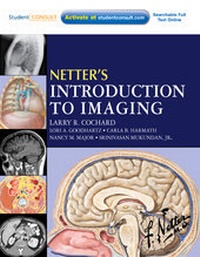
Netter's Introduction to Imaging
with Student Consult Access
Published on 25. July 2011
Book
Paperback/Softback
296 pages
978-1-4377-0759-5 (ISBN)
Description
Netter's Introduction to Imaging, by Larry R. Cochard, PhD, Lori A Goodhartz, MD Carla B, Harmath, MD, Nancy M. Major MD, and Srinivasan Mukundan, JR, MD, makes interpreting normal and abnormal X-ray, CT, and MR images easy by correlating them with crystal-clear Netter illustrations. You'll learn to recognize anatomical relationships in images and apply them to a variety of examples of pathology throughout the body, including the imaging of masses, air, or blood in organs and spaces...fractures, thickening, constriction, and compression...and more. You can also access the book from any computer at studentconsult.com. It's an ideal introduction to diagnostic imaging!
Visualize anatomical structures and relationships with perfect clarity with the aid of vivid, colorful Netter artwork. The coloring, texture, and idealized emphasis help you interpret relationships between structures and compartments as seen in cross section and in X-rays, CT, and MRI.
Develop your ability to better identify pathologies by viewing normal healthy anatomical images and abnormal images. Comparative images reinforce your basic understanding of what normal tissues and anatomy look like and serve as a guide in recognizing disease patterns and processes: atypically large or small organs and compartments, masses, air, or blood in organs and spaces, fractures, thickening, constriction, compression, and more.
Understand the principles that underlie X-ray, CT, MR, ultrasound, and nuclear medicine imaging, the use of contrast and angiography.
Understand how radiologists apply systematic search strategies in imaging studies of each region of the body.
Access the complete text and images online at studentconsult.com
Visualize anatomical structures and relationships with perfect clarity with the aid of vivid, colorful Netter artwork. The coloring, texture, and idealized emphasis help you interpret relationships between structures and compartments as seen in cross section and in X-rays, CT, and MRI.
Develop your ability to better identify pathologies by viewing normal healthy anatomical images and abnormal images. Comparative images reinforce your basic understanding of what normal tissues and anatomy look like and serve as a guide in recognizing disease patterns and processes: atypically large or small organs and compartments, masses, air, or blood in organs and spaces, fractures, thickening, constriction, compression, and more.
Understand the principles that underlie X-ray, CT, MR, ultrasound, and nuclear medicine imaging, the use of contrast and angiography.
Understand how radiologists apply systematic search strategies in imaging studies of each region of the body.
Access the complete text and images online at studentconsult.com
More details
Series
Language
English
Place of publication
London
United Kingdom
Publishing group
Elsevier Health Sciences
Target group
College/higher education
Illustrations
243 illustrations (243 in full color); Illustrations
Dimensions
Height: 276 mm
Width: 216 mm
Weight
810 gr
ISBN-13
978-1-4377-0759-5 (9781437707595)
Copyright in bibliographic data and cover images is held by Nielsen Book Services Limited or by the publishers or by their respective licensors: all rights reserved.
Schweitzer Classification
Other editions
Additional editions
Larry R. Cochard | Lori A. Goodhartz | Carla Harmath
Netter's Introduction to Imaging E-Book
Netter's Introduction to Imaging E-Book
E-Book
06/2011
Saunders
€44.99
Available for download
Persons
Author
The Feinberg School of Medicine, Northwestern University, Chicago, IL, USA
Professor of Radiology and Orthopedics, University of Colorado School of Medicine, Director of Imaging, Sports and Performance Center, Boulder, Colorado
Neuroradiology Network Chief
Brigham and Women's Hospital
Associate Professor of Radiology
Harvard University
Boston, Massachusetts
Brigham and Women's Hospital
Associate Professor of Radiology
Harvard University
Boston, Massachusetts
Content
Introduction to Imaging Modalities
Back and Spinal Cord
Thorax
Abdomen
Pelvis and Perineum
Upper Limb
Lower Limb
Head and Neck
Back and Spinal Cord
Thorax
Abdomen
Pelvis and Perineum
Upper Limb
Lower Limb
Head and Neck