

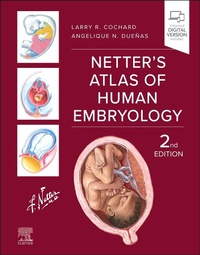
Netter's Atlas of Human Embryology
2nd Edition
Published on 4. January 2024
Book
Paperback/Softback
320 pages
978-0-443-11761-9 (ISBN)
Description
**Selected for 2026 Doody's Core Titles in Anatomy/Embryology**
Illustrated by the world-renowned Frank H. Netter, MD and artists working in his tradition, Netter's Atlas of Human Embryology, Second Edition, provides a rich pictorial overview of human prenatal development. For each stage of development and for each body system, you'll find a brief description of the developmental plan, with key concepts and terminology, followed by discussions of histological principles, the classification of congenital anomalies, and basic cellular, molecular, and genetic concepts. An emphasis on morphological patterns in the embryo and fetus makes it easy to understand the structure and function of the adult body and the embryonic basis of natural variation as well as birth anomalies.
Uses vibrant, high-quality illustrations and concise text to teach key points quickly, effectively, and memorably
Includes new Inclusionary Consideration Points that detail key information such as differences between sex and gender-particularly for the embryology of sex determination; and perspectives on disability and disability advocacy-including person-first vs. identity-first language; plus new illustrations with more diversity and better representation of skin tones, sex, and body habitus
Discusses topics new to this edition, including Conjoined Twins, Early Detection of Pregnancy, Exstrophy of the Bladder, Genetic Sex Variations, Congenital Limb Anomalies, Holoprosencephaly, and more
Provides expanded coverage of clinical correlations and congenital anomalies and new Clinical Notes boxes throughout
Contains summary tables and terminology sections at the end of each chapter, plus an appendix with all major congenital anomalies and their embryonic basis, making it easy to review course material and prepare for the USMLE
An eBook version is included with purchase. The eBook allows you to access all of the text, figures and references, with the ability to search, make notes and highlights, and have content read aloud
Evolve Instructor site with an image collection is available to instructors through their Elsevier sales rep or via request at https://evolve.elsevier.com.
Illustrated by the world-renowned Frank H. Netter, MD and artists working in his tradition, Netter's Atlas of Human Embryology, Second Edition, provides a rich pictorial overview of human prenatal development. For each stage of development and for each body system, you'll find a brief description of the developmental plan, with key concepts and terminology, followed by discussions of histological principles, the classification of congenital anomalies, and basic cellular, molecular, and genetic concepts. An emphasis on morphological patterns in the embryo and fetus makes it easy to understand the structure and function of the adult body and the embryonic basis of natural variation as well as birth anomalies.
Uses vibrant, high-quality illustrations and concise text to teach key points quickly, effectively, and memorably
Includes new Inclusionary Consideration Points that detail key information such as differences between sex and gender-particularly for the embryology of sex determination; and perspectives on disability and disability advocacy-including person-first vs. identity-first language; plus new illustrations with more diversity and better representation of skin tones, sex, and body habitus
Discusses topics new to this edition, including Conjoined Twins, Early Detection of Pregnancy, Exstrophy of the Bladder, Genetic Sex Variations, Congenital Limb Anomalies, Holoprosencephaly, and more
Provides expanded coverage of clinical correlations and congenital anomalies and new Clinical Notes boxes throughout
Contains summary tables and terminology sections at the end of each chapter, plus an appendix with all major congenital anomalies and their embryonic basis, making it easy to review course material and prepare for the USMLE
An eBook version is included with purchase. The eBook allows you to access all of the text, figures and references, with the ability to search, make notes and highlights, and have content read aloud
Evolve Instructor site with an image collection is available to instructors through their Elsevier sales rep or via request at https://evolve.elsevier.com.
Reviews / Votes
"The book's audience is first year medical, dental, and other students of embryology. The highly illustrated nature makes it an exemplary study of human embryonic development in a sequential format. The online format enhances the ability to have the book with you on a tablet or laptop and using the online index is vastly better and easier than using the print version.The new edition is of significant value as it now includes new Consideration Points, new topics, and expanded coverage of clinical correlations and congenital anomalies. New summary tables and terminology sections at the end of each chapter, plus an appendix with all congenital anomalies and their embryological basis make it valuable for reviewing course material and preparing for the USMLE.
Weighted Numerical Score: 100 - 5 Stars!" --Brian R. MacPherson, PhD (University of Kentucky College of Medicine)
More details
Series
Edition
2nd edition
Language
English
Place of publication
London
United Kingdom
Publishing group
Elsevier Health Sciences
Target group
College/higher education
Illustrations
236 illustrations (236 in full color); Illustrations
Dimensions
Height: 277 mm
Width: 223 mm
Thickness: 15 mm
Weight
856 gr
ISBN-13
978-0-443-11761-9 (9780443117619)
Copyright in bibliographic data and cover images is held by Nielsen Book Services Limited or by the publishers or by their respective licensors: all rights reserved.
Schweitzer Classification
Other editions
Previous edition
Book
07/2012
Saunders
€74.46
Article exhausted; check for reprint
Persons
Content
1. Overview of Developmental Events, Processes, and Anomalies
2. Early Embryonic Development and the Placenta
3. The Nervous System
4. The Cardiovascular System
5. The Respiratory System
6. The Gastrointestinal System and Abdominal Wall
7. The Urogenital System
8. The Musculoskeletal System
9. Head and Neck
Appendix: Summary of Common Congenital Anomalies Throughout the Body and their Embryonic Causes
2. Early Embryonic Development and the Placenta
3. The Nervous System
4. The Cardiovascular System
5. The Respiratory System
6. The Gastrointestinal System and Abdominal Wall
7. The Urogenital System
8. The Musculoskeletal System
9. Head and Neck
Appendix: Summary of Common Congenital Anomalies Throughout the Body and their Embryonic Causes