

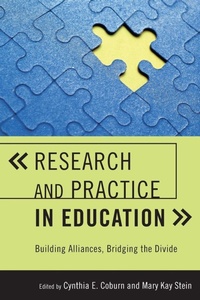
Research and Practice in Education
Building Alliances, Bridging the Divide
Published on 16. April 2010
Book
Paperback/Softback
256 pages
978-0-7425-6407-7 (ISBN)
Description
That there is a divide between research and practice is a common lament across policy-oriented disciplines, and education is no exception. Rhetoric abounds about the role research plays (or does not play) in the improvement of schools and classrooms, and policy makers push solutions that are rooted in assumptions about the way that research should influence practice. Yet few people have studied the relationship between research and practice empirically. This book presents findings from a series of interlocking case studies of nationally visible R&D projects, with a unique focus on how researchers and practitioners actually worked together, and the policy, social, and institutional processes that either enabled or hindered their work. The book investigates the dynamics of cross-institutional collaboration and the relationship between tool design, teacher learning, and the implementation of research-based approaches. It also explores conditions for learning in schools and the role of evidence in district decision making. By investigating the roles played by research and practice in these ten educational improvement efforts, the book illuminates lessons for those who seek to do this kind of work in the future. It concludes by suggesting implications for designers, funders, school and district leaders, and universities.
Reviews / Votes
For all the rhetoric of linking research to practice, Coburn and Stein et al help us understand clearly how research and practice can come together to improve education in the United States. This book will set the agenda for future collaborations between researchers and practitioners committed to education reform and improvement. -- Paul Goren, The Spencer Foundation This book is essential reading for all who work with schools to support improvement in the quality of instruction. The authors frame the question of how productive relations can be forged between research and practice as an empirical issue. Their findings are comprehensive and encompass the development of sustainable, long-term partnerships, the design of tools that bridge research and practice, and the development of school conditions that support teachers' learning. The image that emerges of successful researcher-practitioner partnerships is of complex, two-way relationships in which intermediary organizations frequently play a critical role. The work reported in this book has far-reaching implications for funders, for researchers and the type of work they conduct, and for intermediary organizations. -- Paul Cobb, University of Notre Dame Whether you're thinking about implementing a new program, building a researcher-practitioner partnership, or having productive ideas travel to new sites, "What works?" turns out to be the wrong question. The right one is: What helps collaborative programs develop and take hold, and what causes problems? That's the question Coburn, Stein, and their colleagues explore. This book contains valuable lessons for researchers and administrators who want to make things better in our schools. You'll think differently about making change happen after reading it. -- Alan H. Schoenfeld, University of California Coburn (Univ. of California, Berkeley) and Stein (Univ. of Pittsburgh), both education policy scholars, offer an insightful collection of empirical examples in which social and education theory has informed educational policy. This book's strength is its critical account of contexts where theory succeeded or failed to make long-lasting educational change. Vignettes contribute to the four useful policy perspectives: innovation-focused partnerships, tools for enabling theory into practice, conditions for knowledge development, and approaches for school districts to use research in decision making. The focus is a practical one....A useful entry point for theory-focused researchers wishing to join policy conversations. The strongest section deals with approaches to introducing theory into school district decision making. Yet, readers will find value throughout, as the book's central aim is to identify situations in which researchers' findings have resonated with educational decision makers so that theoretical perspective became part of policy making. The book could prove essential to those studying policy and curriculum theory in education, as well as public policy or administration researchers. Summing Up: Highly recommended. * Choice Reviews * Cynthia Coburn and Mary Kay Stein take aim at the idea that researchers can develop a set of plans or prescriptions that, if followed by practitioners, can transform teaching and learning....Although Coburn and Stein argue that the principal aim of their volume is to make visible the inner workings of research-practice partnerships, perhaps just as significant is the image these cases provide for what it means to bring about improvements to teaching and learning at scale. * Teachers College Record * I applaud Coburn and Stein and the contributions to this edited volume for systematically investigating an issue of utmost importance and relevance and recommend this book to innovators and designers (those whom Coburn and Stein identified as the new players in research -- practice perhaps), researchers interested in impacting educational outcomes, and university leaders hoping to move their institutions toward locally embedded research. The book may also be helpful to school superintendents and principals, those whom the authors identified as increasingly bridging research-theory relationships, and funders, as a source of ideas for evaluating grant proposals that extol research-practice partnerships. * Journal of Educational Research *More details
Language
English
Place of publication
United States
Publishing group
Bloomsbury Publishing Plc
Target group
Professional and scholarly
College/higher education
Dimensions
Height: 229 mm
Width: 152 mm
Thickness: 15 mm
Weight
402 gr
ISBN-13
978-0-7425-6407-7 (9780742564077)
Copyright in bibliographic data and cover images is held by Nielsen Book Services Limited or by the publishers or by their respective licensors: all rights reserved.
Schweitzer Classification
Other editions
Additional editions
Cynthia E. Coburn | Mary Kay Stein
Research and Practice in Education
Building Alliances, Bridging the Divide
E-Book
04/2010
1st Edition
Rowman & Littlefield Publishers
€66.49
Available for download
Cynthia E. Coburn | Mary Kay Stein
Research and Practice in Education
Building Alliances, Bridging the Divide
E-Book
04/2010
1st Edition
Rowman & Littlefield Publishers
€66.49
Available for download
Persons
Cynthia E. Coburn is Associate Professor in Policy, Organization, Measurement, and Evaluation at University of California at Berkeley.
Mary Kay Stein is Associate Director of the Learning Research & Development Center and Founding Director of the Learning Policy Center at University of Pittsburgh. She also holds a joint appointment at the University of Pittsburgh as professor of Learning Policy and Senior Scientist at the Learning Research and Development Center.
Mary Kay Stein is Associate Director of the Learning Research & Development Center and Founding Director of the Learning Policy Center at University of Pittsburgh. She also holds a joint appointment at the University of Pittsburgh as professor of Learning Policy and Senior Scientist at the Learning Research and Development Center.
Content
1 Foreword
2 1. Reframing the Problem of Research and Practice
3 Part I: Fostering Partnerships for Educational Innovation
4 2. The Middle School Mathematics through Applications Project: Supporting Productive Collaborations During Two Different Phases of Curriculum Design
5 3. The Center for Learning Technologies in Urban Schools: Evolving Relationships in Design-based Research
6 4. Examining a Novel Partnership for Educational Innnovation: Promises and Complexities of Cross-institutional Collaboration
7 Part II: Role of Tools in the Relationship Between Research and Practice
8 5. Success for All: Using Tools to Transport Research-based Practices to the Classroom
9 6. Tools to Deepen Practitioner's Engagement with Research: The Case of the Institute for Learning
10 7. QUASAR: The Evolution of Tools to Support Educational Improvement
11 Part III: Developing Conditions to Foster Knowledge Development in Schools
12 8. Building Demand for Research through Lesson Study
13 9. The National Writing Project: Anatomy of an Improvement Infrastructure
14 Part IV: Research and Decision Making in School Districts
15 10. The Partnership for District Change: Challeneges of Evidence Use in a Major Urban District
16 11. Research-to-Practice: A Case Study of Boston Public Schools, Boston Plan for Excellence and Education Matters
17 12. Key Lessons About the Relationship between Research and Practice
18 Appendix A: Research Methodology
19 References
20 Contributors
2 1. Reframing the Problem of Research and Practice
3 Part I: Fostering Partnerships for Educational Innovation
4 2. The Middle School Mathematics through Applications Project: Supporting Productive Collaborations During Two Different Phases of Curriculum Design
5 3. The Center for Learning Technologies in Urban Schools: Evolving Relationships in Design-based Research
6 4. Examining a Novel Partnership for Educational Innnovation: Promises and Complexities of Cross-institutional Collaboration
7 Part II: Role of Tools in the Relationship Between Research and Practice
8 5. Success for All: Using Tools to Transport Research-based Practices to the Classroom
9 6. Tools to Deepen Practitioner's Engagement with Research: The Case of the Institute for Learning
10 7. QUASAR: The Evolution of Tools to Support Educational Improvement
11 Part III: Developing Conditions to Foster Knowledge Development in Schools
12 8. Building Demand for Research through Lesson Study
13 9. The National Writing Project: Anatomy of an Improvement Infrastructure
14 Part IV: Research and Decision Making in School Districts
15 10. The Partnership for District Change: Challeneges of Evidence Use in a Major Urban District
16 11. Research-to-Practice: A Case Study of Boston Public Schools, Boston Plan for Excellence and Education Matters
17 12. Key Lessons About the Relationship between Research and Practice
18 Appendix A: Research Methodology
19 References
20 Contributors