

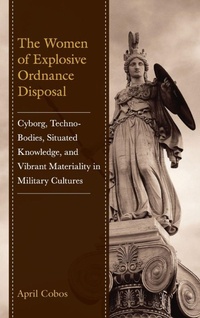
The Women of Explosive Ordnance Disposal
Cyborg, Techno-Bodies, Situated Knowledge, and Vibrant Materiality in Military Cultures
Published on 7. June 2024
Book
Hardback
150 pages
978-1-6669-5102-8 (ISBN)
Description
The Women of Explosive Ordnance Disposal: Cyborg, Techno-Bodies, Situated Knowledge, and Vibrant Materiality in Military Cultures addresses the disparities between policy discourse and the lived experiences of women in the Explosive Ordnance Disposal community who these policies seek to regulate through a rhetorical framework. During the Global War on Terrorism, the changing contexts of war brought the community to the forefront of combat preceding the 2016 policy repeal restricting women's service in combat, which positioned these women at a poignant moment in history. Their positioning also sheds light on the challenges twenty-first century scholars face in analyzing shifting gender roles in the workplace with policies advocating for gender equality, which often buries continued gendered ideologies and discourse. This book takes a mixed methods approach of qualitative and quantitative data from surveys, available government documents, and other cultural artifacts to create a more triangulated analysis. While this book is rooted in rhetorical analysis, its dynamic nature demands using an interdisciplinary approach that pulls from discourse analysis, political, historical, and military scholarship, and other humanities-based feminist scholarship.
Reviews / Votes
"Cobos explores the changing roles of women in combat-connected positions in the military, highlighting how conceptions of gender and agency have evolved in the armed forces and larger American society. She draws from feminist theory, embodied rhetoric, cyborgization, and discourse analysis to present a complex picture of the women who dispose of explosive ordnance and the military in which they work." -- Mark Blaauw-Hara, University of Toronto Mississauga A triumph of interdisciplinary feminist rhetorical scholarship! April Cobos's astute analysis of the tension between the official Department of Defense public language of 'gender neutrality' and 'full integration' of women into combat and the situated knowledge and embodied experiences of military women serving in hypermasculinized Explosive Ordnance and Disposal (EOD) units supplements and extends the work of feminist scholars such as Cheryl Glenn, Jacqueline Jones Royster, Gesa Kirsch, Jessica Enoch, Jordynn Jack, and others and complicates the field's understanding of 'agency and authority, institutional power, and marginalized rhetors.' This timely publication gives voice to servicewomen who do not consider themselves 'overtly feminist or purposefully radical' and yet kairotically seize upon discursive affordances and techno-bodies to work toward institutional and societal change. -- D. Alexis Hart, Allegheny CollegeMore details
Language
English
Place of publication
United States
Publishing group
Bloomsbury Publishing Plc
Target group
Professional and scholarly
Illustrations
6 b/w illustrations; 3 tables; 2 graphs
Dimensions
Height: 235 mm
Width: 157 mm
Thickness: 13 mm
Weight
378 gr
ISBN-13
978-1-6669-5102-8 (9781666951028)
Copyright in bibliographic data and cover images is held by Nielsen Book Services Limited or by the publishers or by their respective licensors: all rights reserved.
Schweitzer Classification
Other editions
Additional editions
April Cobos
The Women of Explosive Ordnance Disposal
Cyborg, Techno-Bodies, Situated Knowledge, and Vibrant Materiality in Military Cultures
E-Book
05/2024
1st Edition
Lexington Books
€90.99
Available for download
April Cobos
The Women of Explosive Ordnance Disposal
Cyborg, Techno-Bodies, Situated Knowledge, and Vibrant Materiality in Military Cultures
E-Book
05/2024
1st Edition
Lexington Books
€90.99
Available for download
Person
April Cobos is lecturer at Christopher Newport University.
Content
Chapter 1: Cyborg, Techno Bodies and the Shifting Rhetorical Contexts of War
Chapter 2: Situated Knowledge and the Rhetorical Uncertainty of Institutional Policies
Chapter 3: Intentionality, Agency, and Authority in the Survey Responses of Women in EOD
Conclusion: Genderquakes, Definitional Ruptures, and Backlashes: The Push and Pull of Gender Equality in the Twenty-First Century American Military
Chapter 2: Situated Knowledge and the Rhetorical Uncertainty of Institutional Policies
Chapter 3: Intentionality, Agency, and Authority in the Survey Responses of Women in EOD
Conclusion: Genderquakes, Definitional Ruptures, and Backlashes: The Push and Pull of Gender Equality in the Twenty-First Century American Military