

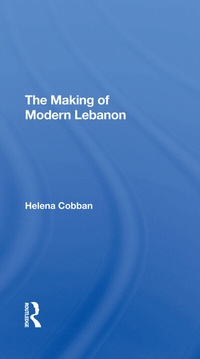
The Making Of Modern Lebanon
1st Edition
Published on 13. September 2019
Book
Hardback
248 pages
978-0-367-29371-0 (ISBN)
Description
This book provides a vivid and readable account of Lebanon's development since its first emergence in 1585, unravelling the intricacies of the sectarian/religious groups and the special kinds of communities which have sunk 900-year-old roots in the remote fastnesses of the Mount Lebanon interior.
More details
Language
English
Place of publication
London
United Kingdom
Publishing group
Taylor & Francis Ltd
Target group
College/higher education
Professional and scholarly
Academic and Postgraduate
Dimensions
Height: 224 mm
Width: 135 mm
Weight
360 gr
ISBN-13
978-0-367-29371-0 (9780367293710)
Copyright in bibliographic data and cover images is held by Nielsen Book Services Limited or by the publishers or by their respective licensors: all rights reserved.
Schweitzer Classification
Other editions
Additional editions
Helena Cobban
The Making Of Modern Lebanon
Book
10/2024
1st Edition
Routledge
€45.87
Shipment within 15-20 days
Helena Cobban
The Making Of Modern Lebanon
E-Book
09/2019
1st Edition
Routledge
€51.49
Available for download
Helena Cobban
The Making Of Modern Lebanon
E-Book
09/2019
1st Edition
Routledge
€51.49
Available for download
Person
A former Middle East correspondent for the Sunday Times of London, Helena Cobban now writes a regular column on global affairs for the Christian Science Monitor. She has published four books on war and peace issues in the Middle East. Cobban also sits on an advisory committee for Human Rights Watch and is a member of the International Institute of Strategic Studies.
Content
Preface -- Introduction -- The emergence of inter-sect rule (1516-1920) -- Foundations of the modern state (1920-43) -- The experience of independence (1943-67) -- The breakdown starts (1967-75) -- Eighteen months of civil war (1975-6) -- A troubled inter bellum (1977-82) -- The battles of Beirut (1982-4) -- Conclusions: the inter-sect system enters its fifth century