

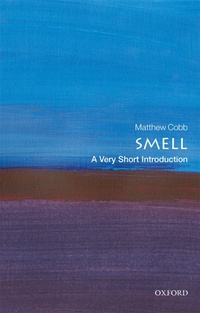
Smell
A Very Short Introduction
Published on 28. May 2020
Book
Paperback/Softback
176 pages
978-0-19-882525-8 (ISBN)
Description
Our sense of smell - or olfaction as it is technically known - is our most enigmatic sense. It can conjure up memories, taking us back to very specific places and emotions, whilst powerful smells can induce strong feelings of hunger or nausea. In the animal kingdom smell can be used to find food, a mate, or a home; to sense danger; and to send and receive complex messages with other members of a species. Yet despite its fundamental importance in our mental life and in the existence of all animals, our scientific understanding of how smell works is limited.
In this Very Short Introduction, Matthew Cobb describes the latest scientific research on smell in humans and other mammals, in insects, and even in fish. He looks at how smell evolved, how animals use it to navigate and communicate, and disorders of smell in humans. Understanding smell, especially its neurobiology, has proved a big challenge, but olfactory science has revealed genetic factors that determine what we can and cannot smell, and why some people like a given smell while others find it unbearable. He ends by considering future treatments for smell disorders, and speculating on the role of smell in a world of robots.
ABOUT THE SERIES:
The Very Short Introductions series from Oxford University Press contains hundreds of titles in almost every subject area. These pocket-sized books are the perfect way to get ahead in a new subject quickly. Our expert authors combine facts, analysis, perspective, new ideas, and enthusiasm to make interesting and challenging topics highly readable.
In this Very Short Introduction, Matthew Cobb describes the latest scientific research on smell in humans and other mammals, in insects, and even in fish. He looks at how smell evolved, how animals use it to navigate and communicate, and disorders of smell in humans. Understanding smell, especially its neurobiology, has proved a big challenge, but olfactory science has revealed genetic factors that determine what we can and cannot smell, and why some people like a given smell while others find it unbearable. He ends by considering future treatments for smell disorders, and speculating on the role of smell in a world of robots.
ABOUT THE SERIES:
The Very Short Introductions series from Oxford University Press contains hundreds of titles in almost every subject area. These pocket-sized books are the perfect way to get ahead in a new subject quickly. Our expert authors combine facts, analysis, perspective, new ideas, and enthusiasm to make interesting and challenging topics highly readable.
More details
Series
Language
English
Place of publication
Oxford
United Kingdom
Illustrations
A number of black and white images
Dimensions
Height: 170 mm
Width: 109 mm
Thickness: 10 mm
Weight
140 gr
ISBN-13
978-0-19-882525-8 (9780198825258)
Copyright in bibliographic data and cover images is held by Nielsen Book Services Limited or by the publishers or by their respective licensors: all rights reserved.
Schweitzer Classification
Other editions
Person
Matthew Cobb is Professor of Zoology at the University of Manchester. He has a degree in Psychology and has studied the sense of smell in maggots and other animals for over 30 years. Since 2004, he has taught a final-year course at Manchester on Chemical Communication in Animals, which is the basis for this book. His favourite smells are the back of a baby's neck, and petrichor: the smell of soil in the summer after it has rained. In 2015, he was shortlisted for the Royal Society Book Prize for his book Life's Greatest Secret: The Race to Crack the Genetic Code (Profile Books, 2015).
Content
List of illustrations
1: How we smell
2: Smelling with genes
3: Animal olfaction
4: Human smelling
5: The future of smell
6: Smelling to remember, remembering smells
7: Chemical signals
Further reading
Index
1: How we smell
2: Smelling with genes
3: Animal olfaction
4: Human smelling
5: The future of smell
6: Smelling to remember, remembering smells
7: Chemical signals
Further reading
Index