

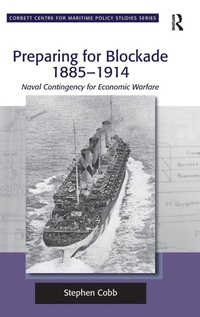
Preparing for Blockade 1885-1914
Naval Contingency for Economic Warfare
1st Edition
Published on 22. March 2013
Book
Hardback
376 pages
978-1-4094-3419-1 (ISBN)
Description
Today, the First World War is remembered chiefly for the carnage of the Western Front, but at the time the Royal Navy's blockade of Germany was a more frequent source of debate. For, even at a time of war, there were influential voices in Britain who baulked at a concept of economic warfare that hindered the free passage of goods on the high seas, and brought German society to the brink of famine. To further our understanding of these issues, this book looks at the background to the blockade, and the effects of its implementation in 1914. It argues that there was a widely shared, but largely unwritten, strategic culture within British naval circles which accepted that in a war with a major maritime power the British response would be to attack enemy trade. This is demonstrated by the fact that from at least the late 1880s the Royal Navy planned for the use of armed merchantmen to enforce an economic blockade of an enemy. This it did by entering into detailed arrangements with major British shipping companies for the design and subsidy of liners with the potential for use as merchant cruisers, and stockpiling their prospective armament. In line with the contemporary, Corbettian, view that seapower depends upon free communications, the book concludes by asserting that the primary role of the Grand Fleet in the First World War was to guarantee the ability of the merchant cruisers on the Northern Patrol to interdict German seaborne trade, rather than to engage in large set-piece battles.
Reviews / Votes
'Stephen Cobb has written a work that makes a fine contribution to the modern study of a subject that, despite its importance in World War I, is only now receiving the attention deserving of it.' Journal of Military History 'This book provides an important new perspective on British naval policy in the First World War era and is required reading for historians of the blockade. Supporters of a more ambitious definition of 'economic warfare' would also be well advised to consider Cobb's conclusions.' The Mariner's Mirror '... a valuable contribution to the naval histories of the period.' The Naval ReviewMore details
Series
Language
English
Place of publication
London
United Kingdom
Publishing group
Taylor & Francis Ltd
Target group
College/higher education
Dimensions
Height: 240 mm
Width: 161 mm
Thickness: 25 mm
Weight
728 gr
ISBN-13
978-1-4094-3419-1 (9781409434191)
Copyright in bibliographic data and cover images is held by Nielsen Book Services Limited or by the publishers or by their respective licensors: all rights reserved.
Schweitzer Classification
Other editions
Additional editions

Book
10/2016
1st Edition
Routledge
€84.50
Shipment within 10-20 days
E-Book
04/2016
Routledge
€77.99
Available for download
E-Book
04/2016
Routledge
€77.99
Available for download
Person
Stephen Cobb
Content
Contents: Foreword, Andrew Lambert; Preface; Strategy, planning and culture; The Naval Intelligence department; Economic warfare; Cruiser warfare; Professional debate; The provision of armed merchant cruisers, 1876-1900; The provision of armed merchant cruisers, 1900-1905; The 1906 'grand manoeuvres'; The provision of armed merchant cruisers, 1906-1914; How did the experience of 1914-18 bear out war planning?; Appendices; Bibliography and sources; Index.