

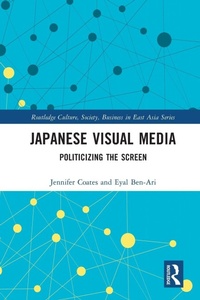
Japanese Visual Media
Politicizing the Screen
1st Edition
Published on 31. May 2023
Book
Paperback/Softback
232 pages
978-0-367-72299-9 (ISBN)
Description
This book uncovers and explains the ways by which politics is naturalized and denaturalized, and familiarized and de-familiarized through popular media. It explores the tensions between state actors such as censors, politicized and nonpoliticized audiences, and visual media creators, at various points in the history of Japanese visual media. It offers new research on a wide array of visual media texts including classical narrative cinema, television, documentary film, manga, and animated film. It spans the militarized decades of the 1930s and 1940s, through the Asia Pacific War into the present day, and demonstrates how processes of politicization and depoliticization should be understood as part of wider historical developments including Japan's postwar devastation and poverty, subsequent rapid modernization and urbanization, and the aging population and economic struggles of the twenty-first century.
More details
Series
Language
English
Place of publication
London
United Kingdom
Publishing group
Taylor & Francis Ltd
Illustrations
7 s/w Abbildungen, 7 s/w Photographien bzw. Rasterbilder
7 Halftones, black and white; 7 Illustrations, black and white
Dimensions
Height: 234 mm
Width: 156 mm
Thickness: 13 mm
Weight
363 gr
ISBN-13
978-0-367-72299-9 (9780367722999)
Copyright in bibliographic data and cover images is held by Nielsen Book Services Limited or by the publishers or by their respective licensors: all rights reserved.
Schweitzer Classification
Other editions
Additional editions
Book
08/2021
1st Edition
Routledge
€207.60
Shipment within 15-20 days
E-Book
08/2021
1st Edition
Routledge
€59.49
Available for download
E-Book
08/2021
1st Edition
Routledge
€59.49
Available for download
Persons
Jennifer Coates is a senior lecturer in Japanese studies in the School of East Asian Studies, University of Sheffield, UK.
Eyal Ben-Ari is director of the Kinneret Center for Society, Security and Peace, Israel.
Eyal Ben-Ari is director of the Kinneret Center for Society, Security and Peace, Israel.
Content
Introduction
JENNIFER COATES AND EYAL BEN- ARI
SECTION A
Historical contexts
1 A question of form: dissent and the nouvelle vagueISOLDE STANDISH
2 Negotiating sex, the bizarre, and politics: the Abe Sada incident in ?lms
KATSUYUKI HIDAKA
3 The four lives of Matsugoro the Lawless: agency, constraint, and what is "worthy" of ?lm censorship in trans-war Japan
IRIS HAUKAMP
4 Tarzan and Japan: racial portraits of a nation in Boy Kenya DEANNA T. NARDY
SECTION B
Critique, contestation, and resistance
5 Down in the dumps: Tokyo wastelands and marginalized groups in Japanese ?lm and anime
ALISA FREEDMAN
6 Cinema at the edge of the world: visions of precarity in the ?lms of Kumakiri Kazuyoshi
LINDSAY NELSON
7 How to remember 3.11? Post-Fukushima documentary and the politics of Tohoku Documentary Trilogy (2011-2013)
RAN MA
SECTION C
Creating the political subject through media
8 The Japanese self-defence forces and cinematic productions: resonance and reverberation in the normalization of organized state violence
ATSUKO FUKUURA AND EYAL BEN-ARI
9 Politicizing the audience? Film fans' experiences of cinema in the 1960s
JENNIFER COATES
10 Fading away from the screen: cinematic responses to queer ageing in contemporary Japanese cinema
YUTAKA KUBO
JENNIFER COATES AND EYAL BEN- ARI
SECTION A
Historical contexts
1 A question of form: dissent and the nouvelle vagueISOLDE STANDISH
2 Negotiating sex, the bizarre, and politics: the Abe Sada incident in ?lms
KATSUYUKI HIDAKA
3 The four lives of Matsugoro the Lawless: agency, constraint, and what is "worthy" of ?lm censorship in trans-war Japan
IRIS HAUKAMP
4 Tarzan and Japan: racial portraits of a nation in Boy Kenya DEANNA T. NARDY
SECTION B
Critique, contestation, and resistance
5 Down in the dumps: Tokyo wastelands and marginalized groups in Japanese ?lm and anime
ALISA FREEDMAN
6 Cinema at the edge of the world: visions of precarity in the ?lms of Kumakiri Kazuyoshi
LINDSAY NELSON
7 How to remember 3.11? Post-Fukushima documentary and the politics of Tohoku Documentary Trilogy (2011-2013)
RAN MA
SECTION C
Creating the political subject through media
8 The Japanese self-defence forces and cinematic productions: resonance and reverberation in the normalization of organized state violence
ATSUKO FUKUURA AND EYAL BEN-ARI
9 Politicizing the audience? Film fans' experiences of cinema in the 1960s
JENNIFER COATES
10 Fading away from the screen: cinematic responses to queer ageing in contemporary Japanese cinema
YUTAKA KUBO