

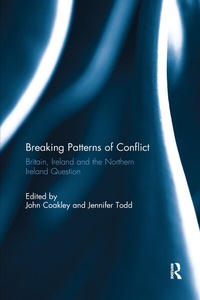
Breaking Patterns of Conflict
Britain, Ireland and the Northern Ireland Question
1st Edition
Published on 18. December 2020
Book
Paperback/Softback
181 pages
978-0-367-73946-1 (ISBN)
Description
The role of external powers and international bodies in efforts to break patterns of conflict and to install stable and durable peace settlements is well known. This book focuses on an unusual case where the sovereign state and a neighbour state help broker an agreed settlement in a disputed and conflictual region. It analyses the roles of the British and Irish governments in pursuing political stability in Northern Ireland, a disputed region of the United Kingdom over which the Irish state has had a territorial claim.
The book focuses on the changes in the British state, whose writ extends over Northern Ireland, but also the Irish state, which surrendered a strong formal but ineffective claim to jurisdiction over Northern Ireland for the reality of a significant voice in its political future. These changes ultimately facilitated the process of settlement leading to the 1998 Good Friday Agreement, and the later transformation of institutions and political relations in Northern Ireland and between the UK and Ireland. It innovates by using a new oral archive of elite interviews built up over the past decade.
The authors of the various chapters address a range of dimensions in which these changes are reflected. These include new interpretations of the dynamics of the Northern Ireland conflict and in particular of the evolving British-Irish relationship, new perspectives on the positions of governments and parties, and new analyses of the contribution of cross-border contacts in two areas where consequences are likely to be indirect but profound: television broadcasting and business cooperation.
This book was published as a special issue of Irish Political Studies.
The book focuses on the changes in the British state, whose writ extends over Northern Ireland, but also the Irish state, which surrendered a strong formal but ineffective claim to jurisdiction over Northern Ireland for the reality of a significant voice in its political future. These changes ultimately facilitated the process of settlement leading to the 1998 Good Friday Agreement, and the later transformation of institutions and political relations in Northern Ireland and between the UK and Ireland. It innovates by using a new oral archive of elite interviews built up over the past decade.
The authors of the various chapters address a range of dimensions in which these changes are reflected. These include new interpretations of the dynamics of the Northern Ireland conflict and in particular of the evolving British-Irish relationship, new perspectives on the positions of governments and parties, and new analyses of the contribution of cross-border contacts in two areas where consequences are likely to be indirect but profound: television broadcasting and business cooperation.
This book was published as a special issue of Irish Political Studies.
More details
Language
English
Place of publication
London
United Kingdom
Publishing group
Taylor & Francis Ltd
Target group
College/higher education
Dimensions
Height: 234 mm
Width: 156 mm
Weight
640 gr
ISBN-13
978-0-367-73946-1 (9780367739461)
Copyright in bibliographic data and cover images is held by Nielsen Book Services Limited or by the publishers or by their respective licensors: all rights reserved.
Schweitzer Classification
Other editions
Additional editions
John Coakley | Jennifer Todd
Breaking Patterns of Conflict
Britain, Ireland and the Northern Ireland Question
Book
10/2014
1st Edition
Routledge
€206.00
Shipment within 10-20 days
Persons
John Coakley is Professor in the School of Politics, International Studies and Philosophy, Queen's University Belfast. He has published extensively on nationalism and ethnic conflict. Recent publications include Pathways from Ethnic Conflict: Institutional Redesign in Divided Societies (editor, Routledge, 2010); Nationalism, Ethnicity and the State (Sage, 2012); Reforming Political Institutions: Ireland in Comparative Perspective (IPA, 2013); and The Irish Presidency: Power, Ceremony and Politics (co-editor, Irish Academic Press, 2014).
Jennifer Todd is Professor in the School of Politics and International Relations, University College Dublin. She has researched and published extensively (individually and jointly) on the Northern Ireland conflict and settlement process, and on ethnicity, identity and identity change in, inter alia, Political Studies, West European Politics, Nationalism and Ethnic Politics, Nations and Nationalism, Theory and Society. Her most recent book is the co-edited Ethnicity and Religion: Intersections and Comparisons (Routledge, 2011).
Jennifer Todd is Professor in the School of Politics and International Relations, University College Dublin. She has researched and published extensively (individually and jointly) on the Northern Ireland conflict and settlement process, and on ethnicity, identity and identity change in, inter alia, Political Studies, West European Politics, Nationalism and Ethnic Politics, Nations and Nationalism, Theory and Society. Her most recent book is the co-edited Ethnicity and Religion: Intersections and Comparisons (Routledge, 2011).
Content
1. Breaking patterns of conflict in Northern Ireland: new perspectives 2. History, structure and action in the settlement of complex conflicts: the Northern Ireland case 3. The complexity of British-Irish interdependence 4. The changing British-Irish relationship: the sovereignty dimension 5. British-Irish institutional structures: towards a new relationship 6. The dimensions of Irish Government involvement in the pursuit of a settlement of the Northern Ireland conflict 7. 'The first major step in the peace process'? Exploring the impact of the Anglo-Irish Agreement on Irish republican thinking 8. The provision of Irish television in Northern Ireland: a slow British-Irish success story 9. The business of building peace: private sector cooperation across the Irish border