

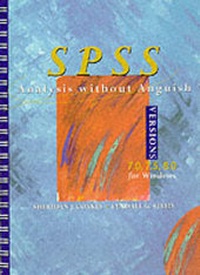
SPSS Analysis 7.0, 7.5, 8.0 Windows
Analysis without Anguish
Published on 4. March 1999
Book
Paperback/Softback
286 pages
978-0-471-34080-5 (ISBN)
Description
The new edition of this text is based on Versions 7.0, 7.5 and 8.0 of SPSS for Windows. SPSS is being continually modified, but the steps of entering and analyzing data are very similar in these three versions. The major difference is in the presentation of the output. Thus, users of any of these versions will be able to work with this text, as will users of any earlier version of SPSS for Windows. Intended both as an introduction to the use of SPSS for Windows and as a guide for users wishing to conduct more complicated analytic procedures, this book guides readers through techniques and procedures using worked examples and practice examples to help them consolidate their skills. Solutions are provided to assist both students and lecturers, and assumption testing for each procedure is discussed at the beginning of every chapter. This text also examines the descriptive and analytical functions available in SPSS, such as the tables function, and techniques such as cluster analysis and multi-dimensional scaling that are used frequently in market research and business environments.
More details
Language
English
Place of publication
Chichester
United Kingdom
Publishing group
John Wiley and Sons Ltd
Target group
College/higher education
Professional and scholarly
Illustrations
illustrations
Dimensions
Height: 295 mm
Width: 225 mm
Thickness: 25 mm
Weight
815 gr
ISBN-13
978-0-471-34080-5 (9780471340805)
Copyright in bibliographic data and cover images is held by Nielsen Book Services Limited or by the publishers or by their respective licensors: all rights reserved.
Schweitzer Classification
Other editions
New editions

Sheridan J. Coakes | Lyndall G. Steed
SPSS Analysis without Anguish (Version 11)
Book
03/2003
Wiley
€24.75
Article is exhausted, reprint undefined
Content
Introduction to SPSS; preparation of data files; data screening and transformation; descriptive statistics and the tables function; working with output; correlation; t-tests; one-way between groups ANOVA with post-hoc comparisons; one-way between groups ANOVA with planned comparisons; two-way between groups ANOVA; one-way repeated measures ANOVA; two-way repeated measures ANOVA; trend analysis; mixed plot design (SPANOVA); one-way analysis of covariance (ANCOVA); reliability analysis; factor analysis; multiple regression; multivariate analysis of variance (MANOVA); non-parametric techniques; multiple response and multiple dichotomy analysis; cluster analysis; multiple discriminant analysis.