

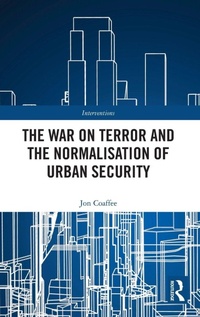
The War on Terror and the Normalisation of Urban Security
1st Edition
Published on 8. November 2021
Book
Hardback
308 pages
978-1-138-61755-1 (ISBN)
Description
This book explores the processes by which, in the 20 years after 9/11, the practices of urban security and counter-terrorism have impacted the everyday experiences of the Western city. Highlighting the localised urban responses to new security challenges, it reflects critically upon the historical trajectory of techniques of territorialisation and physical protection, urban surveillance and the increasing need for cities to enhance resilience and prepare for anticipated future attacks and unpacks the practices and impacts of the intensification of recent urban security practices in the name of countering terrorism.
Drawing on over 25 years of research and practical experience, the author utilises a range of international case studies, framed by conceptual ideas drawn from critical security, political and geographical theory.
The book will be of interest to students and scholars of politics, war studies, urban studies, geography, sociology, criminology, and the growing market of security and resilience professionals, as well as non-academic audiences seeking to understand responses to terrorist risk.
Drawing on over 25 years of research and practical experience, the author utilises a range of international case studies, framed by conceptual ideas drawn from critical security, political and geographical theory.
The book will be of interest to students and scholars of politics, war studies, urban studies, geography, sociology, criminology, and the growing market of security and resilience professionals, as well as non-academic audiences seeking to understand responses to terrorist risk.
Reviews / Votes
Pete Fussey, Professor of Criminology, University of Essex, UK.Tracing and drawing together the precursors of contemporary approaches to urban security, Jon Coaffee offers an authoritative account of how the city irrevocably changed as a result of the mundane and exceptional measures introduced as a result of the U.S-led War on terror. Building on Professor Coaffee's longstanding engagement with the field and marshalling and interrogating an unparalleled range of empirical studies and interdisciplinary insights from both before and since 9/11, this important book showcases how national governments, city administrations, technology companies, the military, policing and intelligence agencies, and the citizenry have become increasingly implicated into countering the enduring threat of urban terrorism. Informed by a range of critical social theory, this account further addresses important questions concerning the intensification of social control and surveillance, and the reshaping of civic responsibility. At the same time, this unique analysis illuminates how ideas of militarism, preparedness, pre-emption and resilience have become institutionalised within systems of security governance and emerged as an integral part of normal everyday city life.
Nick Vaughan-Williams, Professor of International Security and Interventions book series editor, University of Warwick, UK.
Jon Coaffee's most recent book is a timely and welcome addition to the Interventions book series. In this groundbreaking text, many of the conventions of IR and global politics are critically challenged as post-9/11 counter-terrorism interventions are interrogated and their implications for everyday life detailed. In this synthesis of critical theory and an understanding of security practices and behaviours across an ever expanding range of security actors and civil society, a greater focus is placed upon better understanding the role of security's many audiences than in traditional scholarship. The result is a detailed rendering of the rescaling and refocusing of security concerns to the metropolitan level and below as a result of anxieties about 'new terrorism' and the purported need to enhance resilience. Whether this is through concerns for the protection of vulnerable crowded locations, the 'lockdown' security that has become an accepted part of staging high-profile events, attempts to counter the radicalisation and violent extremism of individuals and certain communities, the impact of state-level threats assessments and public warning and informing campaigns, or the overlap between counter-terrorism and pandemic response practices, this book provides a grounded account of the importance of understanding how 'spaces of security' have been steadily intensified over recent decades, and the wider implications of this 'new normal' for the securitisation of everyday life.
More details
Series
Language
English
Place of publication
London
United Kingdom
Publishing group
Taylor & Francis Ltd
Target group
College/higher education
Illustrations
3 s/w Zeichnungen, 2 s/w Tabellen, 26 s/w Abbildungen, 23 s/w Photographien bzw. Rasterbilder
2 Tables, black and white; 3 Line drawings, black and white; 23 Halftones, black and white; 26 Illustrations, black and white
Dimensions
Height: 240 mm
Width: 161 mm
Thickness: 22 mm
Weight
652 gr
ISBN-13
978-1-138-61755-1 (9781138617551)
Copyright in bibliographic data and cover images is held by Nielsen Book Services Limited or by the publishers or by their respective licensors: all rights reserved.
Schweitzer Classification
Other editions
Additional editions
Book
05/2023
1st Edition
Routledge
€65.90
Shipment within 10-20 days
E-Book
11/2021
1st Edition
Routledge
€59.49
Available for download
E-Book
11/2021
1st Edition
Routledge
€59.49
Available for download
Person
Jon Coaffee is a professor in Urban Geography in the Department of Politics and International Studies at the University of Warwick, United Kingdom and is an international expert in counter-terrorism, security and urban resilience. His work includes Terrorism, Risk and the City (2003); The Everyday Resilience of the City: How Cities Respond to Terrorism and Disaster (2008); Terrorism, Risk and the Global City - Towards Urban Resilience (2009); Sustaining and Securing the Olympic City (2011); Urban Resilience: Planning for Risk Crisis and Uncertainty (2016); Futureproof (2019) Resilience and Planning: Planning's Role in Countering Terrorism (2020).
Content
Part 1: The search for urban security
Introduction: Security and the urban imagination
The city as target
Detonation boulevards
Part 2: Conventional tactics and techniques of urban security
Padded bunkers
Territorial security and the panoptical gaze
The fearful shock of 9/11 and the rise of military and urban geopolitics
Part 3: The longer term implications of 9/11
Normal protective streetscapes
Preparation and anticipation in the global War on Terror
Everyday terror prevention
Part 4: The future of urban security
Towards impenetrable and smart security
Pop-up security and the politics of exceptionality
Conclusions: Normalising urban security
Introduction: Security and the urban imagination
The city as target
Detonation boulevards
Part 2: Conventional tactics and techniques of urban security
Padded bunkers
Territorial security and the panoptical gaze
The fearful shock of 9/11 and the rise of military and urban geopolitics
Part 3: The longer term implications of 9/11
Normal protective streetscapes
Preparation and anticipation in the global War on Terror
Everyday terror prevention
Part 4: The future of urban security
Towards impenetrable and smart security
Pop-up security and the politics of exceptionality
Conclusions: Normalising urban security