

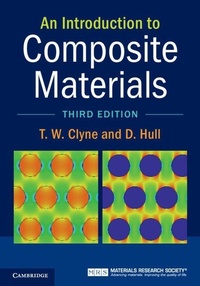
An Introduction to Composite Materials
3rd Edition
Published on 11. July 2019
Book
Hardback
360 pages
978-0-521-86095-6 (ISBN)
Description
This fully expanded and updated edition provides both scientists and engineers with all the information they need to understand composite materials, covering their underlying science and technological usage. It includes four completely new chapters on surface coatings, highly porous materials, bio-composites and nano-composites, as well as thoroughly revised chapters on fibres and matrices, the design, fabrication and production of composites, mechanical and thermal properties, and industry applications. Extensively expanded referencing engages readers with the latest research and industrial developments in the field, and increased coverage of essential background science makes this a valuable self-contained text. A comprehensive set of homework questions, with model answers available online, explains how calculations associated with the properties of composite materials should be tackled, and educational software accompanying the book is available online. An invaluable text for final-year undergraduates in materials science and engineering, and graduate students and researchers in academia and industry.
Reviews / Votes
'This introductory textbook goes beyond the descriptive level and the usual engineering approximations to a deeper, yet accessible, level of fundamental composite mechanics that provides valuable insights into composite performance.' William Curtin, Ecole polytechnique federale de Lausanne 'Composite materials combine and comprise an understanding of materials science, mechanics and general engineering. The third edition of An Introduction to Composite Materials by T. W. Clyne and D. Hull is an carefully revised version of the previous very successful textbook. It is a comprehensive summary of the current knowledge in composites science and technology - specially prepared as a textbook for young scientists and graduate students to get a substantial insight into this still young area. I personally recommend this book to my graduate students.' Karl Schulte, Technische Universitaet Hamburg 'This extensively revised and expanded edition includes the latest developments in composites research and applications. The new chapters on surface coatings, highly porous materials, bio- and nano-composites are uniquely valuable.' Tsu-Wei Chou, University of DelawareMore details
Edition
3rd Revised edition
Language
English
Place of publication
Cambridge
United Kingdom
Target group
College/higher education
Edition type
Revised edition
Illustrations
Worked examples or Exercises; 43 Halftones, black and white; 172 Line drawings, black and white
Dimensions
Height: 250 mm
Width: 175 mm
Thickness: 24 mm
Weight
804 gr
ISBN-13
978-0-521-86095-6 (9780521860956)
Copyright in bibliographic data and cover images is held by Nielsen Book Services Limited or by the publishers or by their respective licensors: all rights reserved.
Schweitzer Classification
Other editions
Additional editions
T. W. Clyne
Introduction to Composite Materials
E-Book
07/2019
Cambridge University Press
€44.49
Available for download
T. W. Clyne | D. Hull
An Introduction to Composite Materials
E-Book
07/2019
3rd Edition
Cambridge University Press
€47.49
Available for download
Previous edition
D. Hull | T. W. Clyne
An Introduction to Composite Materials
Book
08/1996
2nd Edition
Cambridge University Press
€76.74
Article exhausted; check for reprint
Persons
T. W. Clyne is Professor of Mechanics of Materials in the Department of Materials Science and Metallurgy at the University of Cambridge, and the Director of the Gordon Laboratory. He is also the Director of DoITPoMS, an educational materials science website, a Fellow of the Royal Academy of Engineering, and a Helmholtz International Fellow. D. Hull is an Emeritus Professor at the University of Liverpool. He is also a Fellow of the Royal Society and a Fellow of the Royal Academy of Engineering.
Content
Preface; Nomenclature; 1. General introduction; 2. Fibres, matrices and their architecture in composites; 3. Elastic deformation of long fibre composites; 4. Tensor analysis of anisotropic materials and the elastic deformation of laminae; 5. Elastic deformation of laminates; 6. Stresses and strains in short fibre and particulate composites; 7. The interface region; 8. Stress-based treatment of the strength of composites; 9. Fracture mechanics and the toughness of composites; 10. Thermal effects in composites; 11. Surface coatings as composite systems; 12. Highly porous materials as composite systems; 13. Biocomposites and recycling; 14. Scale effects and nanocomposites; 15. Fabrication of composites; 16. Applications of composites; Appendix: questions; Index.