

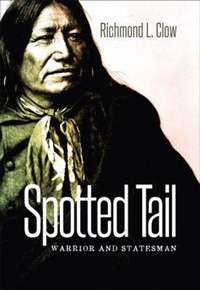
Spotted Tail
Warrior and Statesman
Published on 30. August 2019
Book
Hardback
390 pages
978-0-9845041-8-3 (ISBN)
Description
As a prominent leader of the Sicangu Lakotas during a time of conflict and change, Spotted Tail (1823-1881) left his mark on the Northern Great Plains. He was not a hereditary chief but developed his standing over time, first proving himself a capable warrior and later a persuasive negotiator. As white settlers encroached on Indian lands in ever-greater numbers, Spotted Tail decided to forgo engaging in prolonged conflicts with the United States, including those led by Red Cloud and Crazy Horse. Instead, he determined to negotiate with the United States to secure a homeland, education, employment, and other necessities essential to the future of his people. Had Spotted Tail chosen to fight, Captain John G. Bourke wrote in 1891, "neither North nor South Dakota, Wyoming nor Montana might now be on the map."
Not all Lakotas agreed with his philosophy, and his tactics, heavy-handed at times, earned him enemies. On 5 August 1881, Crow Dog, a fellow Sicangu leader on the Rosebud Indian Reservation, shot and killed Spotted Tail, ending years of rivalry. Even in death, Spotted Tail continued to have an impact as Crow Dog's conviction for his murder made its way to the United States Supreme Court, ultimately impacting tribal sovereignty.
In the first full biography of Spotted Tail since the 1960s, Richmond L. Clow uses firsthand accounts from tribal and nontribal sources, government records, and published works to establish Spotted Tail as both a warrior and a statesman. The author's voluminous research into contemporary news accounts, including interviews with Spotted Tail, provides a wealth of information about his views and actions that, until now, have been remarkably underutilised.
Not all Lakotas agreed with his philosophy, and his tactics, heavy-handed at times, earned him enemies. On 5 August 1881, Crow Dog, a fellow Sicangu leader on the Rosebud Indian Reservation, shot and killed Spotted Tail, ending years of rivalry. Even in death, Spotted Tail continued to have an impact as Crow Dog's conviction for his murder made its way to the United States Supreme Court, ultimately impacting tribal sovereignty.
In the first full biography of Spotted Tail since the 1960s, Richmond L. Clow uses firsthand accounts from tribal and nontribal sources, government records, and published works to establish Spotted Tail as both a warrior and a statesman. The author's voluminous research into contemporary news accounts, including interviews with Spotted Tail, provides a wealth of information about his views and actions that, until now, have been remarkably underutilised.
More details
Language
English
Place of publication
Pierre
United States
Product notice
sewn/stitched
Cloth over boards
Dimensions
Height: 206 mm
Width: 122 mm
Thickness: 36 mm
Weight
522 gr
ISBN-13
978-0-9845041-8-3 (9780984504183)
Copyright in bibliographic data and cover images is held by Nielsen Book Services Limited or by the publishers or by their respective licensors: all rights reserved.
Schweitzer Classification
Person
Richmond L. Clow is professor emeritus of Native American Studies at the University of Montana in Missoula. A graduate of the University of South Dakota, he received his doctorate in history from the University of New Mexico. Clow has written extensively on the American Indians of the Northern Great Plains in addition to the history of the Black Hills. A longtime contributor to South Dakota History, he is the editor of The Sioux in South Dakota History: A Twentieth-Century Reader from the South Dakota Historical Society Press. He received the Robinson Award from the South Dakota State Historical Society for lifetime achievement in history.