

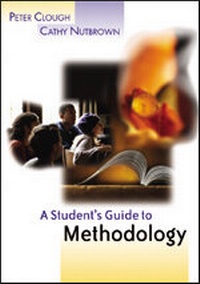
A Student's Guide to Methodology
Justifying Enquiry
1st Edition
Published on 19. September 2002
Book
Hardback
224 pages
978-0-7619-7421-5 (ISBN)
Description
`Well-written and presented in a student-friendly fashion - a reflection of the expertise of the authors in this area' - Journal of Family Studies
`At first glance Iwas doubtful that A Student's Guide to Methodology would add anything much to the growing numbers of student study guides already on the market. However, it was a pleasant surprise to find most sections of the book to be helpful in the task of writing a dissertation, and particularly relevant if used in conjunction with the research training programme that most social science postgraduate students are now required to follow.... I would recommend Clough and Nutbrown's work as as essential piece of reading for students participating in research training programmes, as the textbook provides an original and invaluable contribution to the study of methodology' - Sociology
`This is a thoughtful, well-crafted, easily accessible book. It will be a treat to teach from, as it creates a series of exercises that reflexively build on one another, as the student moves from assignment to assignment, chapter to chapter, a solid body of knowledge and a nuanced set of interpretive tools are developed. I believe this book would work well for a variety of methodology courses, and I would direct students and colleagues to use it' - Norman K Denzin, University of Illinois, Urbana-Champaign
`A text which students setting out on a masters or doctoral research journey will find invaluable' - Professor Peter Gilroy, Institute of Education, Manchester Metropolitan University
As a comprehensive and practical guide for students, this book presents clear and straightforward information and advice. The authors present a perspective on methodology as a process, which begins from the moment that curiosity about a topic is aroused. Although in dissertations and theses methodology is normally reported within a single methodology chapter, the authors show how every element of the account - from the framing of Research Questions to the drawing of Conclusions - is a function of methodology. Methodology describes what lies behind every single decision made in the creation of a research study.
Methodology is about justifying the decisions researchers make in selecting and using their methods. The successful dissertation persuades the reader that what the researcher chose to do was not only appropriate but also necessary.
The authors distinguish clearly between methods and methodology, and describe in detail how their relationship is articulated in practice. Methodology is not just a chapter, but a process, which begins from day one of research design.
The text is supported by a series of activities, which will contribute directly to the writing of students' own methodology chapters. The authors refer to a wide range of other contemporary research guides, and include useful suggested Further Reading in specific areas.
`At first glance Iwas doubtful that A Student's Guide to Methodology would add anything much to the growing numbers of student study guides already on the market. However, it was a pleasant surprise to find most sections of the book to be helpful in the task of writing a dissertation, and particularly relevant if used in conjunction with the research training programme that most social science postgraduate students are now required to follow.... I would recommend Clough and Nutbrown's work as as essential piece of reading for students participating in research training programmes, as the textbook provides an original and invaluable contribution to the study of methodology' - Sociology
`This is a thoughtful, well-crafted, easily accessible book. It will be a treat to teach from, as it creates a series of exercises that reflexively build on one another, as the student moves from assignment to assignment, chapter to chapter, a solid body of knowledge and a nuanced set of interpretive tools are developed. I believe this book would work well for a variety of methodology courses, and I would direct students and colleagues to use it' - Norman K Denzin, University of Illinois, Urbana-Champaign
`A text which students setting out on a masters or doctoral research journey will find invaluable' - Professor Peter Gilroy, Institute of Education, Manchester Metropolitan University
As a comprehensive and practical guide for students, this book presents clear and straightforward information and advice. The authors present a perspective on methodology as a process, which begins from the moment that curiosity about a topic is aroused. Although in dissertations and theses methodology is normally reported within a single methodology chapter, the authors show how every element of the account - from the framing of Research Questions to the drawing of Conclusions - is a function of methodology. Methodology describes what lies behind every single decision made in the creation of a research study.
Methodology is about justifying the decisions researchers make in selecting and using their methods. The successful dissertation persuades the reader that what the researcher chose to do was not only appropriate but also necessary.
The authors distinguish clearly between methods and methodology, and describe in detail how their relationship is articulated in practice. Methodology is not just a chapter, but a process, which begins from day one of research design.
The text is supported by a series of activities, which will contribute directly to the writing of students' own methodology chapters. The authors refer to a wide range of other contemporary research guides, and include useful suggested Further Reading in specific areas.
Reviews / Votes
`At first glance Iwas doubtful that A Student's Guide to Methodology would add anything much to the growing numbers of student study guides already on the market. However, it was a pleasant surprise to find most sections of the book to be helpful in the task of writing a dissertation, and particularly relevant if used in conjunction with the research training programme that most social science postgraduate students are now required to follow.... I would recommend Clough and Nutbrown's work as as essential piece of reading for students participating in research training programmes, as the textbook provides an original and invaluable contribution to the study of methodology' - Sociology`This is a thoughtful, well-crafted, easily accessible book. It will be a treat to teach from, as it creates a series of exercises that reflexively build on one another, as the student moves from assignment to assignment, chapter to chapter, a solid body of knowledge and a nuanced set of interpretive tools are developed. I believe this book would work well for a variety of methodology courses, and I would direct students and colleagues to use it' - Norman K Denzin, University of Illinois, Urbana-Champaign
`A text which students setting out on a masters or doctoral research journey will find invaluable' - Professor Peter Gilroy, Institute of Education, Manchester Metropolitan University
More details
Edition
First Edition
Language
English
Place of publication
Thousand Oaks
United States
Target group
College/higher education
Dimensions
Height: 242 mm
Width: 170 mm
Weight
543 gr
ISBN-13
978-0-7619-7421-5 (9780761974215)
Copyright in bibliographic data and cover images is held by Nielsen Book Services Limited or by the publishers or by their respective licensors: all rights reserved.
Schweitzer Classification
Other editions
New editions
Peter Clough | Cathy Nutbrown
A Student's Guide to Methodology
Book
09/2007
2nd Edition
SAGE Publications Ltd
€115.32
Article exhausted; check for reprint
Persons
Peter Clough is Professor of Education at the University of Brighton. Often using innovative, arts-based qualitative methodologies, his research is concerned particularly with the inclusion of marginalised voices, and spans all age phases. Among his many publications are Inclusion in the Early Years (Sage), and Narratives and Fictions in Educational Research (OUP). Recent research includes the Family Literacy in Prisons project in collaboration with the Prison Advice and Care Trust.
Cathy Nutbrown is President of Early Education and Professor of Education in the School of Education at the University of Sheffield. Her research over the last 30 years, has focussed on young children's learning and work with parents to support young children's literacy development. She won an ESRC Award for Research with Outstanding Impact on Society and a Nursery World Lifetime Achievement Award. She is author of over 150 publications including Early Literacy Work with Families (with Hannon and Morgan, Sage, 2005), Early Childhood Educational Research (Sage, 2019), and Home Learning Environments for Young Children (with Clough, Davies and Hannon, Sage, 2022).
Cathy Nutbrown is President of Early Education and Professor of Education in the School of Education at the University of Sheffield. Her research over the last 30 years, has focussed on young children's learning and work with parents to support young children's literacy development. She won an ESRC Award for Research with Outstanding Impact on Society and a Nursery World Lifetime Achievement Award. She is author of over 150 publications including Early Literacy Work with Families (with Hannon and Morgan, Sage, 2005), Early Childhood Educational Research (Sage, 2019), and Home Learning Environments for Young Children (with Clough, Davies and Hannon, Sage, 2022).
Content
Preface
How to Read This Book
PART ONE: RESEARCH IS METHODOLOGY
What Is Research?
What Is Methodology?
PART TWO: THE PERVASIVE NATURE OF METHODOLOGY
Looking
Seeing beyond the Known
Listening
Issues of Voice
Reading
Purposes and Positionality
Questioning
The Focus of Research
PART THREE: MAKING RESEARCH PUBLIC
Research Design
Shaping the Study
Reporting Research
Telling the Story
Research Action
Next Steps
How to Read This Book
PART ONE: RESEARCH IS METHODOLOGY
What Is Research?
What Is Methodology?
PART TWO: THE PERVASIVE NATURE OF METHODOLOGY
Looking
Seeing beyond the Known
Listening
Issues of Voice
Reading
Purposes and Positionality
Questioning
The Focus of Research
PART THREE: MAKING RESEARCH PUBLIC
Research Design
Shaping the Study
Reporting Research
Telling the Story
Research Action
Next Steps