

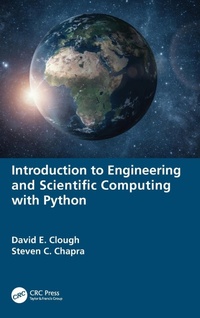
Introduction to Engineering and Scientific Computing with Python
1st Edition
Published on 7. September 2022
Book
Hardback
420 pages
978-1-032-18894-2 (ISBN)
Description
As more and more engineering departments and companies choose to use Python, this book provides an essential introduction to this open-source, free-to-use language. Expressly designed to support first-year engineering students, this book covers engineering and scientific calculations, Python basics, and structured programming.
Based on extensive teaching experience, the text uses practical problem solving as a vehicle to teach Python as a programming language. By learning computing fundamentals in an engaging and hands-on manner, it enables the reader to apply engineering and scientific methods with Python, focusing this general language to the needs of engineers and the problems they are required to solve on a daily basis. Rather than inundating students with complex terminology, this book is designed with a leveling approach in mind, enabling students at all levels to gain experience and understanding of Python. It covers such topics as structured programming, graphics, matrix operations, algebraic equations, differential equations, and applied statistics. A comprehensive chapter on working with data brings this book to a close.
This book is an essential guide to Python, which will be relevant to all engineers, particularly undergraduate students in their first year. It will also be of interest to professionals and graduate students looking to hone their programming skills, and apply Python to engineering and scientific contexts.
Based on extensive teaching experience, the text uses practical problem solving as a vehicle to teach Python as a programming language. By learning computing fundamentals in an engaging and hands-on manner, it enables the reader to apply engineering and scientific methods with Python, focusing this general language to the needs of engineers and the problems they are required to solve on a daily basis. Rather than inundating students with complex terminology, this book is designed with a leveling approach in mind, enabling students at all levels to gain experience and understanding of Python. It covers such topics as structured programming, graphics, matrix operations, algebraic equations, differential equations, and applied statistics. A comprehensive chapter on working with data brings this book to a close.
This book is an essential guide to Python, which will be relevant to all engineers, particularly undergraduate students in their first year. It will also be of interest to professionals and graduate students looking to hone their programming skills, and apply Python to engineering and scientific contexts.
More details
Language
English
Place of publication
London
United Kingdom
Publishing group
Taylor & Francis Ltd
Illustrations
265 s/w Abbildungen, 56 s/w Photographien bzw. Rasterbilder, 209 s/w Zeichnungen, 55 s/w Tabellen
55 Tables, black and white; 209 Line drawings, black and white; 56 Halftones, black and white; 265 Illustrations, black and white
Dimensions
Height: 235 mm
Width: 157 mm
Thickness: 27 mm
Weight
759 gr
ISBN-13
978-1-032-18894-2 (9781032188942)
Copyright in bibliographic data and cover images is held by Nielsen Book Services Limited or by the publishers or by their respective licensors: all rights reserved.
Schweitzer Classification
Other editions
Additional editions
David E. Clough | Steven C. Chapra
Introduction to Engineering and Scientific Computing with Python
Book
approx. 12/2025
1st Edition
CRC Press
€79.40
Not yet published
David E. Clough | Steven C. Chapra
Introduction to Engineering and Scientific Computing with Python
E-Book
09/2022
1st Edition
CRC Press
€69.99
Available for download
David E. Clough | Steven C. Chapra
Introduction to Engineering and Scientific Computing with Python
E-Book
09/2022
1st Edition
CRC Press
€69.99
Available for download
Persons
David E. Clough is Professor Emeritus at the University of Colorado. He has experience in a wide array of programming languages and computing tools and has applied his expertise through his teaching, research, and industrial applications. Over his career, Clough has taught hundreds of short courses to practicing professionals on applied computing and problem solving.
Steven C. Chapra is the Emeritus Professor and Louis Berger Chair in Civil and Environmental Engineering at Tufts University. Before joining Tufts, he worked for the U.S. Environmental Protection Agency and the National Oceanic and Atmospheric Administration, and taught at Texas A&M University, the University of Colorado, and Imperial College London. He is a Fellow and Distinguished Member of the American Society of Civil Engineering (ASCE) and has received several awards for his scholarly and academic contributions, including the Rudolph Hering Medal (ASCE), and the Meriam-Wiley Distinguished Author Award (American Society for Engineering Education). As a strong proponent of continuing education, he has taught more than 90 workshops around the world for professionals on numerical methods, computer programming, and environmental modeling.
Steven C. Chapra is the Emeritus Professor and Louis Berger Chair in Civil and Environmental Engineering at Tufts University. Before joining Tufts, he worked for the U.S. Environmental Protection Agency and the National Oceanic and Atmospheric Administration, and taught at Texas A&M University, the University of Colorado, and Imperial College London. He is a Fellow and Distinguished Member of the American Society of Civil Engineering (ASCE) and has received several awards for his scholarly and academic contributions, including the Rudolph Hering Medal (ASCE), and the Meriam-Wiley Distinguished Author Award (American Society for Engineering Education). As a strong proponent of continuing education, he has taught more than 90 workshops around the world for professionals on numerical methods, computer programming, and environmental modeling.
Content
Chapter 1 Engineering and Scientific Calculations
Chapter 2 Computer-Based Calculations
Chapter 3 Python Basics
Chapter 4 Structured Programming with Python
Chapter 5 Graphics-Matplotlib
Chapter 6 Array and Matrix Operations
Chapter 7 Solving Single Algebraic Equations
Chapter 8 Solving Sets of Algebraic Equations
Chapter 9 Solving Differential Equations
Chapter 10 Working with Data
Chapter 2 Computer-Based Calculations
Chapter 3 Python Basics
Chapter 4 Structured Programming with Python
Chapter 5 Graphics-Matplotlib
Chapter 6 Array and Matrix Operations
Chapter 7 Solving Single Algebraic Equations
Chapter 8 Solving Sets of Algebraic Equations
Chapter 9 Solving Differential Equations
Chapter 10 Working with Data