

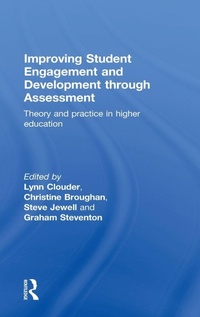
Improving Student Engagement and Development through Assessment
Theory and practice in higher education
Published on 14. May 2012
Book
Hardback
228 pages
978-0-415-61819-9 (ISBN)
Description
With a unique focus on the relationship between assessment and engagement this book explores what works in terms of keeping students on course to succeed.
Against a backdrop of massification and the associated increase in student diversity there is an escalating requirement for personalized, technology driven learning in higher education. In addition, the advent of student fees has promoted a consumer culture resulting in students having an increasingly powerful voice in shaping curricula to their own requirements. How does one engage and retain a group of students of such diverse culture, ethnicity, ambition and experience?
Using examples from a variety of institutions worldwide this edited collection provides a well-researched evidence base of current thinking and developments in assessment practices in higher education. The chapters discuss:
Staff and student views on assessment
Engaging students through assessment feedback
Assessment for learning
Assessing for employability
Interdisciplinary and transnational assessment
Technology supported assessment for retention
The book draws together a wealth of expertise from a range of contributors including academic staff, academic developers, pedagogical researchers, National Teaching Fellows and Centres for Excellence in Higher Education. Recognising that a pedagogy which is embedded and taken-for-granted in one context might be completely novel in another, the authors share best practice and evaluate evidence of assessment strategies to enable academic colleagues to make informed decisions about adopting new and creative approaches to assessment. This interdisciplinary text will prove an invaluable tool for those working and studying in higher education.
Against a backdrop of massification and the associated increase in student diversity there is an escalating requirement for personalized, technology driven learning in higher education. In addition, the advent of student fees has promoted a consumer culture resulting in students having an increasingly powerful voice in shaping curricula to their own requirements. How does one engage and retain a group of students of such diverse culture, ethnicity, ambition and experience?
Using examples from a variety of institutions worldwide this edited collection provides a well-researched evidence base of current thinking and developments in assessment practices in higher education. The chapters discuss:
Staff and student views on assessment
Engaging students through assessment feedback
Assessment for learning
Assessing for employability
Interdisciplinary and transnational assessment
Technology supported assessment for retention
The book draws together a wealth of expertise from a range of contributors including academic staff, academic developers, pedagogical researchers, National Teaching Fellows and Centres for Excellence in Higher Education. Recognising that a pedagogy which is embedded and taken-for-granted in one context might be completely novel in another, the authors share best practice and evaluate evidence of assessment strategies to enable academic colleagues to make informed decisions about adopting new and creative approaches to assessment. This interdisciplinary text will prove an invaluable tool for those working and studying in higher education.
More details
Language
English
Place of publication
London
United Kingdom
Publishing group
Taylor & Francis Ltd
Target group
Professional and scholarly
Academic, Professional, and Professional Practice & Development
Illustrations
10 s/w Abbildungen, 2 s/w Tabellen
2 Tables, black and white; 10 Illustrations, black and white
Dimensions
Height: 240 mm
Width: 161 mm
Thickness: 17 mm
Weight
514 gr
ISBN-13
978-0-415-61819-9 (9780415618199)
Copyright in bibliographic data and cover images is held by Nielsen Book Services Limited or by the publishers or by their respective licensors: all rights reserved.
Schweitzer Classification
Other editions
Additional editions
Lynn Clouder | Christine Broughan | Steve Jewell
Improving Student Engagement and Development through Assessment
Theory and practice in higher education
E-Book
05/2013
1st Edition
Routledge
€55.49
Available for download
Lynn Clouder | Christine Broughan | Steve Jewell
Improving Student Engagement and Development through Assessment
Theory and practice in higher education
E-Book
05/2013
1st Edition
Routledge
€55.49
Available for download
Lynn Clouder | Christine Broughan | Steve Jewell
Improving Student Engagement and Development through Assessment
Theory and practice in higher education
Book
05/2012
Routledge
€74.30
Shipment within 15-20 days
Persons
Lynn Clouder is Director of the Centre for Excellence in Learning Enhancement (CELE) at Coventry University, UK.
Christine Broughan is Head of Applied Research at Student Services, at Coventry University, UK.
Steve Jewell is Senior Lecturer in Strategy and Applied Management at Coventry University, UK.
Graham Steventon is Senior lecturer in Criminology at Coventry University, UK.
Christine Broughan is Head of Applied Research at Student Services, at Coventry University, UK.
Steve Jewell is Senior Lecturer in Strategy and Applied Management at Coventry University, UK.
Graham Steventon is Senior lecturer in Criminology at Coventry University, UK.
Content
1. The Challenges of Retention 2. Assessment for Learning 3. Exploring and Valuing what Students Bring to their Education 4. Student Teacher Relationships 5. Pleasure in Learning 6. Technology Supported Assessment for Retention 7. Using Technology for Feedback and Feed Forward 8. Digital Story-telling as an Alternative Assessment 9. Finding a Voice: Podcasting in Teaching, Learning and Assessment 10. Learner Experience of e-Portfolios for Formative and Summative Feedback 11 Interdisciplinary Assessment 12. Journeys in Peer E-communication: Student Mentors' Perspectives 13. Student Views of Assessment 14. The Academic Staff Perspective 15. Pedagogical Change Strategy