

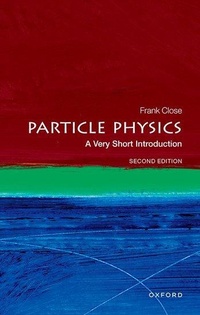
Particle Physics
A Very Short Introduction
2nd Edition
Published on 23. November 2023
Book
Paperback/Softback
176 pages
978-0-19-287375-0 (ISBN)
Description
Very Short Introductions: Brilliant, Sharp, Inspiring
Following the discovery of the Higgs boson, Frank Close has produced this major revision to his classic and compelling introduction to the fundamental particles that make up the universe. Frank Close takes us on a journey into the atom to examine known particles such as quarks, electrons, and the ghostly neutrino, and explains the key role and significance of the Higgs boson. Along the way he provides fascinating insights into how discoveries in particle physics have actually been made, and discusses how our picture of the world has been radically revised in the light of these developments. He concludes by looking ahead to new ideas about the mystery of antimatter and massive neutrinos, and to what the next 50 years of research might reveal about the nature of the Higgs field which moulds the fundamental particles and forces.
ABOUT THE SERIES: The Very Short Introductions series from Oxford University Press contains hundreds of titles in almost every subject area. These pocket-sized books are the perfect way to get ahead in a new subject quickly. Our expert authors combine facts, analysis, perspective, new ideas, and enthusiasm to make interesting and challenging topics highly readable.
Following the discovery of the Higgs boson, Frank Close has produced this major revision to his classic and compelling introduction to the fundamental particles that make up the universe. Frank Close takes us on a journey into the atom to examine known particles such as quarks, electrons, and the ghostly neutrino, and explains the key role and significance of the Higgs boson. Along the way he provides fascinating insights into how discoveries in particle physics have actually been made, and discusses how our picture of the world has been radically revised in the light of these developments. He concludes by looking ahead to new ideas about the mystery of antimatter and massive neutrinos, and to what the next 50 years of research might reveal about the nature of the Higgs field which moulds the fundamental particles and forces.
ABOUT THE SERIES: The Very Short Introductions series from Oxford University Press contains hundreds of titles in almost every subject area. These pocket-sized books are the perfect way to get ahead in a new subject quickly. Our expert authors combine facts, analysis, perspective, new ideas, and enthusiasm to make interesting and challenging topics highly readable.
More details
Series
Edition
2nd Revised edition
Language
English
Place of publication
Oxford
United Kingdom
Edition type
Revised edition
Illustrations
numerous line drawings and halftones
Dimensions
Height: 169 mm
Width: 112 mm
Thickness: 27 mm
Weight
150 gr
ISBN-13
978-0-19-287375-0 (9780192873750)
Copyright in bibliographic data and cover images is held by Nielsen Book Services Limited or by the publishers or by their respective licensors: all rights reserved.
Schweitzer Classification
Other editions
Additional editions
E-Book
05/2024
2nd Edition
OUP eBook
€9.49
Available for download
E-Book
10/2023
2nd Edition
OUP eBook
€9.49
Available for download
Previous edition
Book
05/2004
Oxford University Press
€11.13
Article exhausted; check for reprint
Person
Frank Close OBE FRS is Professor Emeritus of Physics at Oxford University and a Fellow Emeritus of Exeter College. He was formerly the Head of the Theoretical Physics Division at the Rutherford Appleton Laboratory, and Head of Communications and Public Education at CERN. He is the author of several books, including the best-selling Lucifer's Legacy (OUP, 2000), and was the winner of the Kelvin Medal of the Institute of Physics for his 'outstanding contributions to the public understanding of physics'. His other books include The Cosmic Onion (1983), The Particle Explosion (1987), End (1988), Too Hot to Handle (1991), and The Infinity Puzzle (OUP, 2012). In 2013 Professor Close was awarded the Royal Society Michael Faraday Prize for communicating science.
Content
1: Journey to the centre of the universe
2: How big and small are big and small?
3: How we learn what things are made of, and what we found
4: The heart of the matter
5: Accelerators: cosmic and manmade
6: Detectors: cameras and time machines
7: The forces of Nature
8: Exotic matter (and antimatter)
9: Where has matter come from?
10: Questions for the 21st century
2: How big and small are big and small?
3: How we learn what things are made of, and what we found
4: The heart of the matter
5: Accelerators: cosmic and manmade
6: Detectors: cameras and time machines
7: The forces of Nature
8: Exotic matter (and antimatter)
9: Where has matter come from?
10: Questions for the 21st century