

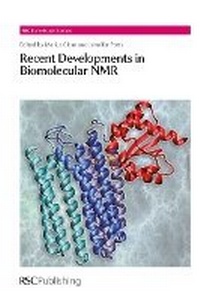
Recent Developments in Biomolecular NMR
Will be published approx. on 1. August 2012
Book
Hardback
347 pages
978-1-84973-120-1 (ISBN)
Description
NMR spectroscopy is widely used in biomolecular science particularly for structure determination of proteins, nucleic acids and carbohydrates. Much of the innovation within NMR spectroscopy has been within the field of protein NMR spectroscopy, an important technique in structural biology.
Filling a gap in the literature, this book draws together experts in the field to discuss the real advances in NMR methods that have occurred or have an impact on the biomolecular field in the last few years. The coverage includes recent developments in using NMR for determination of protein structures, membrane proteins, the dynamics of RNA and advances in NMR in drug discovery. Edited by leading biological NMR spectroscopists, the book is essential reference for researchers in industry and academia interested in or joining this bioanalytical field.
Filling a gap in the literature, this book draws together experts in the field to discuss the real advances in NMR methods that have occurred or have an impact on the biomolecular field in the last few years. The coverage includes recent developments in using NMR for determination of protein structures, membrane proteins, the dynamics of RNA and advances in NMR in drug discovery. Edited by leading biological NMR spectroscopists, the book is essential reference for researchers in industry and academia interested in or joining this bioanalytical field.
More details
Series
Language
English
Place of publication
Cambridge
United Kingdom
Target group
Professional and scholarly
Product notice
Unsewn / adhesive bound
Dimensions
Height: 241 mm
Width: 161 mm
Thickness: 25 mm
Weight
670 gr
ISBN-13
978-1-84973-120-1 (9781849731201)
Copyright in bibliographic data and cover images is held by Nielsen Book Services Limited or by the publishers or by their respective licensors: all rights reserved.
Schweitzer Classification
Other editions
Additional editions
Marius Clore | Jennifer Potts
Recent Developments in Biomolecular NMR
E-Book
08/2012
1st Edition
Royal Society of Chemistry
€214.99
Available for download
Persons
Dr Marius Clore's career began at University College London where he studied for his BSc in Biochemistry, moving to University College Hospital Medical School he became an MD and finally a PhD at the National Institute for Medical Research, London. In 1984, he became head of the Biological NMR Group at Max-Planck Institute for Biochemistry and then moved in 1988 to NIH, USA. He is currently an NIH Distinguished Investigator and Chief of the Protein Nuclear Magnetic Resonance Section and has made many pioneering contributions in the development of NMR spectroscopy for structural characterization of biological macromolecules. Dr Clore has been awarded numerous prizes and honours and was ranked in the top 20 in h-index ranking of living chemists in 2009. He is also a 3rd Degree black belt in Tae Kwon Do. Dr Jennifer Potts studied at the University of Sydney before becoming a postdoctoral fellow at the University of Oxford in 1992. Staying at Oxford until 2005 as a research associate and latterly lecturer in biochemistry, she then became Anniversary Reader at the University of York where her recent work has been on fibronectin recognition domains which fold on experiencing their target.
Content
Isotope-labelling of Methyl Groups for NMR Studies of Large Proteins;
Low y-nuclei detection experiments for biomolecular NMR;
Making the most of chemical shifts;
Protein Structure Determination using sparse NMR data;
NMR Studies of Disordered but Functional Proteins;
Paramagnetic NMR Spectroscopy and Lowly Populated States;
NMR Relaxation Dispersion Studies of Large Enzymes in Solution;
Residual Dipolar Couplings as a Tool for the Study of Protein Conformation and Conformational Flexibility;
Characterizing RNA Dynamics using NMR Residual Dipolar Couplings;
Non-canonical ligand-binding events as detected by NMR;
Advances in Biomolecular NMR for Drug Discovery;
NMR of membrane proteins;
Recent Developments in Biomolecular Solid-state NMR;
Subject Index
Low y-nuclei detection experiments for biomolecular NMR;
Making the most of chemical shifts;
Protein Structure Determination using sparse NMR data;
NMR Studies of Disordered but Functional Proteins;
Paramagnetic NMR Spectroscopy and Lowly Populated States;
NMR Relaxation Dispersion Studies of Large Enzymes in Solution;
Residual Dipolar Couplings as a Tool for the Study of Protein Conformation and Conformational Flexibility;
Characterizing RNA Dynamics using NMR Residual Dipolar Couplings;
Non-canonical ligand-binding events as detected by NMR;
Advances in Biomolecular NMR for Drug Discovery;
NMR of membrane proteins;
Recent Developments in Biomolecular Solid-state NMR;
Subject Index