

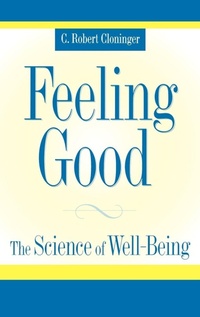
Feeling Good
The Science of Well-Being
Published on 27. May 2004
Book
Hardback
400 pages
978-0-19-505137-7 (ISBN)
Description
All human beings have spontaneous needs for happiness, self-understanding and love. In Feeling Good: The Science of Well Being, psychiatrist Robert Cloninger describes a way to coherent living that satisfies these strong basic needs through growth in the uniquely human gift of self-awareness. The scientific findings that led Dr Cloninger to expand his own views in a stepwise manner during 30 years of research and clinical experience are clearly presented so that readers can consider the validity of his viewpoint for themselves. The principles of well-being are based on a non-reductive scientific paradigm that integrates findings from all the biomedical and psychosocial sciences. Reliable methods are described for measuring human thought and social relationships at each step along the path of self-aware consciousness. Practical mental exercises for stimulating the growth of self-awareness are also provided. The methods are supported by data from brain imaging, genetics of personality, and longitudinal biopsychosocial studies.
Feeling Good: The Science of Well-Being will be of value to anyone involved in the sciences of the mind or the treatment of mental disorders. It will also interest theologians, philosophers, social scientists, and lay readers because it provides contemporary scientific concepts and language for addressing the perennial human questions about being, knowledge, and conduct.
Feeling Good: The Science of Well-Being will be of value to anyone involved in the sciences of the mind or the treatment of mental disorders. It will also interest theologians, philosophers, social scientists, and lay readers because it provides contemporary scientific concepts and language for addressing the perennial human questions about being, knowledge, and conduct.
Reviews / Votes
Cloninger, a distinguished US psychiatrist, starts this book with the question, 'why is it so difficult to be happy'? He is critical of conventional scientific psychiatry's approach to the answer to this question, and throughout the book invokes concepts which science finds it difficult to grapple with - like 'coherence'. He ranges with profound insight widely over philosophy and history plus many other sciences, including mathematics, to take an intelligent stab at the central problems of well-being. * Dr Raj Persaud in the British Journal of Psychiatry * . . . a product of vast erudition . . . radical, comprehensive, audacious, brilliant . . . * PsycCRITIQUES *More details
Language
English
Place of publication
New York
United States
Target group
Professional and scholarly
Illustrations
numerous figures and tables
Dimensions
Height: 240 mm
Width: 161 mm
Thickness: 26 mm
Weight
763 gr
ISBN-13
978-0-19-505137-7 (9780195051377)
Copyright in bibliographic data and cover images is held by Nielsen Book Services Limited or by the publishers or by their respective licensors: all rights reserved.
Schweitzer Classification
Other editions
Additional editions
E-Book
05/2004
1st Edition
OUP eBook
€44.99
Available for download
E-Book
05/2004
1st Edition
OUP eBook
€44.99
Available for download
Person
Author
Wallace Renard Professor of Psychiatry, Professor of Psychology and Genetics, and Director, Sansone Family Center for Well-BeingWallace Renard Professor of Psychiatry, Professor of Psychology and Genetics, and Director, Sansone Family Center for Well-Being, Washington University School of Medicine, USA
Content
1. A brief philosophy of well-being ; 2. The search for an adequate psychology ; 3. The measurement and movement of human thought ; 4. The social psychology of transcendentalism ; 5. Psychophysical theories of contemplation ; 6. Psychophysiology of awareness ; 7. The epigenetic revolution ; 8. The irreductible triad of well-being ; Appendix: The Quantitative Measurement of Thought