

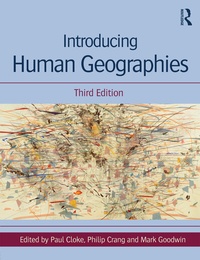
Introducing Human Geographies
3rd Edition
Published on 29. November 2013
Book
Paperback/Softback
1088 pages
978-1-4441-3535-0 (ISBN)
Description
Introducing Human Geographies is the leading guide to human geography for undergraduate students, explaining new thinking on essential topics and discussing exciting developments in the field.
This new edition has been thoroughly revised and updated and coverage is extended with new sections devoted to biogeographies, cartographies, mobilities, non-representational geographies, population geographies, public geographies and securities. Presented in three parts with 60 contributions written by expert international researchers, this text addresses the central ideas through which human geographers understand and shape their subject. Part I: Foundations engages students with key ideas that define human geography's subject matter and approaches, through critical analyses of dualisms such as local-global, society-space and human-nonhuman. Part II: Themes explores human geography's main sub-disciplines, with sections devoted to biogeographies, cartographies, cultural geographies, development geographies, economic geographies, environmental geographies, historical geographies, political geographies, population geographies, social geographies, urban and rural geographies. Finally, Part III: Horizons assesses the latest research in innovative areas, from mobilities and securities to non-representational geographies.
This comprehensive, stimulating and cutting edge introduction to the field is richly illustrated throughout with full colour figures, maps and photos. These are available to download on the companion website, located at www.routledge.com/9781444135350.
This new edition has been thoroughly revised and updated and coverage is extended with new sections devoted to biogeographies, cartographies, mobilities, non-representational geographies, population geographies, public geographies and securities. Presented in three parts with 60 contributions written by expert international researchers, this text addresses the central ideas through which human geographers understand and shape their subject. Part I: Foundations engages students with key ideas that define human geography's subject matter and approaches, through critical analyses of dualisms such as local-global, society-space and human-nonhuman. Part II: Themes explores human geography's main sub-disciplines, with sections devoted to biogeographies, cartographies, cultural geographies, development geographies, economic geographies, environmental geographies, historical geographies, political geographies, population geographies, social geographies, urban and rural geographies. Finally, Part III: Horizons assesses the latest research in innovative areas, from mobilities and securities to non-representational geographies.
This comprehensive, stimulating and cutting edge introduction to the field is richly illustrated throughout with full colour figures, maps and photos. These are available to download on the companion website, located at www.routledge.com/9781444135350.
Reviews / Votes
"A truly wonderful book, vastly wide ranging in its coverage and tremendously exciting in its approach. It is lively, engaging and highly accessible, and provides a thorough grounding for students learning to interpret the world through geographers' eyes. The editors have crafted an indispensable companion for undergraduates setting out on a geographical journey." Jon Shaw, Associate Head, School of Geography, Earth and Environmental Sciences, Plymouth University, UK."A substantial expansion of earlier editions, though still a fantastic, progressive, critical introduction to the discipline. The presentation is clear, the writing is wonderfully accessible and the updated selection of themes remains relevant and challenging." Michael Collyer, Senior Lecturer in Geography at the University of Sussex, UK.
More details
Edition
3rd edition
Language
English
Place of publication
London
United Kingdom
Publishing group
Taylor & Francis Ltd
Target group
College/higher education
Illustrations
284 farbige Abbildungen, 232 Farbfotos bzw. farbige Rasterbilder, 54 farbige Zeichnungen, 17 farbige Tabellen
17 Tables, color; 54 Line drawings, color; 232 Halftones, color; 284 Illustrations, color
Dimensions
Height: 246 mm
Width: 189 mm
Weight
1964 gr
ISBN-13
978-1-4441-3535-0 (9781444135350)
Copyright in bibliographic data and cover images is held by Nielsen Book Services Limited or by the publishers or by their respective licensors: all rights reserved.
Schweitzer Classification
Other editions
New editions
Kelly Dombroski | Mark Goodwin | Junxi Qian
Introducing Human Geographies
Book
07/2024
4th Edition
Routledge
€69.50
Shipment within 15-20 days
Additional editions
Paul Cloke | Philip Crang | Mark Goodwin
Introducing Human Geographies
Book
12/2013
3rd Edition
Routledge
€267.41
Article exhausted; check for reprint
Previous edition
Paul Cloke | Philip Crang | Mark Goodwin
Introducing Human Geographies, Second Edition
Book
05/2005
2nd Edition
Hodder Arnold
€71.98
Article exhausted; check for reprint
Persons
Paul Cloke is Professor of Human Geography at the University of Exeter.
Philip Crang is Professor of Cultural Geography at Royal Holloway, University of London.
Mark Goodwin is Professor of Human Geography and Deputy Vice-Chancellor at the University of Exeter.
Philip Crang is Professor of Cultural Geography at Royal Holloway, University of London.
Mark Goodwin is Professor of Human Geography and Deputy Vice-Chancellor at the University of Exeter.
Content
Part 1: Foundations 1. Local-global 2. Society-space 3. Human-non-human 4. Modern-postmodern 5. Self-other 6. Masculinity-femininity 7. Science-art 8. Explanation-understanding 9. Representation-reality Part 2: Themes Section 1. Biogeographies 10. Nature and Human Geography 11. Animals and Plants 12. Political Ecology Section 2. Cartography 13. Power of Maps 14. Geographical Information Systems 15. Counter Geographies Section 3. Cultural Geographies 16. Imaginative Geographies 17. Place 18. Landscape 19. Material Geographies Section 4. Development Geographies 20. Theories of Development 21. Rethinking Development 22. Survival and Resistance 23. Human Geographies of the Global South Section 5. Economic Geographies 24. Spaces of Production 25. Money and Finance 26. Consumption-reproduction 27. Commodities 28. Economic Globalization Section 6. Environmental Geographies 29. Global & Local Environmental Problems 30. Sustainability 31. Climate Change Section 7. Historical Geographies 32. Modernity & Modernization 33. Colonialism & Postcolonialism 34. Space, Memory & Identity Section 8. Political Geographies 35. Critical Geopolitics 36. War & Peace 37. Nationalism 38. Citizenship & Governance Section 9. Population Geographies 39. Age 40. Health and Well-being 41. Migrants and Refugees Section 10. Social Geographies 42. Identities 43. Identity and Difference: Dis/ability and Sexuality 44. Exclusion 45. Diasporas Section 11. Urban and Rural Geographies 46. Urban Forms 47. Urban Senses 48. Rurality Part 3: Horizons Section 12. Non-representational Geographies 49. Emotion 50. Affect 51. Performances Section 13. Mobilities 52. Mobilities: Politics, Practices, Places 53. Touring Mobilities 54. Virtual Mobilities Section 14. Securities 55. Risk/Fear/Surveillance 56. Resources 57. Securing Life: New hHzards and Biosecurity Section 15. Publics 58. How to Think about Public Space 59. Ethical Spaces