

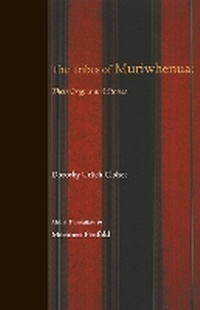
Tribes of Muriwhenua
Their Origins and Stories
Published on 6. November 2025
Book
Paperback/Softback
144 pages
978-1-86940-269-3 (ISBN)
Description
The Tribes of the Muriwhenua is a history of the iwi of Te Hiku o te Ika, the Far North, in particular of Ngati Kuri, Te Aupouri, Ngai Takoto, Te Rarawa and Ngati Kahu. Bringing together the traditional history presented by kaumatua and kuia during the Muriwhenua claim before the Waitangi Tribunal during the 1980s and 1990s, the book is a testament to the richness of korero tuku iho. For each iwi, the author gives whakapapa and a variety of lively and dramatic stories.
The book has been expertly translated by Dr Merimeri Penfold, widely respected for her knowledge of and feel for te reo Maori. The bilingual text is illustrated with photographs of the Muriwhenua landscape.
The book has been expertly translated by Dr Merimeri Penfold, widely respected for her knowledge of and feel for te reo Maori. The bilingual text is illustrated with photographs of the Muriwhenua landscape.
Reviews / Votes
Writing both with respect for the value of oral testimony and a sensitivity towards the sometimes competing stories which have emerged out of the disruptions of colonization, Cloher and Penfold have produced a document that will be of value to both Pakeha and Maori historians as they seek to understand the history of this part of their country.' - Australian Historical StudiesMore details
Language
English
Place of publication
Auckland
New Zealand
Target group
College/higher education
Professional and scholarly
Illustrations
illustrations, list of figures
ISBN-13
978-1-86940-269-3 (9781869402693)
Copyright in bibliographic data and cover images is held by Nielsen Book Services Limited or by the publishers or by their respective licensors: all rights reserved.
Schweitzer Classification
Other editions
Additional editions
E-Book
11/2013
Auckland University Press
€29.49
Available for download
Persons
Dr Dorothy Urlich Cloher (Ngapuhi, 1930-2011) was formerly head of the James Henare Research Centre at the University of Auckland. Alongside The Tribes of Muriwhenua she wrote Hongi Hika: Warrior Chief (Penguin, 2003), published widely in specialist journals and produced a number of high profile reports into Maori issues including sustainable economic development and childhood education.
Dr Merimeri Penfold (Ngati Kuri, 1920-2014) spent 20 years teaching in schools and then in 1964 she became the first lecturer in te reo Maori at a New Zealand university, teaching at the University of Auckland for the next 30 years. She was an inaugural member and dominion vice president of the Maori Women's Welfare League and served on the Maori Education Foundation, the Broadcasting Commission, the Human Rights Commission and numerous other organisations. An acknowledged expert on Maori language and culture, she was part of the editorial team for the seventh edition of Williams' Dictionary of the Maori Language. Prior to The Tribes of Muriwhenua she co-authored Women in the Arts in New Zealand (1986), edited the Maori sections of The Book of New Zealand Women (1991), and published her translation of Shakespearean sonnets, Nga Waiata Aroha a Hekepia/Love Sonnets by Shakespeare: Nine Sonnets (2000). In 2000, Penfold was awarded an honorary Doctorate of Literature by the University of Auckland, in 2001 she was appointed a Companion of the New Zealand Order of Merit for services to Maori, and in 2008 she was awarded Te Tohu Aroha mo Ngoi Kumeroa Pewhairangi for her contribution to te reo Maori in the 2008 Nga Taonga Toi a Te Waka Toi from Creative New Zealand.
Dr Merimeri Penfold (Ngati Kuri, 1920-2014) spent 20 years teaching in schools and then in 1964 she became the first lecturer in te reo Maori at a New Zealand university, teaching at the University of Auckland for the next 30 years. She was an inaugural member and dominion vice president of the Maori Women's Welfare League and served on the Maori Education Foundation, the Broadcasting Commission, the Human Rights Commission and numerous other organisations. An acknowledged expert on Maori language and culture, she was part of the editorial team for the seventh edition of Williams' Dictionary of the Maori Language. Prior to The Tribes of Muriwhenua she co-authored Women in the Arts in New Zealand (1986), edited the Maori sections of The Book of New Zealand Women (1991), and published her translation of Shakespearean sonnets, Nga Waiata Aroha a Hekepia/Love Sonnets by Shakespeare: Nine Sonnets (2000). In 2000, Penfold was awarded an honorary Doctorate of Literature by the University of Auckland, in 2001 she was appointed a Companion of the New Zealand Order of Merit for services to Maori, and in 2008 she was awarded Te Tohu Aroha mo Ngoi Kumeroa Pewhairangi for her contribution to te reo Maori in the 2008 Nga Taonga Toi a Te Waka Toi from Creative New Zealand.
Content
Significance of the place named Muriwhenua; origin of the name; cradle of early New Zealand; a first landing place for Kupe and ancestral canoes; Ngati Kuri, the tangata whenua tribe; early settlement and establishment of the house of Muriwhenua; origins of Ngati Kuri and its name; Tohe and a major naming exercise; Tumatahina; Te Ara Wairua -the Spiritual Pathway; Te Aupouri, the tribe that emerged from under a cloud of smoke; a planned evacuation; a welcome from Kin Houtaewa - the fearless; Ngai Takoto, the tribe that conceived from grief; tribal ancestors; reversals of fortune; Te Rarawa, a strong rope of plaited flax; a case of two descent lines; Tumoana and the tinana canoe; Houpure, Patito and Toakai; the Moetonga line to Tarutaru; Tarutaru the terrible; Poroa the consolidator; Reituu and Reipae; Nopera Panakareo; Kaitaia - Principal town in Muriwhenua; the origins of Ngati Kahu - a tangled web; Doubtless Bay arrivals; the origins of Ngati Kahu; a challenging vision; Te Paatu of Oruru, a resourceful fighting tribe; Ngapuhi attacks Kauhanga Pa; Tukitahua as founder?; a more ancient tribe than is thought.