

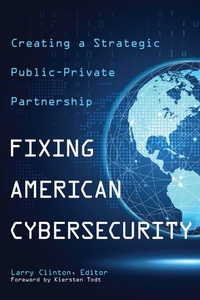
Fixing American Cybersecurity
Creating a Strategic Public-Private Partnership
Published on 1. February 2023
Book
Hardback
292 pages
978-1-64712-149-5 (ISBN)
Description
Advocates a cybersecurity "social contract" between government and business in seven key economic sectors
Cybersecurity vulnerabilities in the United States are extensive, affecting everything from national security and democratic elections to critical infrastructure and economy. In the past decade, the number of cyberattacks against American targets has increased exponentially, and their impact has been more costly than ever before. A successful cyber-defense can only be mounted with the cooperation of both the government and the private sector, and only when individual corporate leaders integrate cybersecurity strategy throughout their organizations.
A collaborative effort of the Board of Directors of the Internet Security Alliance, Fixing American Cybersecurity is divided into two parts. Part One analyzes why the US approach to cybersecurity has been inadequate and ineffective for decades and shows how it must be transformed to counter the heightened systemic risks that the nation faces today. Part Two explains in detail the cybersecurity strategies that should be pursued by each major sector of the American economy: health, defense, financial services, utilities and energy, retail, telecommunications, and information technology.
Fixing American Cybersecurity will benefit industry leaders, policymakers, and business students. This book is essential reading to prepare for the future of American cybersecurity.
Cybersecurity vulnerabilities in the United States are extensive, affecting everything from national security and democratic elections to critical infrastructure and economy. In the past decade, the number of cyberattacks against American targets has increased exponentially, and their impact has been more costly than ever before. A successful cyber-defense can only be mounted with the cooperation of both the government and the private sector, and only when individual corporate leaders integrate cybersecurity strategy throughout their organizations.
A collaborative effort of the Board of Directors of the Internet Security Alliance, Fixing American Cybersecurity is divided into two parts. Part One analyzes why the US approach to cybersecurity has been inadequate and ineffective for decades and shows how it must be transformed to counter the heightened systemic risks that the nation faces today. Part Two explains in detail the cybersecurity strategies that should be pursued by each major sector of the American economy: health, defense, financial services, utilities and energy, retail, telecommunications, and information technology.
Fixing American Cybersecurity will benefit industry leaders, policymakers, and business students. This book is essential reading to prepare for the future of American cybersecurity.
Reviews / Votes
[Fixing American Cybersecurity] would be an ideal text for a course in cybersecurity and a great read for anyone seeking a deeper understanding of today's cyber vulnerabilities. * The Cipher Brief * While the book paints a sobering picture of our current cybersecurity landscape, it offers valuable recommendations for improving our defenses and mitigating future risks. This book is essential for security professionals, policymakers, and concerned citizens alike. * Brilliance Security Magazine * Essential reading to prepare for the future of American cybersecurity, especially in light of contemporary and all to often successful efforts by criminals and hostile nations to breach and manipulate American internet and computer databases, "Fixing American Cybersecurity" must have the widest possible readership and considered an essential addition to personal, professional, community, governmental, corporate, and academic library Cybersecurity & Database protection collections and supplemental curriculum studies lists. * Midwest Book Review * The content of this volume is up-to-date throughout, and will provide an excellent overview for readers at all levels. * CHOICE connect *More details
Language
English
Place of publication
Washington, DC
United States
Target group
US School Grade: College Graduate Student and over
Product notice
sewn/stitched
Cloth over boards
Illustrations
Not illustrated
Dimensions
Height: 230 mm
Width: 150 mm
Thickness: 28 mm
Weight
640 gr
ISBN-13
978-1-64712-149-5 (9781647121495)
Copyright in bibliographic data and cover images is held by Nielsen Book Services Limited or by the publishers or by their respective licensors: all rights reserved.
Schweitzer Classification
Other editions
Additional editions
E-Book
02/2023
Georgetown University Press
€33.99
Available for download
Persons
Larry Clinton is the president and CEO of the Internet Security Alliance, a multi-sector trade association that focuses on thought leadership, policy advocacy and developing best practices for cyber security. The National Association of Corporate Directors has twice named Clinton as one of the 100 most influential people in the field of corporate governance. Clinton is the author of numerous publications in the cybersecurity space.
Content
Foreword by Kiersten Todt
Introduction
PART ONE: Rethinking Cybersecurity
1 The Economics of Cybersecurity: Advantage Attackers
By Larry Clinton
2 Dangerous and Effective: China's Digital Strategy
By Larry Clinton and Carter (Yingzhou) Zheng
3 The Solar Winds of Change: The Threat of Systemic Cyber Risk
By Anthony Shapella
4 Outdated and Ineffective: Why Our Current Cybersecurity Programs Fail to Keep Us Safe
By Larry Clinton and Alexander T. Green
5 Reinventing Cybersecurity: A Strategic Partnership Approach
By Larry Clinton and Alexander T. Green
6 The Cybersecurity Policy We Need: Incentivize, Modernize, Economize
By Larry Clinton
PART TWO: Sectors of Cybersecurity
7 Health: Cybersecurity as a Core Element of Patient Care
By Lou DeSorbo and Jamison Gardner
8 Defense: Leveraging the Dual Economies of the Defense Industrial Base
By Jeffrey C. Brown, J. R. Williamson, Michael Gordon, Michael Higgins, and Josh Higgins
9 Financial Services: Regulation Isn't Enough
By Greg Montana, Gary McAlum, Kenneth Huh, and Tarun Krishnakumar
10 Energy: Protecting the Smart Grid
By Ryan Boulais and Jamison Gardner
11 Retail: Serving Consumers and Keeping Them Secure
By Andy Kirkland and Alexander T. Green
12 Telecommunications: Managing International Risk in a Post-COVID-19 World
By Richard Spearman
13 Information Technology: Defining How to Govern IT
By Larry Clinton, Carter (Yingzhou) Zheng), and Tarun Krishnakumar
Conclusion
By Larry Clinton
Notes
About the Contributors
Index
Introduction
PART ONE: Rethinking Cybersecurity
1 The Economics of Cybersecurity: Advantage Attackers
By Larry Clinton
2 Dangerous and Effective: China's Digital Strategy
By Larry Clinton and Carter (Yingzhou) Zheng
3 The Solar Winds of Change: The Threat of Systemic Cyber Risk
By Anthony Shapella
4 Outdated and Ineffective: Why Our Current Cybersecurity Programs Fail to Keep Us Safe
By Larry Clinton and Alexander T. Green
5 Reinventing Cybersecurity: A Strategic Partnership Approach
By Larry Clinton and Alexander T. Green
6 The Cybersecurity Policy We Need: Incentivize, Modernize, Economize
By Larry Clinton
PART TWO: Sectors of Cybersecurity
7 Health: Cybersecurity as a Core Element of Patient Care
By Lou DeSorbo and Jamison Gardner
8 Defense: Leveraging the Dual Economies of the Defense Industrial Base
By Jeffrey C. Brown, J. R. Williamson, Michael Gordon, Michael Higgins, and Josh Higgins
9 Financial Services: Regulation Isn't Enough
By Greg Montana, Gary McAlum, Kenneth Huh, and Tarun Krishnakumar
10 Energy: Protecting the Smart Grid
By Ryan Boulais and Jamison Gardner
11 Retail: Serving Consumers and Keeping Them Secure
By Andy Kirkland and Alexander T. Green
12 Telecommunications: Managing International Risk in a Post-COVID-19 World
By Richard Spearman
13 Information Technology: Defining How to Govern IT
By Larry Clinton, Carter (Yingzhou) Zheng), and Tarun Krishnakumar
Conclusion
By Larry Clinton
Notes
About the Contributors
Index