

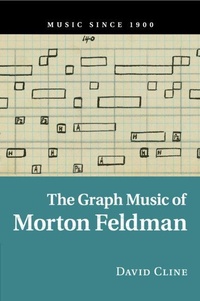
The Graph Music of Morton Feldman
Published on 20. December 2018
Book
Paperback/Softback
404 pages
978-1-107-52141-4 (ISBN)
Description
Morton Feldman is widely regarded as one of America's greatest composers. His music is famously idiosyncratic, but, in many cases, the way he presented it is also unusual because, in the 1950s and 1960s, he often composed in non-standard musical notations, including a groundbreaking variety on graph paper that facilitated deliberately imprecise specifications of pitch and, at times, other musical parameters. Feldman used this notation, intermittently, over seventeen years, producing numerous graph works that invite analysis as an evolving series. Taking this approach, David Cline marshals a wide range of source materials - many previously unpublished - in clarifying the ideology, organisation and generative history of these graphs and their formative role in the chronicle of post-war music. This assists in pinpointing connections with Feldman's compositions in other formats, works by other composers, notably John Cage, and contemporary currents in painting. Performance practice is examined through analysis of Feldman's non-notated preferences and David Tudor's celebrated interpretations.
More details
Series
Language
English
Place of publication
Cambridge
United Kingdom
Target group
Professional and scholarly
Product notice
Paperback (trade)
Illustrations
100 Printed music items; 14 Tables, black and white; 15 Halftones, unspecified; 15 Halftones, black and white
Dimensions
Height: 229 mm
Width: 152 mm
Thickness: 22 mm
Weight
586 gr
ISBN-13
978-1-107-52141-4 (9781107521414)
Copyright in bibliographic data and cover images is held by Nielsen Book Services Limited or by the publishers or by their respective licensors: all rights reserved.
Schweitzer Classification
Other editions
Additional editions
David Cline
The Graph Music of Morton Feldman
Book
05/2016
Cambridge University Press
€146.40
Shipment within 15-20 days
Person
David Cline completed his Ph.D. in Music at Goldsmiths, University of London in 2011 and was a fellow of the Institute of Musical Research at the School of Advanced Study, University of London from 2013 to 2015. His research has appeared in Perspectives of New Music and Twentieth-Century Music.
Content
Introduction; 1. Early graphs, 1950-3; 2. Later graphs, 1958-67; 3. Notation; 4. Ideology; 5. Holism; 6. Compositional methods I; 7. Compositional methods II; 8. Non-notated preferences; 9. Tudor's performances; 10. Connections with works in other notations; 11. Moving on; Epilogue; Appendix 1. Two unpublished graphs; Appendix 2. Other perspectives on compositional methods.