

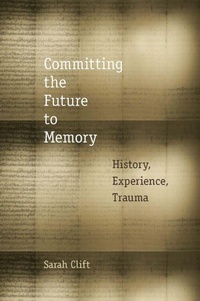
Committing the Future to Memory
History, Experience, Trauma
Published on 11. November 2013
Book
Paperback/Softback
264 pages
978-0-8232-5421-7 (ISBN)
Description
Whereas historical determinacy conceives the past as a complex and unstable network of causalities, this book asks how history can be related to a more radical future. To pose that question, it does not reject determinacy outright but rather seeks to explore how it works. In examining what it means to be "determined" by history, it also asks what kind of openings there might be in our encounters with history for interruptions, re-readings, and re-writings.
Engaging texts spanning multiple genres and several centuries-from John Locke to Maurice Blanchot, from Hegel to Benjamin-Clift looks at experiences of time that exceed the historical narration of experiences said to have occurred in time. She focuses on the co-existence of multiple temporalities and opens up the quintessentially modern notion of historical succession to other possibilities. The alternatives she draws out include the mediations of language and narration, temporal leaps, oscillations and blockages, and the role played by contingency in representation. She argues that such alternatives compel us to reassess the ways we understand history and identity in a traumatic, or indeed in a post-traumatic, age.
Engaging texts spanning multiple genres and several centuries-from John Locke to Maurice Blanchot, from Hegel to Benjamin-Clift looks at experiences of time that exceed the historical narration of experiences said to have occurred in time. She focuses on the co-existence of multiple temporalities and opens up the quintessentially modern notion of historical succession to other possibilities. The alternatives she draws out include the mediations of language and narration, temporal leaps, oscillations and blockages, and the role played by contingency in representation. She argues that such alternatives compel us to reassess the ways we understand history and identity in a traumatic, or indeed in a post-traumatic, age.
Reviews / Votes
"This is a thoughtful and absorbing reflection on the subtle modalities of memory-cultural, psychological, political -in the modern period. At a time when we are all experiencing a surfeit of memory, Sarah Clift injects a new rigor and lucidity into the discussion." -- -Rebecca Comay University of Toronto "Through the originality of her questions, her deft combination of close reading and conceptual generalization, the patience and lucidity of her analyses, and the remarkable surefootedness of her argumentation, Sarah Clift has succeeded in reinvigorating the interpretation of important works by Hannah Arendt, Walter Benjamin, John Locke, G. W. F. Hegel, and Maurice Blanchot. Her book will be of vital interest to political theorists, philosophers, literary critics, and intellectual historians, and may help to transform the discussion of fundamental issues they confront, most notably the relation between history and memory." -- -Thomas Trezise Princeton UniversityMore details
Language
English
Place of publication
New York
United States
Target group
Professional and scholarly
Product notice
Paperback (trade)
Dimensions
Height: 230 mm
Width: 152 mm
Thickness: 23 mm
Weight
372 gr
ISBN-13
978-0-8232-5421-7 (9780823254217)
Copyright in bibliographic data and cover images is held by Nielsen Book Services Limited or by the publishers or by their respective licensors: all rights reserved.
Schweitzer Classification
Other editions
Additional editions
E-Book
11/2013
1st Edition
Fordham University Press
€27.99
Available for download
E-Book
11/2013
1st Edition
Modern Language Initiative
€29.49
Available for download
Person
Sarah Clift is Assistant Professor of Contemporary Studies at the University of King's College, Halifax.
Content
Introduction 1 Narrative life span, in the wake: Benjamin and Arendt 2 Memory in Theory: The Childhood Memories of John Locke (Persons, Parrots) 3 Mourning Memory: The "End" of Art or, Reading (in) the Spirit of Hegel 4 Speculating on the past, the impact of the present: Hegel and his time(s) 5 In Lieu of a Last Word: Maurice Blanchot and the Future of Memory (today) Endnotes Bibliography