

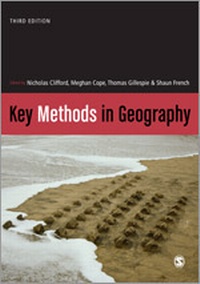
Key Methods in Geography
3rd Edition
Published on 31. May 2016
Book
Paperback/Softback
752 pages
978-1-4462-9860-2 (ISBN)
Description
"Practical, accessible, careful and interesting, this...revised volume brings the subject up-to-date and explains, in bite sized chunks, the 'how's' and 'why's' of modern day geographical study...[It] brings together physical and human approaches again in a new synthesis." -Danny Dorling, Professor of Geography, University of Oxford
Key Methods in Geography is the perfect introductory companion, providing an overview of qualitative and quantitative methods for human and physical geography.
This Third Edition Features:
12 new chapters representing emerging themes including online, virtual and digital geographical methods
Real-life case study examples
Summaries and exercises for each chapter
Free online access to full text of Progress in Human Geography and Progress in Physical Geography Progress Reports
The teaching of research methods is integral to all geography courses: Key Methods in Geography, Third Edition explains all of the key methods with which geography undergraduates must be conversant.
Key Methods in Geography is the perfect introductory companion, providing an overview of qualitative and quantitative methods for human and physical geography.
This Third Edition Features:
12 new chapters representing emerging themes including online, virtual and digital geographical methods
Real-life case study examples
Summaries and exercises for each chapter
Free online access to full text of Progress in Human Geography and Progress in Physical Geography Progress Reports
The teaching of research methods is integral to all geography courses: Key Methods in Geography, Third Edition explains all of the key methods with which geography undergraduates must be conversant.
Reviews / Votes
This excellent book remains the most comprehensive and accessible introduction to research methods in Geography today. The new edition will be essential reading for any student undertaking independent research as part of their degree -- Noel Castree A new generation of scholars explain how to get started with geographical research. Geography is an academic subject that rapidly evolves. What was in vogue on year can soon be passe. However, Key Methods in Geography provides a mixture that both preserves the best of the past and introduces what is both more new and most promising. Unnecessary verbiage is out - clarity is in. Practical, accessible careful and interesting, this greatly updated and revised volume brings the subject up-to-date and explains in bite sized chunks the hows and whys of modern day geographical study that begins to brings together physical and human approaches again in a new synthesis. -- Danny Dorling This collection is a valuable resource for geography students and researchers at all levels, in human geography, physical geography, and GIScience. It stands apart from many methods texts by speaking to the complete research process - from conceptualizing and designing geographical research, to collecting and analyzing many different forms of evidence, to representing results and finding in diverse ways. The volume is noteworthy in the breadth of methods it includes, spanning classic approaches that have been foundational to geographical scholarship and some of the discipline's newest and most innovative methodological practices. -- Sarah ElwoodMore details
Edition
3rd Revised edition
Language
English
Place of publication
London
United Kingdom
Target group
College/higher education
Edition type
Revised edition
Dimensions
Height: 242 mm
Width: 170 mm
Weight
1374 gr
ISBN-13
978-1-4462-9860-2 (9781446298602)
Copyright in bibliographic data and cover images is held by Nielsen Book Services Limited or by the publishers or by their respective licensors: all rights reserved.
Schweitzer Classification
Other editions
New editions
Nicholas Clifford | Meghan Cope | Thomas W. Gillespie
Key Methods in Geography
Book
04/2023
4th Edition
SAGE Publications Ltd
€106.50
Shipment within 15-20 days
Previous edition
Nicholas Clifford | Shaun French | Gill Valentine
Key Methods in Geography
Book
05/2010
2nd Edition
SAGE Publications Inc
€57.13
Article exhausted; check for reprint
Persons
Nick Clifford is Professor and Head of Department at King's College London. Dr. Meghan Cope is an urban social geographer. She is mainly interested in the ways that social, economic, political, and environmental processes influence cities and communities, as well as the ways that people's everyday lives create meaningful spaces and places within, or even against, the larger-scale processes operating on them. Her focus has always been on social/spatial processes of marginalization and disempowerment, for example, through gender, race/ethnicity, class, youth, etc. She is especially motivated by issues such as employment, households and neighborhoods, welfare, public space, poverty, discrimination, and identity. She is also a qualitative researcher who uses ethnography and other methods to learn about the geographic meanings and processes that matter to marginalized groups. Over the past 10 years she has developed an associated interest in critical perspectives on Geographic Information Systems (GIS) and have explored methods of combining qualitative research with GIS (Cope & Elwood, 2009). Thomas Gillespie teaches geography at UCLA. Shaun French is Associate Professor in Economic Geography at the University of Nottingham.
Content
SECTION ONE: PLANNING A RESEARCH PROJECT: GETTING STARTED AND PUTTING YOUR RESEARCH INTO CONTEXT
Getting Started in Geographical Research: how this book can help - Nicholas Clifford, Shaun French, Meghan Cope and Thomas Gillespie
Health, Safety and Risk in the Field - Joanna Bullard
On Being Ethical in Geographical Research - Iain Hay
How to Conduct a Literature Search - Mick Healey and Ruth L. Healey
Effective Research Communication - Jennifer Hill and Helen Walkington
Working in different cultures and different languages - Fiona Smith
SECTION TWO: GENERATING AND WORKING WITH DATA IN HUMAN GEOGRAPHY
Historical and Archival Research - Ruth Craggs
Conducting questionaire surveys - Sara L. McLafferty
Semi-structured interview and focus groups - Robyn Longhurst
Respondent Diaries - Alan Latham
Participant and non-participant observation - Eric Laurier
Researching Affect and Emotion - Ben Anderson
Participatory Action Research - Myrna Breitbart
Textual Analysis - Marcus Doel
Interpreting the Visual - Liz Roberts
Using Geotagged Digital Social Data in Geographic Research - Ate Poorthuis, Matthew Zook, Taylor Shelton, Mark Graham & Monica Stephens
Researching Virtual Communities - Mike Crang & Siti Haji Bin Mohamed
Critical GIS - Matthew W. Wilson
Quantitative modelling in human geography - Alan Marshall
SECTION THREE: GENERATING AND WORKING WITH DATA IN PHYSICAL AND ENVIRONMENTAL GEOGRAPHY
Making Observations and Measurements in the Field - Shelly A. Rayback
Making Observations and Measurements in the Laboratory - Scott A. Mensing
Getting information from the past: Paleoecological studies of terrestrial ecosystems - Laura N. Stahle and Cathy Whitlock
Numerical modelling: Understanding explanation and prediction in physical geography - Stuart Lane
Simulation and reduced complexity models - James D. A. Millington
Remote Sensing and Satellite Earth Observation - Martin Wooster, Nicholas Drake & Tom Smith
Digital Terrain Analysis - Peter L. Guth
Environmental GIS - Thomas Gillespie
Models and Data in Biogeography and Landscape Ecology - George P. Malanson and Benjamin W. Heumann
Environmental audit, appraisal and valuation - Peter Glaves
SECTION FOUR: GEOGRAPHICAL ANALYSIS: REPRESENTING, VISUALISING AND INTERPRETING GEOGRAPHICAL DATA
Making use of secondary data - Naomi Tyrrell
Using Statistics to Describe and Explore Spatial Data - Eric Delmelle
Exploring and presenting quantitative data - Richard Field
Case Study Methodology - Liz Taylor
Mapping and Graphicacy - Chris Perkins
Statistical analysis using MINITAB and SPSS - Stuart Barr
Organizing, Coding and Analyzing Qualitative Data - Meghan Cope & Hilda Kurtz
Using Geographical Information Systems (GIS) - Nigel Walford
Video, Audio & Technology-based Applications - Brad Garrett
Getting Started in Geographical Research: how this book can help - Nicholas Clifford, Shaun French, Meghan Cope and Thomas Gillespie
Health, Safety and Risk in the Field - Joanna Bullard
On Being Ethical in Geographical Research - Iain Hay
How to Conduct a Literature Search - Mick Healey and Ruth L. Healey
Effective Research Communication - Jennifer Hill and Helen Walkington
Working in different cultures and different languages - Fiona Smith
SECTION TWO: GENERATING AND WORKING WITH DATA IN HUMAN GEOGRAPHY
Historical and Archival Research - Ruth Craggs
Conducting questionaire surveys - Sara L. McLafferty
Semi-structured interview and focus groups - Robyn Longhurst
Respondent Diaries - Alan Latham
Participant and non-participant observation - Eric Laurier
Researching Affect and Emotion - Ben Anderson
Participatory Action Research - Myrna Breitbart
Textual Analysis - Marcus Doel
Interpreting the Visual - Liz Roberts
Using Geotagged Digital Social Data in Geographic Research - Ate Poorthuis, Matthew Zook, Taylor Shelton, Mark Graham & Monica Stephens
Researching Virtual Communities - Mike Crang & Siti Haji Bin Mohamed
Critical GIS - Matthew W. Wilson
Quantitative modelling in human geography - Alan Marshall
SECTION THREE: GENERATING AND WORKING WITH DATA IN PHYSICAL AND ENVIRONMENTAL GEOGRAPHY
Making Observations and Measurements in the Field - Shelly A. Rayback
Making Observations and Measurements in the Laboratory - Scott A. Mensing
Getting information from the past: Paleoecological studies of terrestrial ecosystems - Laura N. Stahle and Cathy Whitlock
Numerical modelling: Understanding explanation and prediction in physical geography - Stuart Lane
Simulation and reduced complexity models - James D. A. Millington
Remote Sensing and Satellite Earth Observation - Martin Wooster, Nicholas Drake & Tom Smith
Digital Terrain Analysis - Peter L. Guth
Environmental GIS - Thomas Gillespie
Models and Data in Biogeography and Landscape Ecology - George P. Malanson and Benjamin W. Heumann
Environmental audit, appraisal and valuation - Peter Glaves
SECTION FOUR: GEOGRAPHICAL ANALYSIS: REPRESENTING, VISUALISING AND INTERPRETING GEOGRAPHICAL DATA
Making use of secondary data - Naomi Tyrrell
Using Statistics to Describe and Explore Spatial Data - Eric Delmelle
Exploring and presenting quantitative data - Richard Field
Case Study Methodology - Liz Taylor
Mapping and Graphicacy - Chris Perkins
Statistical analysis using MINITAB and SPSS - Stuart Barr
Organizing, Coding and Analyzing Qualitative Data - Meghan Cope & Hilda Kurtz
Using Geographical Information Systems (GIS) - Nigel Walford
Video, Audio & Technology-based Applications - Brad Garrett