

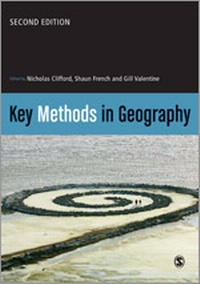
Key Methods in Geography
2nd Edition
Published on 19. May 2010
Book
Hardback
568 pages
978-1-4129-3508-1 (ISBN)
Description
"Its range is far broader than the majority of methods texts, being concerned with both human and physical geography... Given the seriousness with which Key Methods in Geography approaches all aspects of research, it will continue to find wide favour among undergraduate geographers."
- Times Higher Education Textbook Guide
"All geographers, whatever their interest, need to do research. This book will help them get started in the best possible way, with thoughtful advice on everything from project design, through choice of methods, to data analysis and presentation. The editors have assembled an impressive array of authors, all experts in their chosen field."
- Tim Burt, University of Durham
"Excellent book. Valuable teaching aid. Well written and covers a wide range of methods thoroughly."
- Sue Rodway-Dyer, Exeter University
"This is an excellent book and deals with a number of topics (which I teach) outside of the tutorial module where it is a recommended text for geographers. A very useful textbook throughout a 3 year Geography programme."
- Ian Harris, Bangor University
Key Methods in Geography is an introduction to the principal methodological issues involved in the collection, analysis and presentation of geographical information. It is unique in the reference literature for providing an overview of qualitative and quantitative methods for human and physical geography.
An accessible primer, it will be used by students as a reference throughout their degree, on all issues from research design to presentation. This second edition has been fully revised and updated and includes new chapters on internet mediated research, diaries as a research method, making observations and measurements in the field, and the analysis of natural systems.
Organized into four sections: Getting Started in Geographical Research; Generating and Working with Data in Human Geography; Generating and Working with Data in Physical Geography; Representing and Interpreting Geographical Data; each chapter comprises:
A short definition
A summary of the principal arguments
A substantive 5,000-word discussion
Use of real-life examples
Annotated notes for further reading.
The teaching of research methods is integral to all geography courses: Key Methods in Geography, 2nd Edition explains all of the key methods with which geography undergraduates must be conversant.
- Times Higher Education Textbook Guide
"All geographers, whatever their interest, need to do research. This book will help them get started in the best possible way, with thoughtful advice on everything from project design, through choice of methods, to data analysis and presentation. The editors have assembled an impressive array of authors, all experts in their chosen field."
- Tim Burt, University of Durham
"Excellent book. Valuable teaching aid. Well written and covers a wide range of methods thoroughly."
- Sue Rodway-Dyer, Exeter University
"This is an excellent book and deals with a number of topics (which I teach) outside of the tutorial module where it is a recommended text for geographers. A very useful textbook throughout a 3 year Geography programme."
- Ian Harris, Bangor University
Key Methods in Geography is an introduction to the principal methodological issues involved in the collection, analysis and presentation of geographical information. It is unique in the reference literature for providing an overview of qualitative and quantitative methods for human and physical geography.
An accessible primer, it will be used by students as a reference throughout their degree, on all issues from research design to presentation. This second edition has been fully revised and updated and includes new chapters on internet mediated research, diaries as a research method, making observations and measurements in the field, and the analysis of natural systems.
Organized into four sections: Getting Started in Geographical Research; Generating and Working with Data in Human Geography; Generating and Working with Data in Physical Geography; Representing and Interpreting Geographical Data; each chapter comprises:
A short definition
A summary of the principal arguments
A substantive 5,000-word discussion
Use of real-life examples
Annotated notes for further reading.
The teaching of research methods is integral to all geography courses: Key Methods in Geography, 2nd Edition explains all of the key methods with which geography undergraduates must be conversant.
Reviews / Votes
'The second edition of Key Methods in Geography, part of what is now a well-established series, offers a broadly conceived overview of the planning, execution and presentation of geographical research. Its range is far broader than the majority of methods texts, being concerned with both human and physical geography. The book also tackles all-too-often neglected contexts of research such as health and safety ethics. In doing so, it makes clear that these should be seen more as form-filling hurdles to be negotiated before hitting the field. In addition, the volume covers areas - such as conducting a literature search, writing essays, reports and dissertations and understanding assessment - that technically lie beyond the remit suggested in the title, but that undoubtedly enhance its impact. Given the seriousness with which Key Methods in Geography approaches all aspects of research, it will continue to find wide favour among undergraduate geographers...the influence of the editors is apparent in the consistency of tone, style and pitch among the book's 35 contributors. All of the authors are experienced in the area they discuss and offer a general overview rather than one overly focused on their own research. Clearly the editors recognise their audience well and have briefed accordingly' -- Tim Hall, University of Gloucestershire
'All geographers, whatever their interest, need to do research. This book will help them get started in the best possible way, with thoughtful advice on everything from project design, through choice of methods, to data analysis and presentation. The editors have assembled an impressive array of authors, all experts in their chosen field. It will be an especially stimulating source for geography students embarking on their undergraduate dissertations' -- Professor Tim Burt 'An excellent and very comprehensive text and highly recommended for all our undergraduates (around 120 students). The topics covered are very important for undergraduate dissertations and even postgraduate work. It is much more comprehensive than some other texts and is much more specific to the environmental/spatial sciences. This is definitely a text that will be strongly recommended to our students' -- Dr. Paul McKenzie
More details
Edition
2nd Revised edition
Language
English
Place of publication
Thousand Oaks
United States
Target group
College/higher education
Edition type
Revised edition
Dimensions
Height: 242 mm
Width: 170 mm
Weight
1095 gr
ISBN-13
978-1-4129-3508-1 (9781412935081)
Copyright in bibliographic data and cover images is held by Nielsen Book Services Limited or by the publishers or by their respective licensors: all rights reserved.
Schweitzer Classification
Other editions
New editions
Nicholas Clifford | Meghan Cope | Thomas W. Gillespie
Key Methods in Geography
Book
05/2016
3rd Edition
SAGE Publications Ltd
€224.33
Article exhausted; check for reprint
Previous edition
Nicholas Clifford | Gill Valentine
Key Methods in Geography
Book
04/2003
1st Edition
SAGE Publications Inc
€139.64
Article exhausted; check for reprint
Persons
Nick Clifford is Professor and Head of Department at King's College London. Shaun French is Associate Professor in Economic Geography at the University of Nottingham. Professor Valentine has held prestigious international visiting fellowships at the Universities of Sydney, Australia and Otago, New Zealand and has visited and given keynote addresses at a range of prestigious international conferences. She was co-founder and co-editor of the international journal Social and Cultural Geography, and co-edited Gender, Place and Culture. She has undertaken international research in Europe, Africa and the USA and is committed to developing the University of Sheffield's international strategy within the Faculty of Social Sciences.
Content
PART ONE: GETTING STARTED IN GEOGRAPHICAL RESEARCH
Getting Started in Geographical Research: How This Book Can Help - Nick Clifford, Shaun French and Gill Valentine
How to Conduct a Literature Search - Mick Healey and Ruth L Healey
Ethical Practice in Geographical Research - Iain Hay
Health and Safety in the Field - Joanna Bullard
PART TWO: GENERATING AND WORKING WITH DATA IN HUMAN GEOGRAPHY
Making Use of Secondary Data - Paul White
Conducting Questionnaire Surveys - Sara L McLafferty
Finding Historical Sources - Miles Ogborn
Semi-Structured Interviews and Focus Groups - Robyn Longhurst
Participant Observation - Eric Laurier
Geography and the Interpretation of Visual Imagery - Rob Bartram
Participatory Research Methods - Myrna M Breitbart
Working in Different Cultures - Fiona M Smith
Internet Mediated Research - Clare Madge
Diaries as a Research Method - Alan Latham
PART THREE: GENERATING AND WORKING WITH DATA IN PHYSICAL GEOGRAPHY
Getting Information About the Past: Palaeo and Historical Data Sources of Climate - Catherine Souch
Making Observations and Measurements in the Field - Alice Turkington
Sampling in Geography - Stephen Rice
Analysing a Natural System - Ellen Wohl
Numerical Modelling in Physical Geography: Understanding Explanation and Prediction in Physical Geography - Stuart N Lane
Using Remotely Sensed Imagery - Paul Aplin
PART FOUR: REPRESENTING AND INTERPRETING GEOGRAPHICAL DATA
Data Handling and Representation - Richard Field
Mapping and Graphicacy - Chris Perkins
Using Statistics to Describe and Explore Data - Danny Dorling
An Introduction to Geostatistics - Adrian Chappell
Using Geographical Information Systems - Michael Batty
Statistical Analysis Using PASW (formerly SPSS) - John H McKendrick
Coding Transcripts and Diaries - Meghan Cope
Computer Assisted Qualitative Data Analysis - Bettina van Hoven
Analyzing Historical and Archival Sources - Iain S Black
Analysing Cultural Texts - Marcus A Doel
Writing Essays, Reports and Dissertations - Michael Bradford
Understanding Assessment - Robin A Kearns
Getting Started in Geographical Research: How This Book Can Help - Nick Clifford, Shaun French and Gill Valentine
How to Conduct a Literature Search - Mick Healey and Ruth L Healey
Ethical Practice in Geographical Research - Iain Hay
Health and Safety in the Field - Joanna Bullard
PART TWO: GENERATING AND WORKING WITH DATA IN HUMAN GEOGRAPHY
Making Use of Secondary Data - Paul White
Conducting Questionnaire Surveys - Sara L McLafferty
Finding Historical Sources - Miles Ogborn
Semi-Structured Interviews and Focus Groups - Robyn Longhurst
Participant Observation - Eric Laurier
Geography and the Interpretation of Visual Imagery - Rob Bartram
Participatory Research Methods - Myrna M Breitbart
Working in Different Cultures - Fiona M Smith
Internet Mediated Research - Clare Madge
Diaries as a Research Method - Alan Latham
PART THREE: GENERATING AND WORKING WITH DATA IN PHYSICAL GEOGRAPHY
Getting Information About the Past: Palaeo and Historical Data Sources of Climate - Catherine Souch
Making Observations and Measurements in the Field - Alice Turkington
Sampling in Geography - Stephen Rice
Analysing a Natural System - Ellen Wohl
Numerical Modelling in Physical Geography: Understanding Explanation and Prediction in Physical Geography - Stuart N Lane
Using Remotely Sensed Imagery - Paul Aplin
PART FOUR: REPRESENTING AND INTERPRETING GEOGRAPHICAL DATA
Data Handling and Representation - Richard Field
Mapping and Graphicacy - Chris Perkins
Using Statistics to Describe and Explore Data - Danny Dorling
An Introduction to Geostatistics - Adrian Chappell
Using Geographical Information Systems - Michael Batty
Statistical Analysis Using PASW (formerly SPSS) - John H McKendrick
Coding Transcripts and Diaries - Meghan Cope
Computer Assisted Qualitative Data Analysis - Bettina van Hoven
Analyzing Historical and Archival Sources - Iain S Black
Analysing Cultural Texts - Marcus A Doel
Writing Essays, Reports and Dissertations - Michael Bradford
Understanding Assessment - Robin A Kearns