

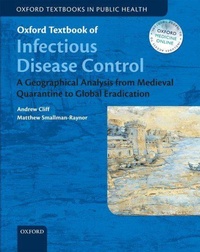
Oxford Textbook of Infectious Disease Control
A Geographical Analysis from Medieval Quarantine to Global Eradication
Published on 11. April 2013
Book
Hardback
208 pages
978-0-19-959661-4 (ISBN)
Description
The Oxford Textbook of Infectious Disease Control: A Geographical Analysis from Medieval Quarantine to Global Eradication is a comprehensive analysis of spatial theory and the practical methods used to prevent the geographical spread of communicable diseases in humans. Drawing on current and historical examples spanning seven centuries from across the globe, this indispensable volume demonstrates how to mitigate the public health impact of infections in disease hotspots and prevent the propagation of infection from such hotspots into other geographical locations.
Containing case studies of longstanding global killers such as influenza, measles and poliomyelitis, through to newly emerged diseases like SARS and highly pathogenic avian influenza in humans, this book integrates theory, data and spatial analysis and locates these quantitative analyses in the context of global demographic and health policy change. Beautifully illustrated with over 100 original maps and diagrams to aid understanding and assimilation, in six sections the authors examine surveillance, quarantine, vaccination, and forecasting for disease control. The discussion covers theoretical approaches, techniques and systems central to mitigating disease spread, and methods that deliver practical disease control. Essential information is also provided on the geographical eradication of diseases, including the design of early warning systems that detect the geographical spread of epidemics, enabling students and practitioners to design spatially-targeted control strategies.
Despite the early hope of eradication of many communicable diseases after the global eradication of smallpox by 1979, the world is still working at the control and elimination of the spatial spread of newly-emerging and resurgent infectious diseases. Learning from past examples and incorporating modern surveillance and reporting techniques that are used to design value-for-money spatially-targeted interventions to protect public health, the Oxford Textbook of Infectious Disease Control is an essential resource for all those working in, or studying ways to control the spread of communicable diseases between humans in a timely and cost-effective manner.
It is ideal for specialists and students in infectious disease control as well as those in the medical sciences, epidemiology, demography, public health, geography, and medical history.
Containing case studies of longstanding global killers such as influenza, measles and poliomyelitis, through to newly emerged diseases like SARS and highly pathogenic avian influenza in humans, this book integrates theory, data and spatial analysis and locates these quantitative analyses in the context of global demographic and health policy change. Beautifully illustrated with over 100 original maps and diagrams to aid understanding and assimilation, in six sections the authors examine surveillance, quarantine, vaccination, and forecasting for disease control. The discussion covers theoretical approaches, techniques and systems central to mitigating disease spread, and methods that deliver practical disease control. Essential information is also provided on the geographical eradication of diseases, including the design of early warning systems that detect the geographical spread of epidemics, enabling students and practitioners to design spatially-targeted control strategies.
Despite the early hope of eradication of many communicable diseases after the global eradication of smallpox by 1979, the world is still working at the control and elimination of the spatial spread of newly-emerging and resurgent infectious diseases. Learning from past examples and incorporating modern surveillance and reporting techniques that are used to design value-for-money spatially-targeted interventions to protect public health, the Oxford Textbook of Infectious Disease Control is an essential resource for all those working in, or studying ways to control the spread of communicable diseases between humans in a timely and cost-effective manner.
It is ideal for specialists and students in infectious disease control as well as those in the medical sciences, epidemiology, demography, public health, geography, and medical history.
Reviews / Votes
This is an elegant publication with clear illustrations, maps and graphs. It is a useful interesting read and fairly priced as research or reference text for occupational physicians. * Peter Noone Occupational Medicine Book Review *More details
Series
Language
English
Place of publication
Oxford
United Kingdom
Target group
College/higher education
Professional and scholarly
Product notice
sewn/stitched
Cloth over boards
Illustrations
205 b&w illustrations, 8 page colour plate section
Dimensions
Height: 284 mm
Width: 222 mm
Thickness: 17 mm
Weight
913 gr
ISBN-13
978-0-19-959661-4 (9780199596614)
Copyright in bibliographic data and cover images is held by Nielsen Book Services Limited or by the publishers or by their respective licensors: all rights reserved.
Schweitzer Classification
Other editions
Additional editions
Andrew Cliff | Matthew Smallman-Raynor
Oxford Textbook of Infectious Disease Control
A Geographical Analysis from Medieval Quarantine to Global Eradication
E-Book
04/2013
1st Edition
OUP eBook
€68.49
Available for download
Andrew Cliff | Matthew Smallman-Raynor
Oxford Textbook of Infectious Disease Control
A Geographical Analysis from Medieval Quarantine to Global Eradication
E-Book
04/2013
1st Edition
OUP eBook
€68.49
Available for download
Persons
Cliff, Professor Andrew David, European Academy 2002; FBA 1996; Professor of Theoretical Geography, University of Cambridge, since 1997; Pro-Vice-Chancellor 2004-2010; Fellow, Christ's College, Cambridge, since 1974. Educ: King's Coll. London (BA 1964); Northwestern Univ. (MA 1966); Univ. of Bristol (PhD 1969; DSc 1982); MA Cantab. 1973. FSS 1968. Teaching Asst in Geog., Northwestern Univ., 1964-66; University of Bristol: Res. Associate in Geog., 1968-69; Lectr 1969-72; Lectr in Geog., Univ. of Cambridge, 1973-91; Reader in Theoretical Geog., Univ. of Cambridge, 1991-97.
Smallman-Raynor, Professor Matthew Richard, Professor of Geography, University of Nottingham, since 2004. Educ: Cambridge University, BA (1988), MA Cantab. (1991), PhD (1991). Res. Associate in Geog., Univ. of Cambridge, 1991-94; Lectr in Geog., Univ. of Exeter, 1994-96; Univ. of Nottingham: Res. Fellow, 1996-98; Lectr in Geog., 1998-2001; Reader in Geog., 2001-4.
Smallman-Raynor, Professor Matthew Richard, Professor of Geography, University of Nottingham, since 2004. Educ: Cambridge University, BA (1988), MA Cantab. (1991), PhD (1991). Res. Associate in Geog., Univ. of Cambridge, 1991-94; Lectr in Geog., Univ. of Exeter, 1994-96; Univ. of Nottingham: Res. Fellow, 1996-98; Lectr in Geog., 1998-2001; Reader in Geog., 2001-4.
Content
PREFACE; REFERENCES