

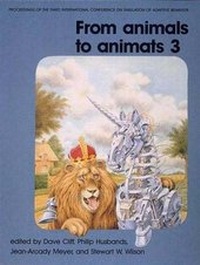
From Animals to Animats 3
Proceedings of the Third International Conference on Simulation of Adpative Behavior
Published on 27. July 1994
Book
Paperback/Softback
519 pages
978-0-262-53122-1 (ISBN)
Description
August 8-12, 1994, Brighton, England
From Animals to Animats 3 brings together research intended to advance the fron tier of an exciting new approach to understanding intelligence. The contributors represent a broad range of interests from artificial intelligence and robotics to ethology and the neurosciences. Unifying these approaches is the notion of "animat" -- an artificial animal, either simulated by a computer or embodied in a robot, which must survive and adapt in progressively more challenging environments. The 58 contributions focus particularly on well-defined models, computer simulations, and built robots in order to help characterize and compare various principles and architectures capable of inducing adaptive behavior in real or artificial animals.
Topics include: - Individual and collective behavior. - Neural correlates of behavior. - Perception and motor control. - Motivation and emotion. - Action selection and behavioral sequences. - Ontogeny, learning, and evolution. - Internal world models and cognitive processes. - Applied adaptive behavior. - Autonomous robots. - Heirarchical and parallel organizations. - Emergent structures and behaviors. - Problem solving and planning. - Goal-directed behavior. - Neural networks and evolutionary computation. - Characterization of environments.
A Bradford Book
From Animals to Animats 3 brings together research intended to advance the fron tier of an exciting new approach to understanding intelligence. The contributors represent a broad range of interests from artificial intelligence and robotics to ethology and the neurosciences. Unifying these approaches is the notion of "animat" -- an artificial animal, either simulated by a computer or embodied in a robot, which must survive and adapt in progressively more challenging environments. The 58 contributions focus particularly on well-defined models, computer simulations, and built robots in order to help characterize and compare various principles and architectures capable of inducing adaptive behavior in real or artificial animals.
Topics include: - Individual and collective behavior. - Neural correlates of behavior. - Perception and motor control. - Motivation and emotion. - Action selection and behavioral sequences. - Ontogeny, learning, and evolution. - Internal world models and cognitive processes. - Applied adaptive behavior. - Autonomous robots. - Heirarchical and parallel organizations. - Emergent structures and behaviors. - Problem solving and planning. - Goal-directed behavior. - Neural networks and evolutionary computation. - Characterization of environments.
A Bradford Book
More details
Series
Language
English
Place of publication
Cambridge, Mass.
United States
Publishing group
MIT Press Ltd
Target group
College/higher education
Professional and scholarly
Interest Age: From 18 years
Product notice
Paperback (trade)
Dimensions
Height: 277 mm
Width: 211 mm
Thickness: 30 mm
Weight
1406 gr
ISBN-13
978-0-262-53122-1 (9780262531221)
Copyright in bibliographic data and cover images is held by Nielsen Book Services Limited or by the publishers or by their respective licensors: all rights reserved.
Schweitzer Classification
Persons
Jean-Arcady Meyer is Emeritus Research Director at CNRS (Centre National de la Recherche Scientifique) and a researcher at the Institute of Intelligent Systems and Robotics, University Pierre and Marie Curie, Paris.
Stewart W. Wilson is a scientist at The Rowland Institute for Science, Cambridge, Massachusetts.
Philip Husbands is Professor of Computer Science and Artificial Intelligence in the Department of Informatics at the University of Sussex and Codirector of the Sussex Centre for Computational Neuroscience and Robotics.
Stewart W. Wilson is a scientist at The Rowland Institute for Science, Cambridge, Massachusetts.
Philip Husbands is Professor of Computer Science and Artificial Intelligence in the Department of Informatics at the University of Sussex and Codirector of the Sussex Centre for Computational Neuroscience and Robotics.