

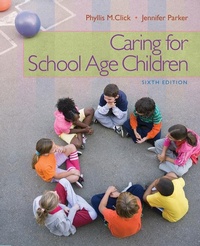
Caring for School-Age Children
6th Edition
Published on 1. January 2011
Book
Paperback/Softback
416 pages
978-1-111-29813-5 (ISBN)
Description
CARING FOR SCHOOL-AGE CHILDREN, 6th Edition, presents the most pertinent information needed by those involved in after-school programs. Current research has established the importance of quality after-school programs due to their tremendous impact on children's academic achievement, overall happiness, and self-esteem. To address this reality, the new edition presents the latest research and information on school-age child care, and offers numerous practical applications and activities that can be put to use immediately in a child care setting.
More details
Edition
6th edition
Language
English
Place of publication
Belmont, CA
United States
Publishing group
Cengage Learning, Inc
Target group
College/higher education
Product notice
Paperback (trade)
Unsewn / adhesive bound
Dimensions
Height: 251 mm
Width: 201 mm
Thickness: 20 mm
Weight
717 gr
ISBN-13
978-1-111-29813-5 (9781111298135)
Copyright in bibliographic data and cover images is held by Nielsen Book Services Limited or by the publishers or by their respective licensors: all rights reserved.
Schweitzer Classification
Persons
Phyllis Click obtained her bachelor and master's degrees from the University of California at Berkeley in psychology and child development. Throughout a long career, she worked in various settings with children and adults. She has taught in preschools, worked in summer camps, and developed and taught in a program for autistic children. She has also worked with adults, taught college students, administered grant programs, and designed a curriculum for prospective teachers for a private college. Now retired, she has been a consultant who has helped others start or administer programs, and has published widely. Her publications include another textbook, articles in professional journals, and ancillary materials for other authors? texts. She belongs to the National Association for the Education of Young Children, the California School-Age Consortium, and the Association for Childhood Education International. Jennifer Parker is currently a professor of Early Childhood Education Studies at Moorpark College, Moorpark, California. She recently was instrumental in adding a school-age component to the child development degree program. Her classes include students with diverse backgrounds and experience, ranging from entry level to those who are currently teaching in early childhood programs.
She received her Master's Degree from California State University, Northridge, and has had extensive experience working with children, families, and adults. She founded a parent-support program for infants and toddlers in a developmentally appropriate environment and has been a lead kindergarten teacher in an on-campus demonstration school. She is currently a member of an evaluation team using the School Age Environmental Rating Scale to evaluate a multi-site before-and-after school child care program.
She received her Master's Degree from California State University, Northridge, and has had extensive experience working with children, families, and adults. She founded a parent-support program for infants and toddlers in a developmentally appropriate environment and has been a lead kindergarten teacher in an on-campus demonstration school. She is currently a member of an evaluation team using the School Age Environmental Rating Scale to evaluate a multi-site before-and-after school child care program.
Content
Section I: THE PEOPLE IN CHILD CARE.
1. Caregivers: Who Are They?
2. The Children.
3. Families: Where Children Are Nurtured.
Section II: HOW CHILDREN GROW AND DEVELOP.
4. Development in Middle Childhood: Physical.
5. Development in Middle Childhood: Cognitive.
6. Development in Middle Childhood: Psychosocial and Moral.
7. Helping Children Develop Social Competence.
Section III: THE BACKGROUND.
8. Program Planning.
9. Creating an Environment.
Section IV: THE CURRICULUM.
10. Games and Other Fun Things to Do.
11. Imagination and the Arts.
12. Science and Math.
13. Helping Children Develop Literacy Competency.
14. Preparing Children for Adult Roles.
15. Getting Fit, Staying Fit.
Section V: RESOURCES AND REGULATIONS.
16. Using Community Resources.
17. Quality and Standards.
1. Caregivers: Who Are They?
2. The Children.
3. Families: Where Children Are Nurtured.
Section II: HOW CHILDREN GROW AND DEVELOP.
4. Development in Middle Childhood: Physical.
5. Development in Middle Childhood: Cognitive.
6. Development in Middle Childhood: Psychosocial and Moral.
7. Helping Children Develop Social Competence.
Section III: THE BACKGROUND.
8. Program Planning.
9. Creating an Environment.
Section IV: THE CURRICULUM.
10. Games and Other Fun Things to Do.
11. Imagination and the Arts.
12. Science and Math.
13. Helping Children Develop Literacy Competency.
14. Preparing Children for Adult Roles.
15. Getting Fit, Staying Fit.
Section V: RESOURCES AND REGULATIONS.
16. Using Community Resources.
17. Quality and Standards.