

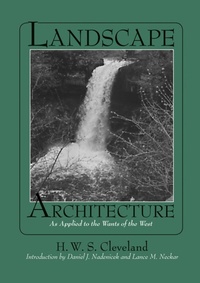
Landscape Architecture
As Applied to the Wants of the West
Published on 1. January 2002
Book
Hardback
224 pages
978-1-952620-03-4 (ISBN)
Description
H. W. S. Cleveland (1814–1900) first explored his “organic” design approach in 1855 at Sleepy Hollow Cemetery in Concord, Massachusetts, where he and Robert Morris Copeland developed a landscape aesthetic based chiefly on the writings of Ralph Waldo Emerson. Landscape Architecture, as Applied to the Wants of the West (1873) is especially significant as the first attempt to define a comprehensive scope for the new profession of landscape architecture in its formative period.
More details
Series
Language
English
Place of publication
United States
Product notice
sewn/stitched
Cloth over boards
Dimensions
Height: 180 mm
Width: 132 mm
Thickness: 18 mm
Weight
363 gr
ISBN-13
978-1-952620-03-4 (9781952620034)
Copyright in bibliographic data and cover images is held by Nielsen Book Services Limited or by the publishers or by their respective licensors: all rights reserved.
Schweitzer Classification
Persons
An important force in nineteenth-century American landscape architecture, H. W. S. Cleveland (1814–1900) has long been overshadowed by Frederick Law Olmsted, with whom he worked briefly at Prospect Park. Cleveland's “organic” design approach was first expressed in 1855 at Sleepy Hollow Cemetery in Concord, Massachusetts, where he and Robert Morris Copeland developed a landscape aesthetic based chiefly on the writings of Ralph Waldo Emerson. Landscape Architecture, as Applied to the Wants of the West, published in 1873, summarizes Cleveland's organic approach and its application at all scales of design and planning. The book is especially significant as the first attempt to define and develop a comprehensive scope for the new profession of landscape architecture in its formative period.