

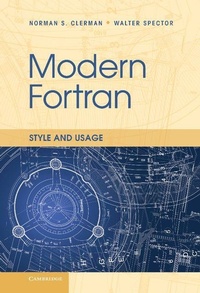
Modern Fortran
Style and Usage
Published on 12. December 2011
Book
Hardback
352 pages
978-0-521-51453-8 (ISBN)
Description
Fortran is one of the oldest high-level languages and remains the premier language for writing code for science and engineering applications. This book is for anyone who uses Fortran, from the novice learner to the advanced expert. It describes best practices for programmers, scientists, engineers, computer scientists and researchers who want to apply good style and incorporate rigorous usage in their own Fortran code or to establish guidelines for a team project. The presentation concentrates primarily on the characteristics of Fortran 2003, while also describing methods in Fortran 90/95 and valuable new features in Fortran 2008. The authors draw on more than a half century of experience writing production Fortran code to present clear succinct guidelines on formatting, naming, documenting, programming and packaging conventions and various programming paradigms such as parallel processing (including OpenMP, MPI and coarrays), OOP, generic programming and C language interoperability.
More details
Language
English
Place of publication
Cambridge
United Kingdom
Target group
Professional and scholarly
Illustrations
1 Halftones, unspecified
Dimensions
Height: 235 mm
Width: 157 mm
Thickness: 23 mm
Weight
661 gr
ISBN-13
978-0-521-51453-8 (9780521514538)
Copyright in bibliographic data and cover images is held by Nielsen Book Services Limited or by the publishers or by their respective licensors: all rights reserved.
Schweitzer Classification
Other editions
Additional editions
E-Book
02/2012
1st Edition
Cambridge University Press
€47.49
Available for download
Book
12/2011
Cambridge University Press
€71.30
Shipment within 15-20 days
E-Book
12/2011
Cambridge University Press
€40.49
Available for download
Persons
Norman S. Clerman is currently a private consultant. He was formerly the Chief Computer Scientist at Opcon Design Associates, LLC, a small company engaged in lens design. Walter Spector has been employed by Silicon Graphics International's Professional Services organization (formerly Cray Research, Inc.) since 1984.
Content
1. Introduction; 2. General principles; 3. Formatting conventions; 4. Naming conventions; 5. Documentation conventions; 6. Programming principles; 7. Programming conventions; 8. Input and output; 9. Packaging conventions; 10. Generic programming; 11. Object orientation; 12. Parallel processing; 13. Numerics and floating point; 14. C interoperability; 15. Updating old programs; Appendix A. Source code; Appendix B. Rule list.