

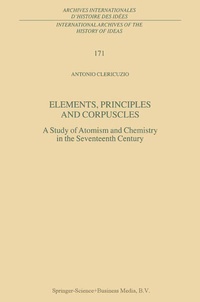
Elements, Principles and Corpuscles
A Study of Atomism and Chemistry in the Seventeenth Century
Published on 15. December 2010
Book
Paperback/Softback
XII, 232 pages
978-90-481-5640-5 (ISBN)
Description
In
Elements, Principles and Particles
, Antonio Clericuzio explores the relationships between chemistry and corpuscular philosophy in the age of the Scientific Revolution. Science historians have regarded chemistry and corpuscular philosophy as two distinct traditions. Clericuzio's view is that since the beginning of the 17th century atomism and chemistry were strictly connected. This is attested by Daniel Sennert and by many hitherto little-known French and English natural philosophers. They often combined a corpuscular theory of matter with Paracelsian chemical (and medical) doctrines. Boyle plays a central part in the present book: Clericuzio redefines Boyle's chemical views, by showing that Boyle did not subordinate chemistry to the principles of mechanical philosophy. When Boyle explained chemical phenomena, he had recourse to corpuscles endowed with chemical, not mechanical, properties. The combination of chemistry and corpuscular philosophy was adopted by a number of chemists active in the last decades of the 17th century, both in England and on the Continent.
Using a large number of primary sources, the author challenges the standard view of the corpuscular theory of matter as identical with the mechanical philosophy. He points out that different versions of the corpuscular philosophy flourished in the 17th century. Most of them were not based on the mechanical theory, i.e. on the view that matter is inert and has only mechanical properties. Throughout the 17th century, active principles, as well as chemical properties, are attributed to corpuscles. Given its broad coverage, the book is a significant contribution to both history of science and history of philosophy.
Using a large number of primary sources, the author challenges the standard view of the corpuscular theory of matter as identical with the mechanical philosophy. He points out that different versions of the corpuscular philosophy flourished in the 17th century. Most of them were not based on the mechanical theory, i.e. on the view that matter is inert and has only mechanical properties. Throughout the 17th century, active principles, as well as chemical properties, are attributed to corpuscles. Given its broad coverage, the book is a significant contribution to both history of science and history of philosophy.
Reviews / Votes
` [...] it is an important contribution to our understanding of early modern matter theory. 'Ambix 50 (2003)
More details
Series
Edition
1st ed. Softcover of orig. ed. 2001
Language
English
Place of publication
Dordrecht
Netherlands
Target group
Professional and scholarly
Research
Illustrations
XII, 232 p.
Dimensions
Height: 235 mm
Width: 155 mm
Thickness: 14 mm
Weight
382 gr
ISBN-13
978-90-481-5640-5 (9789048156405)
DOI
10.1007/978-94-015-9464-6
Schweitzer Classification
Other editions
Additional editions
Antonio Clericuzio
Elements, Principles and Corpuscles
A Study of Atomism and Chemistry in the Seventeenth Century
Book
02/2001
Kluwer Academic Publishers
€106.99
Shipment within 15-20 days
Content
1. Minima to Atoms: Sennert.- 2. Spirit, Chemical Principles and Atoms in France in the First Half of the Seventeenth Century.- 3. Chemistry and Atomism in England (1600 to 1660).- 4. Robert Boyle's Corpuscular Philosophy.- 5. Chemical Theories of Matter in England After 1661.- 6. Corpuscular Chemistry in the Last Decades of the Seventeenth Century.- Epilogue.