

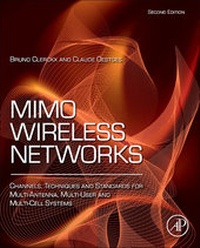
MIMO Wireless Networks
Channels, Techniques and Standards for Multi-Antenna, Multi-User and Multi-Cell Systems
2nd Edition
Published on 28. January 2013
Book
Hardback
776 pages
978-0-12-385055-3 (ISBN)
Description
This book is unique in presenting channels, techniques and standards for the next generation of MIMO wireless networks. Through a unified framework, it emphasizes how propagation mechanisms impact the system performance under realistic power constraints. Combining a solid mathematical analysis with a physical and intuitive approach to space-time signal processing, the book progressively derives innovative designs for space-time coding and precoding as well as multi-user and multi-cell techniques, taking into consideration that MIMO channels are often far from ideal.Reflecting developments since the first edition was published, this book has been thoroughly revised, and now includes new sections and five new chapters, respectively dealing with receiver design, multi-user MIMO, multi-cell MIMO, MIMO implementation in standards, and MIMO system-level evaluation.
More details
Edition
2nd edition
Language
English
Place of publication
San Diego
United States
Publishing group
Elsevier Science Publishing Co Inc
Target group
Professional and scholarly
Wireless communications R&D engineers and graduate students
Dimensions
Height: 235 mm
Width: 191 mm
Weight
1580 gr
ISBN-13
978-0-12-385055-3 (9780123850553)
Copyright in bibliographic data and cover images is held by Nielsen Book Services Limited or by the publishers or by their respective licensors: all rights reserved.
Schweitzer Classification
Other editions
Additional editions
Bruno Clerckx | Claude Oestges
Mimo Wireless Networks
Channels, Techniques and Standards for Multi-Antenna, Multi-User and Multi-Cell Systems
E-Book
01/2013
2nd Edition
Academic Press
€75.95
Available for download
Previous edition
Claude Oestges | Bruno Clerckx
MIMO Wireless Communications
From Real-World Propagation to Space-Time Code Design
Book
03/2007
Academic Press
€99.04
Article exhausted; check for reprint
Persons
Bruno Clerckx is Assistant Professor (Lecturer) at Imperial College London. He held research or visiting positions at Universite catholique de Louvain, Stanford University, EURECOM and Samsung Electronics. His research interests cover wireless communications. He is the author of books, numerous scientific papers, standard contributions (3GPPLTE/LTE-A and IEEE802.16m) and patents. Claude Oestges is Associate Professor with the Institute for Information and Communication Technologies, Electronics and Applied Mathematics (Universite catholique de Louvain). His research interests cover wireless and satellite communications, with a specific focus on channel characterization and modeling. He is the author or co-author of two books and more than 170 scientific papers in international journals and conference proceedings.
Content
Chapter 1 Introduction to multi-antenna communications Chapter 2 From Multi-Dimensional Propagation to Multi-Link MIMO ChannelsChapter 3 Analytical MIMO Channel Representations For System Design Chapter 4 Physical MIMO Channel Models For Performance Simulation Chapter 5 Capacity of single-link MIMO channels Chapter 6 Space-time coding over i.i.d. Rayleigh flat fading channelsChapter 7 MIMO Receiver Design: Detection and Channel EstimationChapter 8 Error probability in real-world MIMO channelsChapter 9 Space-time coding over real-world MIMO channels with no transmit channel knowledgeChapter 10 Space-time coding with partial transmit channel knowledgeChapter 11 Space-time coding for frequency selective channelsChapter 12 Multi-user MIMO Chapter 13 Multi-Cell MIMO Chapter 14 MIMO in LTE, LTE-Advanced and WiMAXChapter 15 MIMO-OFDMA System Level EvaluationAppendix A Useful Mathematical and Matrix PropertiesAppendix B Complex Gaussian Random variables and matricesAppendix C Antenna Coupling ModelAppendix D Derivation of the Average Pairwise Error Probability