

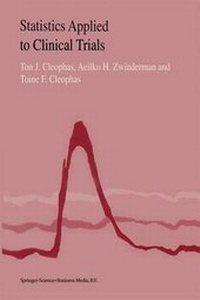
Statistics Applied to Clinical Trials
Published on 31. January 2000
Book
Paperback/Softback
112 pages
978-0-7923-6184-8 (ISBN)
Description
In 1948 the first randomized controlled trial was published by the English Medical Research Council in the British Medical Journal. Until then, observations had been uncontrolled. Initially, trials frequently did not confirm the hypotheses to be tested. This phenomenon was attributed to low sensitivity due to small samples, as well as inappropriate hypotheses based on biased prior trials. Additional flaws were recognized and, subsequently, were better accounted for: carryover effects due to insufficient washout from previous treatments, time effects due to external factors and the natural history of the condition under study, bias due to asymmetry between treatment groups, lack of sensitivity due to a negative correlation between treatment responses, and so on. Such flaws, mainly of a technical nature, have been largely corrected and led to trials after 1970 being of significantly higher quality. The past decade has focused, in addition to technical aspects, on the need for circumspection in the planning and conducting of clinical trials.
As a consequence, prior to approval, clinical trial protocols are now routinely scrutinized by different circumstantial organs, including ethics committees, institutional and federal review boards, national and international scientific organizations, and monitoring committees charged with conducting interim analyses. This book not only explains classical statistical analyses of clinical trials, but also addresses relatively novel issues, including equivalence testing, interim analyses, sequential analyses, and meta-analyses, and provides a framework of the best statistical methods currently available for such purposes. This text should be useful for investigators involved in the field of clinical trials and physicians who wish to better understand the data of trials as currently published.
As a consequence, prior to approval, clinical trial protocols are now routinely scrutinized by different circumstantial organs, including ethics committees, institutional and federal review boards, national and international scientific organizations, and monitoring committees charged with conducting interim analyses. This book not only explains classical statistical analyses of clinical trials, but also addresses relatively novel issues, including equivalence testing, interim analyses, sequential analyses, and meta-analyses, and provides a framework of the best statistical methods currently available for such purposes. This text should be useful for investigators involved in the field of clinical trials and physicians who wish to better understand the data of trials as currently published.
More details
Language
English
Place of publication
United States
Target group
College/higher education
Professional and scholarly
Illustrations
Illustrations
Dimensions
Height: 230 mm
ISBN-13
978-0-7923-6184-8 (9780792361848)
Copyright in bibliographic data and cover images is held by Nielsen Book Services Limited or by the publishers or by their respective licensors: all rights reserved.
Schweitzer Classification
Other editions
New editions
Ton J. Cleophas | etc.
Statistics Applied to Clinical Trials
Book
03/2002
2nd Edition
Kluwer Academic Publishers
€85.55
Article exhausted; check for reprint
Additional editions
Ton J. Cleophas | A.H. Zwinderman
Statistics Applied to Clinical Trials
E-Book
11/2013
1st Edition
Springer
€85.59
Available for download
Persons
Content
Preface. Foreword. 1. Hypotheses, Data, Stratification. 2. The Analysis of Efficacy Data of Drug trials. 3. The Analysis of Safety Data of Drug Trials. 4. Equivalence Testing. 5. Statistical Power and Sample Size. 6. Interim Analyses. 7. Multiple Statistical Inferences. 8. Subgroup Analysis Using Multiple Linear Regression: Confounding, Interaction, Synergism. 9. Meta-Analysis. 10. Capitum Selectum, Crossover Studies with Continuous Variables: Power Analysis. 11. Capitum Selectum: Post-Hoc Analysis in Clinical Trials, A Case For Logistic Regression Analysis. Appendix.