

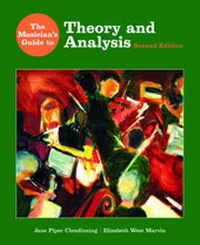
The Musician's Guide to Theory and Analysis
2nd Edition
Published on 1. March 2011
Book
Hardback
992 pages
978-0-393-93081-8 (ISBN)
Description
Theoretically current and pedagogically innovative, the Musician's Guide series uses the phrase model approach to show students how music works in context. With a focus on real music literature that students know and play, it shows how music theory relates directly to practice and performance. The Musician's Guide to Theory and Analysis includes all topics essential to first- and second-year theory for music majors, from fundamentals to post-tonal theory and analysis.
More details
Series
Edition
Second Edition
Language
English
Place of publication
New York
United States
Target group
Professional and scholarly
Edition type
Revised edition
Dimensions
Height: 244 mm
Width: 198 mm
Thickness: 43 mm
Weight
1591 gr
ISBN-13
978-0-393-93081-8 (9780393930818)
Copyright in bibliographic data and cover images is held by Nielsen Book Services Limited or by the publishers or by their respective licensors: all rights reserved.
Schweitzer Classification
Other editions
New editions
Jane Piper Clendinning | Elizabeth West Marvin
The Musician's Guide to Theory and Analysis
Book
08/2016
3rd Edition
WW Norton & Co
€178.27
Article exhausted; check for reprint
Previous edition
Jane Piper Clendinning | Elizabeth West Marvin
The Musician's Guide to Theory and Analysis
Book
08/2004
WW Norton & Co
€49.71
Article exhausted; check for reprint
Persons
Jane Piper Clendinning is professor of music theory at the Florida State University College of Music. She has published articles reflecting her interests in the history of theory, theory and analysis of twentieth-century music, computer pitch recognition, and computer applications in music. Her current research interests include theory and analysis of popular and world musics. She has served as the chair of the Advanced Placement Music Theory Test Development Committee and as an AP reader, and is a regular consultant at AP workshops and summer Institutes. Elizabeth West Marvin is Minehan Professor Emerita of Music Theory and former dean of academic affairs at the Eastman School of Music. She has published in the areas of music cognition, music theory pedagogy, theory and analysis of atonal music, contour theory, history of theory, and analysis and performance. She is past president of the Society for Music Theory and past co-chair of the Advanced Placement Music Theory Test Development Committee. Marvin is the 2012 recipient of the Gail Boyd de Stwolinski Prize for Lifetime Achievement in Music Theory Teaching and Scholarship.
Content
INTRODUCTION: Why Study Music Theory?
PART I: ELEMENTS OF MUSIC
Ch. 1 - Pitch and Pitch Class
Ch. 2 - Simple Meters
Ch. 3 - Pitch Collections, Scales, and Major Keys
Ch. 4 - Compound Meters
Ch. 5 - Minor Keys and the Diatonic Modes
Ch. 6 - Intervals
Ch. 7 - Triads
Ch. 8 - Seventh Chords
Ch. 9 - Connecting Intervals in Note-to-Note Counterpoint
Ch. 10 - Melodic and Rhythmic Embellishment in Two-Voice
Counterpoint
PART II: DIATONIC HARMONY AND TONICIZATION
Ch. 11 - Soprano and Bass Lines in Eighteenth-Century Style
Ch. 12 - The Basic Phrase in SATB Style
Ch. 13 - Dominant Sevenths, the Predominant Area, and Chorale
Harmonization
Ch. 14 - Expanding the Tonic and Dominant Areas
Ch. 15 - Diatonic Harmonies and Root Progressions
Ch. 16 - Embellishing Tones in Four Voices
Ch. 17 - The vii??, vii??,
vii??, and Other Voice-Leading Chords
Ch. 18 - Phrase Structure and Motivic Analysis
Ch. 19 - Diatonic Sequences
Ch. 20 - Secondary Dominants and Leading-Tone Chords to V
Ch. 21 - Tonicizing Scale Degrees Other Than V
PART III: CHROMATIC HARMONY AND FORM
Ch. 22 - Modulation to Closely Related Keys
Ch. 23 - Binary and Ternary Forms
Ch. 24 - Invention, Fugue, and Other Contrapuntal Genres
Ch. 25 - Modal Mixture
Ch. 26 - The Neapolitan Sixth and Augmented-Sixth Chords
Ch. 27 - Vocal Forms
Ch. 28 - Popular Music
Ch. 29 - Chromatic Harmony and Voice-Leading
Ch. 30 - Chromatic Modulation
Ch. 31 - Variation and Rondo
Ch. 32 - Sonata and Related Forms
PART IV: THE TWENTIETH CENTURY AND BEYOND
Ch. 33 - Modes, Scales, and Sets
Ch. 34 - Music Analysis with Sets
Ch. 35 - Sets and Set Classes
Ch. 36 - Ordered Segments and Serialism
Ch. 37 - Twelve-Tone Rows and the Row Matrix
Ch. 38 - Rhythm, Meter, and Duration
Ch. 39 - Musical Form
Ch. 40 - The Composer's Materials Today
Appendix 1 - Try it answers
Appendix 2 - Glossary
Appendix 3 - Summary of Part-Writing Key Concepts
Appendix 4 - Selected Instrumental Ranges
Appendix 5 - Set Class Table
PART I: ELEMENTS OF MUSIC
Ch. 1 - Pitch and Pitch Class
Ch. 2 - Simple Meters
Ch. 3 - Pitch Collections, Scales, and Major Keys
Ch. 4 - Compound Meters
Ch. 5 - Minor Keys and the Diatonic Modes
Ch. 6 - Intervals
Ch. 7 - Triads
Ch. 8 - Seventh Chords
Ch. 9 - Connecting Intervals in Note-to-Note Counterpoint
Ch. 10 - Melodic and Rhythmic Embellishment in Two-Voice
Counterpoint
PART II: DIATONIC HARMONY AND TONICIZATION
Ch. 11 - Soprano and Bass Lines in Eighteenth-Century Style
Ch. 12 - The Basic Phrase in SATB Style
Ch. 13 - Dominant Sevenths, the Predominant Area, and Chorale
Harmonization
Ch. 14 - Expanding the Tonic and Dominant Areas
Ch. 15 - Diatonic Harmonies and Root Progressions
Ch. 16 - Embellishing Tones in Four Voices
Ch. 17 - The vii??, vii??,
vii??, and Other Voice-Leading Chords
Ch. 18 - Phrase Structure and Motivic Analysis
Ch. 19 - Diatonic Sequences
Ch. 20 - Secondary Dominants and Leading-Tone Chords to V
Ch. 21 - Tonicizing Scale Degrees Other Than V
PART III: CHROMATIC HARMONY AND FORM
Ch. 22 - Modulation to Closely Related Keys
Ch. 23 - Binary and Ternary Forms
Ch. 24 - Invention, Fugue, and Other Contrapuntal Genres
Ch. 25 - Modal Mixture
Ch. 26 - The Neapolitan Sixth and Augmented-Sixth Chords
Ch. 27 - Vocal Forms
Ch. 28 - Popular Music
Ch. 29 - Chromatic Harmony and Voice-Leading
Ch. 30 - Chromatic Modulation
Ch. 31 - Variation and Rondo
Ch. 32 - Sonata and Related Forms
PART IV: THE TWENTIETH CENTURY AND BEYOND
Ch. 33 - Modes, Scales, and Sets
Ch. 34 - Music Analysis with Sets
Ch. 35 - Sets and Set Classes
Ch. 36 - Ordered Segments and Serialism
Ch. 37 - Twelve-Tone Rows and the Row Matrix
Ch. 38 - Rhythm, Meter, and Duration
Ch. 39 - Musical Form
Ch. 40 - The Composer's Materials Today
Appendix 1 - Try it answers
Appendix 2 - Glossary
Appendix 3 - Summary of Part-Writing Key Concepts
Appendix 4 - Selected Instrumental Ranges
Appendix 5 - Set Class Table