

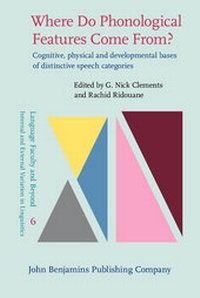
Where Do Phonological Features Come From?
Cognitive, physical and developmental bases of distinctive speech categories
Published on 28. July 2011
Book
Hardback
347 pages
978-90-272-0823-1 (ISBN)
Description
This volume offers a timely reconsideration of the function, content, and origin of phonological features, in a set of papers that is theoretically diverse yet thematically strongly coherent. Most of the papers were originally presented at the International Conference "Where Do Features Come From?" held at the Sorbonne University, Paris, October 4-5, 2007. Several invited papers are included as well. The articles discuss issues concerning the mental status of distinctive features, their role in speech production and perception, the relation they bear to measurable physical properties in the articulatory and acoustic/auditory domains, and their role in language development. Multiple disciplinary perspectives are explored, including those of general linguistics, phonetic and speech sciences, and language acquisition. The larger goal was to address current issues in feature theory and to take a step towards synthesizing recent advances in order to present a current "state of the art" of the field.
More details
Series
Language
English
Place of publication
Amsterdam
Netherlands
Target group
Professional and scholarly
Illustrations
+ index
Dimensions
Height: 245 mm
Width: 164 mm
Weight
810 gr
ISBN-13
978-90-272-0823-1 (9789027208231)
Copyright in bibliographic data and cover images is held by Nielsen Book Services Limited or by the publishers or by their respective licensors: all rights reserved.
Schweitzer Classification
Other editions
Additional editions
G. Nick Clements | Rachid Ridouane
Where Do Phonological Features Come From?
Cognitive, physical and developmental bases of distinctive speech categories
E-Book
07/2011
1st Edition
John Benjamins Publishing Company
€130.99
Available for download
Persons
Content
1. Table of contents; 2. Obituary (by Clements, G. Nick); 3. List of contributors; 4. Editors' overview (by Ridouane, Rachid); 5. Features, segments, and the sources of phonological primitives (by Cohn, Abigail C.); 6. Feature economy in natural, random, and synthetic inventories (by Mackie, Scott); 7. Sound systems are shaped by their users: The recombination of phonetic substance (by Lindblom, Bjorn); 8. What features underline the /s/ vs. /s'/ contrast in Korean?: Phonetic and phonological evidence (by Kim, Hyunsoon); 9. Automaticity vs. feature-enhancement in the control of segmental F0 (by Hoole, Philip); 10. Categorization and features: Evidence from American English /r/ (by Archangeli, Diana); 11. Features as an emergent product of computing perceptual cues relative to expectations (by McMurray, Bob); 12. Features are phonological transforms of natural boundaries (by Serniclaes, Willy); 13. Features in child phonology: Inherent, emergent, or artefacts of analysis? (by Menn, Lise); 14. Phonological features in infancy (by Cristia, Alejandrina); 15. Acoustic cues to stop-coda voicing contrasts in the speech of 2-3-year-olds learning American English (by Shattuck-Hufnagel, Stefanie); 16. Language index; 17. Subject index