

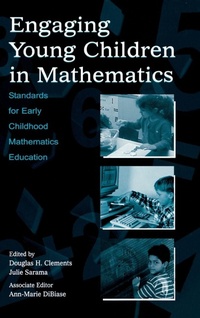
Engaging Young Children in Mathematics
Standards for Early Childhood Mathematics Education
Published on 1. July 2003
Book
Hardback
490 pages
978-0-8058-4210-4 (ISBN)
Description
This book consists of conclusions drawn from the expertise shared at the Conference on Standards for Prekindergarten and Kindergarten Mathematics Education. It offers substantive detail regarding young students' understandings of mathematical ideas.
More details
Series
Language
English
Place of publication
New York
United States
Publishing group
Taylor & Francis Inc
Target group
Professional and scholarly
Dimensions
Height: 235 mm
Width: 157 mm
Thickness: 33 mm
Weight
943 gr
ISBN-13
978-0-8058-4210-4 (9780805842104)
Copyright in bibliographic data and cover images is held by Nielsen Book Services Limited or by the publishers or by their respective licensors: all rights reserved.
Schweitzer Classification
Other editions
Additional editions
Douglas H. Clements | Julie Sarama | Associate Edito DiBiase
Engaging Young Children in Mathematics
Standards for Early Childhood Mathematics Education
E-Book
10/2003
1st Edition
Routledge
€101.99
Available for download
Douglas H. Clements | Julie Sarama | Associate Edito DiBiase
Engaging Young Children in Mathematics
Standards for Early Childhood Mathematics Education
E-Book
10/2003
1st Edition
Routledge
€101.99
Available for download
Douglas H. Clements | Julie Sarama | Associate Edito DiBiase
Engaging Young Children in Mathematics
Standards for Early Childhood Mathematics Education
Book
07/2003
Routledge
€110.60
Shipment within 10-20 days
Persons
Clements, Douglas H.; Sarama, Julie; DiBiase, Associate Edito; DiBiase, Ann-Marie
Content
Part I: Major Themes and Recommendations 1. Major Themes and Recommendations Part II: Elaboration of Major Themes and Recommendations Section 1: Standards in Early Childhood Education 2. Standards for Preschool and Kindergarten Mathematics Education 3. Mathematics Curriculum in the Early Childhood Context Section 2: Math Standards and Guidelines 4. What is Developmentally Appropriate in Early Childhood Mathematics Education? Lessons from New Research 5. Pre-K to Grade 2 Goals and Standards: Achieving 21st-Century Mastery for All 6. The Role of Psychological Research in the Development of Early Childhood Mathematics Standards 7. The Developmental Bases for Early Childhood Number and Operations Standards 8. PSSM from a Constructivist Perspective 9. A Prospective Developmental Perspective on Early Mathematics Instruction 10. Geometric and Spatial Thinking in Early Childhood Education 11. Measurement in Pre-K to Grade 2 Mathematics Section 3: Curriculum, Learning, Teaching, and Assessment 12. Making Sense 13. Number Worlds: A Research-Based Mathematics Program for Young Children 14. Fostering Preschool Children's Mathematical Knowledge: Findings From the Berkeley Math Readiness Project 15. Technology in Early Childhood Mathematics: Building Blocks as an Innovative Technology-Based Curriculum 16. Mathematics Problem-Solving Adventures: A Language-Arts-Based Supplementary Series for Early Childhood That Focuses on Spatial Sense Section 4: Professional Development 17. Early Childhood Mathematics Instruction: Seeing the Opportunities among the Challenges 18. The Early Childhood Collaborative: A Professional Development Model to Communicate and Implement the Standards 19. The Professional Development Challenge in Preschool Mathematics Section 5: Toward the Future: Implementation and Policy 20. Mathematics Guidelines for Preschool