

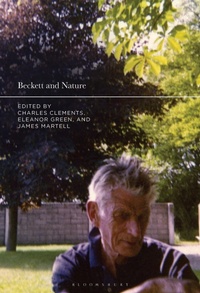
Beckett and Nature
Published on 7. August 2025
Book
Hardback
288 pages
979-8-7651-2541-0 (ISBN)
Description
New analyses on the insightful ways in which Beckett's work actively engages with contested notions of Nature and the natural, developing a radical version of modernism's main questions and insights.
Beckett and Nature takes its cue from contemporary developments in Beckett scholarship focused on ecocriticism, posthumanism, and the Anthropocene, going beyond them into a questioning of the very concepts of "Nature" and "the natural." It examines one of the most unthought ontological dimensions of literature and life: that symbolic space, deemed natural or part of Nature, appears necessary and undeniable and, therefore, impossible to be deconstructed. In doing so, the authors show that, in fact, this space takes on many shapes, recognizing three "natural" dimensions criticized by Beckett: bodies, worlds, and literatures.
Featuring a wide range of both Beckett's work and Beckett scholars - including Jean-Michel Rabate and Stanley E. Gontarski - Beckett and Nature offers contextualized readings of the understandings of nature and the natural throughout his decade-spanning oeuvre. The volume shows that part of the radicality of Beckett's writing is that - through a variety of evolving techniques and strategies - it questions what appears in our cultures as the most unquestionable and opens up possibilities for thinking not only what is human, literature, and philosophy, but also gender, identity, and any attempt at definitions of ourselves or the world at large.
Beckett and Nature takes its cue from contemporary developments in Beckett scholarship focused on ecocriticism, posthumanism, and the Anthropocene, going beyond them into a questioning of the very concepts of "Nature" and "the natural." It examines one of the most unthought ontological dimensions of literature and life: that symbolic space, deemed natural or part of Nature, appears necessary and undeniable and, therefore, impossible to be deconstructed. In doing so, the authors show that, in fact, this space takes on many shapes, recognizing three "natural" dimensions criticized by Beckett: bodies, worlds, and literatures.
Featuring a wide range of both Beckett's work and Beckett scholars - including Jean-Michel Rabate and Stanley E. Gontarski - Beckett and Nature offers contextualized readings of the understandings of nature and the natural throughout his decade-spanning oeuvre. The volume shows that part of the radicality of Beckett's writing is that - through a variety of evolving techniques and strategies - it questions what appears in our cultures as the most unquestionable and opens up possibilities for thinking not only what is human, literature, and philosophy, but also gender, identity, and any attempt at definitions of ourselves or the world at large.
Reviews / Votes
We find in Beckett and Nature an incongruous and yet generative pairing yielding rich reflections on ecologies of world, body, and thought. More often than not, the discussion of Beckett's nature(s) creates what the introduction calls a 'productive impasse'-deftly illustrating the writer's playful, ambivalent, and incisive engagement with taxonomies of the human and more-than-human. A fascinating and timely work. * Elizabeth Barry, Professor of Modern Literature, University of Warwick, UK, and President of The Samuel Beckett Society * These essays will take you to a Pakistani revision of Godot, to the Pirana Landfill, to the landscapes of Martin McDonagh. Reading Beckett and Nature caused me to survey my surroundings and to question what is right outside my window. This is a volume that can alter your mood and prompt you to reassess the world around you. * Paul Shields, Associate Professor of English, Assumption University, USA *More details
Language
English
Place of publication
New York
United States
Publishing group
Bloomsbury Publishing Plc
Target group
College/higher education
Professional and scholarly
Illustrations
3 b&w illustrations
Dimensions
Height: 235 mm
Width: 157 mm
Thickness: 20 mm
Weight
566 gr
ISBN-13
979-8-7651-2541-0 (9798765125410)
Copyright in bibliographic data and cover images is held by Nielsen Book Services Limited or by the publishers or by their respective licensors: all rights reserved.
Schweitzer Classification
Other editions
Additional editions
Charles Clements | Eleanor Green | James Martell
Beckett and Nature
E-Book
07/2025
Bloomsbury Academic
€98.99
Available for download
Charles Clements | Eleanor Green | James Martell
Beckett and Nature
E-Book
07/2025
1st Edition
Bloomsbury Academic USA
€98.99
Available for download
Persons
Charles Clements is a Ph.D. candidate in English Literature at Tufts University, USA. His research focuses on the metaphysical assumptions of 20th-century Irish and British fiction with a particular emphasis on issues of representation and non-knowledge.
Eleanor Green works at the University of Manchester, UK. They are also Co-Ordinator for the Beyond Radical Network, a queer studies research network in the UK. They have presented at national and international conferences and their reviews and interviews can be found at the Beckett Circle and Review 31.
James Martell is Associate Professor of French at Lyon College, USA. His publications include Beckett and Derrida (forthcoming), Modernism, Self-Creation, and the Maternal: The Mother's Son (2019), Samuel Beckett and the Encounter of Philosophy and Literature (2013; with Arka Chattopadhyay), and Tattooed Bodies: Theorizing Body Inscription Across Disciplines and Cultures (2021; with Erik Larsen). He is the volume editor of Understanding Sade, Understanding Modernism (Bloomsbury, 2025).
Eleanor Green works at the University of Manchester, UK. They are also Co-Ordinator for the Beyond Radical Network, a queer studies research network in the UK. They have presented at national and international conferences and their reviews and interviews can be found at the Beckett Circle and Review 31.
James Martell is Associate Professor of French at Lyon College, USA. His publications include Beckett and Derrida (forthcoming), Modernism, Self-Creation, and the Maternal: The Mother's Son (2019), Samuel Beckett and the Encounter of Philosophy and Literature (2013; with Arka Chattopadhyay), and Tattooed Bodies: Theorizing Body Inscription Across Disciplines and Cultures (2021; with Erik Larsen). He is the volume editor of Understanding Sade, Understanding Modernism (Bloomsbury, 2025).
Content
List of FIgures
Acknowledgements
Introduction (Charles Clements, Tufts University, USA, Eleanor Green, University of Manchester, UK, and James Martell, Lyon College, USA)
Part I. Natural Bodies
1. Mother Remains: Beckett's autour Function and the Ecological (Jonathan Basile, University of British Columbia, Canada)
2. Nonrelational Literature and Immanent Metaphysics: What Spinoza's Nature Has to Say About Beckett's Form (Charles Clements, Tufts University, USA)
3. "For the space of an instant": Beckett on the Subject of Thought (Bryan Counter, Framingham State University, USA)
4. Enough Is Too Much: Reading Gender through Flowers in Beckett (Eleanor Green, University of Manchester, UK)
5. Clinical Olfactory Environment Shapes Care Relationships in Samuel Beckett's Murphy and Sam Thompson's Jott. (Swati Joshi, Independent Researcher, India)
Part II. Natural Worlds
6. Breathing Human within Breathless Nature: Waiting for Godot in Pakistan (Saeed Muhammad Nasir, Emerson University Multan, Pakistan)
7. Samuel Beckett's Neo-Biomorphic Playlet Breath (1969) Sets the Stage for the Pirana (Swati Joshi, Independent Researcher, India)
8. Foreseeing and Foresaying the Buddhist Unborn beyond Birth and Death in Beckett's Ill Seen Ill Said (Asijit Datta, Symbiosis Centre for Media and Communication, Symbiosis International (Deemed University), India)
9. Adorno's Dialectic of Natural Beauty and Beckett's Not I (Justin Neville Kaushall, Independent Scholar, UK)
10. The Inanimate Agency: An Object-Oriented Ontological Reading of Beckett's Endgame and Its Anti-Anthropocentric Implications (Mehmet Zeki Giritli, Koc University, Turkey)
Part III. Natural Literatures
11. Beckett's Foiled Mimesis is/in Nature (James Martell, Lyon College, USA)
12. Beckett and the Scream of Nature (Jean-Michel Rabate, University of Pennsylvania, USA)
13. "Everything oozes": On Mud and Molebane in Beckett's Dystopian Landscapes (Stanley E. Gontarski, Florida State University, USA)
14. Denaturing and Renaturing: Samuel Beckett's Reception in Martin McDonagh's Cinema (Jack Dudley, Mount St. Mary's University, USA)
Notes on Contributors
Index
Acknowledgements
Introduction (Charles Clements, Tufts University, USA, Eleanor Green, University of Manchester, UK, and James Martell, Lyon College, USA)
Part I. Natural Bodies
1. Mother Remains: Beckett's autour Function and the Ecological (Jonathan Basile, University of British Columbia, Canada)
2. Nonrelational Literature and Immanent Metaphysics: What Spinoza's Nature Has to Say About Beckett's Form (Charles Clements, Tufts University, USA)
3. "For the space of an instant": Beckett on the Subject of Thought (Bryan Counter, Framingham State University, USA)
4. Enough Is Too Much: Reading Gender through Flowers in Beckett (Eleanor Green, University of Manchester, UK)
5. Clinical Olfactory Environment Shapes Care Relationships in Samuel Beckett's Murphy and Sam Thompson's Jott. (Swati Joshi, Independent Researcher, India)
Part II. Natural Worlds
6. Breathing Human within Breathless Nature: Waiting for Godot in Pakistan (Saeed Muhammad Nasir, Emerson University Multan, Pakistan)
7. Samuel Beckett's Neo-Biomorphic Playlet Breath (1969) Sets the Stage for the Pirana (Swati Joshi, Independent Researcher, India)
8. Foreseeing and Foresaying the Buddhist Unborn beyond Birth and Death in Beckett's Ill Seen Ill Said (Asijit Datta, Symbiosis Centre for Media and Communication, Symbiosis International (Deemed University), India)
9. Adorno's Dialectic of Natural Beauty and Beckett's Not I (Justin Neville Kaushall, Independent Scholar, UK)
10. The Inanimate Agency: An Object-Oriented Ontological Reading of Beckett's Endgame and Its Anti-Anthropocentric Implications (Mehmet Zeki Giritli, Koc University, Turkey)
Part III. Natural Literatures
11. Beckett's Foiled Mimesis is/in Nature (James Martell, Lyon College, USA)
12. Beckett and the Scream of Nature (Jean-Michel Rabate, University of Pennsylvania, USA)
13. "Everything oozes": On Mud and Molebane in Beckett's Dystopian Landscapes (Stanley E. Gontarski, Florida State University, USA)
14. Denaturing and Renaturing: Samuel Beckett's Reception in Martin McDonagh's Cinema (Jack Dudley, Mount St. Mary's University, USA)
Notes on Contributors
Index