

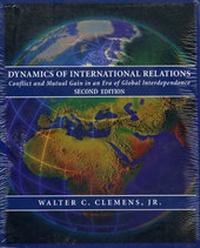
Dynamics of International Relations
Conflict and Mutual Gain in an Era of Global Interdependence
2nd Edition
Published on 16. February 2004
Book
Paperback/Softback
672 pages
978-0-7425-3011-9 (ISBN)
Description
Student-friendly and professor-endorsed, Dynamics of International Relations is an innovative, introductory level core text. It compares realist and idealist theories and the paradigm of interdependence against case studies of recurrent problems-why wage war, how to make peace, how to transcend conflict, when and where to mediate, how to increase GDP but also quality of life, and how to organize for peace and promote human rights. Against a backdrop of the threat of terrorism, Clemens clearly demonstrates both the danger and opportunities inherent in a growing global interdependence.
Reviews / Votes
This text is original, lively, and engaging. Students should benefit from adopting the policy frame of mind that each of the chapters develops. -- Michael W. Doyle, Princeton University Dynamics of International Relations is a text that is sure to engage introductory students of international relations. It presents the major approaches and concepts of the discipline in an accessible way by integrating them with real world events grounded in a historical perspective. I particularly like the problem-solving approach, which engages students in solving policy issues through the presentation of different courses of action from mutual gain to power politics. It also offers coverage of some of the new issues in international politics such as nationalism, ethnic wars, human rights, gender, and development, issues which are frequently omitted in the discipline of international relations. -- J. Ann Tickner, American University One of the best books that I have ever read, suitable for beginners in Introduction to International Relations and advanced courses as well. The ample simulation role-playing exercises are excellent. Even foreign students for whom English is not their native language can easily comprehend this book. -- Ephraim Kahana, Western Galilee College Superb-well structured, clearly written, lively, and analytical. -- Alvin Z. Rubinstein, University of Pennsylvania Dynamics of International Relations is a major work. It contains and distills much of the current discussions regarding international affairs, and students will find it of great help in organizing their thoughts. -- Zbigniew Brzezinski, "Compelling, readable, and very moving!" I have seen scores of texts, and many of them suffer from lack of focus, excessive but not articulated normative commitments, and inadequate research into the relevant literature. The Clemens text has a consistent theoretical and ethical perspective explicitly stated, the thoroughness of his research is impressive, and the whole thing is beautifully written. Even the sidebars are useful. -- J David Singer, University of Michigan The coverage of ecopolitics is outstanding in its capacity to provide a thorough, objective, and thoughtful overview of the challenges of global environmental management as they are experienced by both developed and developing nations. -- Maria Guadalupe Rodrigues, Tufts University The role-playing exercise that allows the reader to play the role of advisor to principal international relations actors adds a refreshing new dimension to the topical coverage and organization. Case studies of major events help the reader understand how rapid changes unleashed in the post-WW II period pose an enormous challenge to scholars and policymakers alike. . . . Includes excellent source notes that facilitate the book's accessibility. -- Richard Frese, Bentley College Reads quickly, smoothly, and absorbingly, and should be readily accessible to students . . . In a field with a plethora of introductory IR texts, this one is distinguished by its clear focus on fashioning workable compromises between realism and idealism in the post-Cold War environment; deep historical roots; and wide-ranging, relevant, and well-researched cases. -- William H Baugh, University of Oregon The author awakes the reader's motivation to examine the practical and applicability of theory, especially by presenting issues in the international community affecting each individual. What emerges throughout the whole book and definitely constitutes its value-added, is the author's imperceptible aim to mobilize the reader's responsible thinking about the world as an interdependent community. * Journal of International Relations and Development *More details
Edition
Second Edition
Language
English
Place of publication
United States
Publishing group
Bloomsbury Publishing Plc
Target group
College/higher education
Dimensions
Height: 248 mm
Width: 187 mm
Thickness: 33 mm
Weight
1665 gr
ISBN-13
978-0-7425-3011-9 (9780742530119)
Copyright in bibliographic data and cover images is held by Nielsen Book Services Limited or by the publishers or by their respective licensors: all rights reserved.
Schweitzer Classification
Person
Walter C. Clemens, Jr. is professor of political science at Boston University and an associate at Harvard University's Davis Center for Russian and Eurasian Studies. He is the author or coauthor of more than a dozen books, including America and the World, The Baltic Transformed, Can Russia Change?, Superpowers and Arms Control, World Perspectives on International Politics, and Toward a Strategy of Peace.
Content
Part 1 I Hard Realties, High Ideals, and Global Interdependence Chapter 2 Is IR "Winner-Take-All"? Can It Be Mutual Gain? Chapter 3 How to Win at Peace: Creating New World Orders Chapter 4 Foreign Policy Decision Making: Do Individuals Count? Chapter 5 Why Wage War? Does It Pay to Fight? Chapter 6 Power and Influence: What Wins? Part 7 II From Anarchy, Order? Chapter 8 Arms and Arms Control: Can Swords Become Plowshares? Chapter 9 Negotiating Conflict: How Can Foes Become Partners? Chapter 10 What Unites and Divides Humanity? Nationalism and Faith Chapter 11 Intervention and Mediation: HowCan Outsiders Help? Part 12 III International Political Economy Chapter 13 Democracy and Authoritarianism: What Impact on International Peace and Prosperity? Chapter 14 The Wealth of Nations: Top Down or Bottom Up? Chapter 15 Challenges of Development: South Meets North Part 16 IV Building a Better World Chapter 17 Ecopolitics: The Health of Nations Chapter 18 Organizing for Mutual Gain: The United Nations, Europe, and Nonstate Actors Chapter 19 International Law and Human Rights: Sham or Revolution? Chapter 20 Alternative Futures: Lessons from the Past