

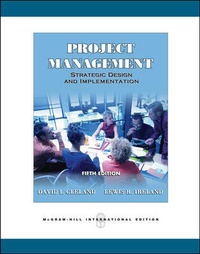
Project Management
5th Edition
Will be published approx. on 16. June 2007
Book
Paperback/Softback
978-0-07-126237-8 (ISBN)
Description
The theme of the last edition will continue as authors improve individual chapters by adding a brief introduction that outlines the central points of the chapter and warms up readers for what follows. Each chapter concludes with four additional sections: a listing of additional sources of information in the form of a generously annotated bibliography; a listing of project management principles that summarize chapter content in pithy statements of enduring, universal value; a project management situation--a brief, descriptive case study that illuminates chapter content by way of a practical example; and a student/reader assignment that offers food for thought, discussion, or investigation. More student problems are added in this edition along with new chapters throughout and up-dated chapters where change is warranted. Graphics and illustrations updated with side bar information included throughout and the book with have a new look in a larger 7 3/8 x 9 A trim.
More details
Edition
5th edition
Language
English
Place of publication
United States
Publishing group
McGraw-Hill Education - Europe
Target group
College/higher education
Professional and scholarly
Dimensions
Height: 236 mm
Width: 187 mm
Thickness: 20 mm
Weight
812 gr
ISBN-13
978-0-07-126237-8 (9780071262378)
Schweitzer Classification
Persons
1983 No Address/Systems Analysis and Project Management
Content
PREFACEACKNOWLEDGMENTSINTRODUCTIONPart 1: IntroductionChapter 1: The Evolution of Project ManagementChapter 2: Why Project Management?Chapter 3: The Project Management ProcessPart 2: The Strategic Context of ProjectsChapter 4: When to Use Project ManagementChapter 5: The Strategic Context of ProjectsChapter 6: The Board of Directors and Major ProjectsChapter 7: Project Stakeholder ManagementChapter 8: Strategic Issues in Project ManagementPart 3: Organizational Design for Project ManagementChapter 9: Organizing for Project Management Chapter 10: Project Portfolio ManagementChapter 11: Project AuthorityChapter 12: Project Management MaturityPart 4: Project OperationsChapter 13: Project PlanningChapter 14: Project Management Information SystemChapter 15: Project Monitoring. Evaluation, and ControlChapter 16: The Project Earned Value Management SystemChapter 17: Project TerminationPart 5: Interpersonal Dynamics in the Management of ProjectsChapter 18: Project LeadershipChapter 19: Project CommunicationsChapter 20: Successful Project TeamsPart 6: The Cultural ElementsChapter 21: Continuous Improvement Through ProjectsChapter 22: Cultural Considerations in Project ManagementPart 7: New ProspectsChapter 23: Alternative Project TeamsINDEX