

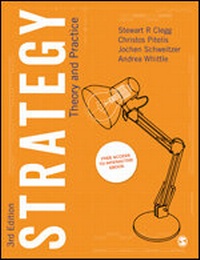
Strategy
Theory and Practice
3rd Edition
Published on 25. November 2019
Book
Hardback
744 pages
978-1-5264-7878-8 (ISBN)
Description
Providing a fresh perspective on strategy from an organizational perspective through a discursive approach featuring key theoretic tenets, this text is also pragmatic and emphasizes the practices of strategy to encourage the reader to be open to a wider set of ideas, with a little more relevance, and with a cooler attitude towards the affordances of the digital world and the possibilities for strategy's futures.
The key areas of Strategy take a critical stance in the new edition, and also include areas less evident in conventional strategy texts such as not-for-profit organizations, process theories, globalization, organizational politics and decision-making as well as the futures of strategy.
The key areas of Strategy take a critical stance in the new edition, and also include areas less evident in conventional strategy texts such as not-for-profit organizations, process theories, globalization, organizational politics and decision-making as well as the futures of strategy.
Reviews / Votes
"Once again, Clegg, Pitelis, Schweitzer and Whittle provide an exciting and accessible introduction to business strategy that will engage students and provide them with a relevant and insightful understanding of a key topic." -- Thomas B. Lawrence "Strategy: Theory and Practice speaks to me. The book offers an insightful introduction to the key theories and topics of strategic management. Unlike most other textbooks, it is written from a critical perspective, which is very much needed in today's world of grand challenges and wicked problems." -- Eero Vaara "This updated and extended third edition of Strategy: Theory and Practice is an excellent textbook that manages to translate the latest strategy knowledge into a form and language that is accessible to students and practitioners alike. A refreshing alternative to the traditional, economics-based strategy textbook!" -- Professor David Seidl "This book is a detailed compendium of ideas in the field of strategy, including especially criticisms of core constructs and theoretical linkages. Full of examples, questions, and study guidance, it deals with the challenges of setting strategies for non-profit organizations and governments as well as for private-sector actors. Students and practitioners interested in the theory and practice of strategy will find this book to be a great resource." -- Professor Anita M. McGahan This book offers all the basics that business students need to know about the economic and organizational sides of strategy in an appealing easy-to-read format complete with exercises, and mini-cases while stepping outside the run of the mill by provoking critical reflection on established ideas and placing the tools and concepts in perspective. The chapters on the politics, processes and practices of strategy are particularly valuable.We need more textbooks like this to ensure that future generations of managers become informed yet reflexive consumers of strategic management knowledge and ideas. -- Ann Langley
More details
Edition
3rd Revised edition
Language
English
Place of publication
London
United Kingdom
Target group
College/higher education
Edition type
Revised edition
Dimensions
Height: 246 mm
Width: 189 mm
Weight
1803 gr
ISBN-13
978-1-5264-7878-8 (9781526478788)
Copyright in bibliographic data and cover images is held by Nielsen Book Services Limited or by the publishers or by their respective licensors: all rights reserved.
Schweitzer Classification
Other editions
New editions
Book
11/2022
4th Edition
SAGE Publications Ltd
€249.60
Shipment within 15-20 days
Previous edition
Book
12/2016
2nd Edition
SAGE Publications Ltd
€209.47
Article exhausted; check for reprint
Persons
Stewart Clegg is Professor at the University of Sydney in the School of Project Management and the John Grill Institute for Project Leadership and an Emeritus Professor of the University of Technology Sydney.
Jochen Schweitzer is an Associate Professor at the University of Technology Sydney (UTS). Trained as both an engineer and a social scientist, his research on issues of strategy, entrepreneurship and innovation with a particular interest in design thinking and emerging technologies. Jochen also serves as the Faculty Director of UTS's Executive MBA and Bachelor in Entrepreneurship (Honours) programs. He was Visiting Scholar at Stanford University and Hasso Plattner Institute (HPI) School of Design Thinking at Potsdam University. Jochen is a winner of the Strategic Management Societies' Best Paper Award, and he received Honourable Mention by the Strategic Management Division of the Academy of Management. Jochen is a passionate educator who has taught at universities in the UK, Japan, China, the US, Germany, Netherlands and New Zealand. Before becoming an academic, Jochen was Principal at PwC's European Strategy Consulting practice.
Andrea Whittle is Professor of Management at Newcastle University Business School. Andrea's academic interest in strategy started without any plan or intention, like many strategies also emerge. First, in her doctoral research, she became fascinated with the social, political, material and discursive practices through which the group of management consultants she was studying sought to influence the strategic direction of the firm. Since then, she has conducted research on strategic change in a number of organizational settings as well as studying how the strategies of firms are scrutinized by the media and politicians. The common theme in her research is the role of discourse in shaping how people and societies make sense of organizations and the strategies they pursue.
Christos Pitelis is Head of Department of International Business, Professor of International Business and Sustainable Competitiveness, University of Leeds and Life Fellow, Queens' College, University of Cambridge. He is co-editor of the Cambridge Journal of Economics, a member of the Cambridge Political Economy Society and the literary executor of the collected papers of Edith Penrose. He has also coordinated projects, taught, consulted, trained, and designed policies for international organizations, national governments and regions, NGOs and businesses. He was International Expect of the European Commission Networking for Innovation (NETWIN) program on innovation clusters.
Jochen Schweitzer is an Associate Professor at the University of Technology Sydney (UTS). Trained as both an engineer and a social scientist, his research on issues of strategy, entrepreneurship and innovation with a particular interest in design thinking and emerging technologies. Jochen also serves as the Faculty Director of UTS's Executive MBA and Bachelor in Entrepreneurship (Honours) programs. He was Visiting Scholar at Stanford University and Hasso Plattner Institute (HPI) School of Design Thinking at Potsdam University. Jochen is a winner of the Strategic Management Societies' Best Paper Award, and he received Honourable Mention by the Strategic Management Division of the Academy of Management. Jochen is a passionate educator who has taught at universities in the UK, Japan, China, the US, Germany, Netherlands and New Zealand. Before becoming an academic, Jochen was Principal at PwC's European Strategy Consulting practice.
Andrea Whittle is Professor of Management at Newcastle University Business School. Andrea's academic interest in strategy started without any plan or intention, like many strategies also emerge. First, in her doctoral research, she became fascinated with the social, political, material and discursive practices through which the group of management consultants she was studying sought to influence the strategic direction of the firm. Since then, she has conducted research on strategic change in a number of organizational settings as well as studying how the strategies of firms are scrutinized by the media and politicians. The common theme in her research is the role of discourse in shaping how people and societies make sense of organizations and the strategies they pursue.
Christos Pitelis is Head of Department of International Business, Professor of International Business and Sustainable Competitiveness, University of Leeds and Life Fellow, Queens' College, University of Cambridge. He is co-editor of the Cambridge Journal of Economics, a member of the Cambridge Political Economy Society and the literary executor of the collected papers of Edith Penrose. He has also coordinated projects, taught, consulted, trained, and designed policies for international organizations, national governments and regions, NGOs and businesses. He was International Expect of the European Commission Networking for Innovation (NETWIN) program on innovation clusters.
Content
Chapter 1: Strategy: Theory and Practice - An Introduction
Chapter 2: Strategy, Competitive Forces and Positioning
Chapter 3: Strategy, Resources and Capabilities
Chapter 4: Strategy and Innovation
Chapter 5: Strategy: Make or Buy?
Chapter 6: Strategy, Inter-organizational Cooperation and Alliances
Chapter 7: Strategy: Going Global
Chapter 8: Strategy and Corporate Governance
Chapter 9: Strategy Processes
Chapter 10: Strategy Practice
Chapter 11: Strategy and Organizational Politics
Chapter 12: Strategy and Strategic Change
Chapter 13: Strategy Reconsidered
Chapter 2: Strategy, Competitive Forces and Positioning
Chapter 3: Strategy, Resources and Capabilities
Chapter 4: Strategy and Innovation
Chapter 5: Strategy: Make or Buy?
Chapter 6: Strategy, Inter-organizational Cooperation and Alliances
Chapter 7: Strategy: Going Global
Chapter 8: Strategy and Corporate Governance
Chapter 9: Strategy Processes
Chapter 10: Strategy Practice
Chapter 11: Strategy and Organizational Politics
Chapter 12: Strategy and Strategic Change
Chapter 13: Strategy Reconsidered