

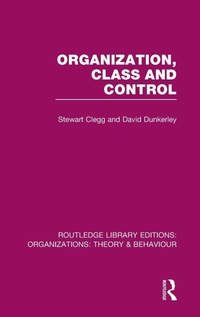
Organization, Class and Control (RLE: Organizations)
Organizations)
1st Edition
Published on 20. March 2013
Book
Hardback
626 pages
978-0-415-82308-1 (ISBN)
Description
In this volume the authors develop a systematic and chronologically based critique of the major concepts, figures and schools in organization. Themes discussed include:
the development of scientific management and the responses of Gramsci and Lenin to it
the meaning of Mayo and the Human Relations School
the development of typological systems and contingency models of the organization
key concepts of goals, environment and technology.
the development of scientific management and the responses of Gramsci and Lenin to it
the meaning of Mayo and the Human Relations School
the development of typological systems and contingency models of the organization
key concepts of goals, environment and technology.
More details
Series
Language
English
Place of publication
London
United Kingdom
Publishing group
Taylor & Francis Ltd
Target group
College/higher education
Professional and scholarly
General, Postgraduate, Professional, and Undergraduate
Dimensions
Height: 240 mm
Width: 161 mm
Thickness: 38 mm
Weight
1104 gr
ISBN-13
978-0-415-82308-1 (9780415823081)
Copyright in bibliographic data and cover images is held by Nielsen Book Services Limited or by the publishers or by their respective licensors: all rights reserved.
Schweitzer Classification
Other editions
Additional editions
Book
12/2015
1st Edition
Routledge
€76.10
Shipment within 10-20 days
Stewart Clegg | David Dunkerley
Organization, Class and Control (RLE: Organizations)
E-Book
05/2013
1st Edition
Routledge
€67.49
Available for download
Stewart Clegg | David Dunkerley
Organization, Class and Control (RLE: Organizations)
E-Book
05/2013
1st Edition
Routledge
€67.49
Available for download
Persons
Multivolume collection by leading authors in the field
Content
Acknowledgements. Introduction. 1. Classical Sociology, Organizations and Theory. 2. Max Weber, Karl Marx and Rationality In Organizations. 3. The emergence of an Organizational Theory. 4. Typologies of Organizations. 5. Organizations as Systems. 6. Organizations as Empirically Contingent Structures. 7. Organizations as Structures of Action. 8. Goals in Organizations. 9. Organization and Technology. 10. Organizations and Environments. 11. People in Organizations. 12. Power and Class in Organizations. 13. The Political Economy of Organizations. Notes. Bibliography. Indices.