

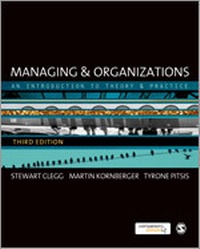
Managing and Organizations
An Introduction to Theory and Practice
1st Edition
Book
Hardback
712 pages
978-1-85702-040-3 (ISBN)
Description
Electronic Inspection Copy available for instructors here
Now in its Third Edition, this unique and highly esteemed text goes from strength to strength, continuing to offer:
- seamless coverage of the essential topics of organizational behaviour
- a realist's guide to management capturing the complex life of organizations (the paradoxical, emotional, insecure, self-confident, responsible, irresponsible) and delivers the key themes and debates in an accessible way
- interactive, instructive (and fun) learning aids and features, both in the text and on the Companion Website
- an attractive, easily navigable, full-colour text design
- a guide to further reading including hand-selected journal articles, many of which are available on the Companion Website.
As well as cutting-edge content and features, the Third Edition now includes:
- clearer, more concise exposition of all you need to know about organizations
- expanded coverage of public-sector, informal and non-profit organizations
- additional discussion of international cultures
- revised case studies to cater for readers across the world at all levels of knowledge and experience
- a revisited Companion Website with longer case studies.
Over the last seven years, more and more students and tutors have been won over by Managing and Organizations' coverage, wisdom and insight, and this new edition is a yet more essential guide to negotiating and understanding the bustling and complex life of organizations.
Visit the Companion Website at www.sagepub.co.uk/managingandorganizations3
To watch Tyrone Pitsis talk about the new edition of Managing and Organizations - click here.
Now in its Third Edition, this unique and highly esteemed text goes from strength to strength, continuing to offer:
- seamless coverage of the essential topics of organizational behaviour
- a realist's guide to management capturing the complex life of organizations (the paradoxical, emotional, insecure, self-confident, responsible, irresponsible) and delivers the key themes and debates in an accessible way
- interactive, instructive (and fun) learning aids and features, both in the text and on the Companion Website
- an attractive, easily navigable, full-colour text design
- a guide to further reading including hand-selected journal articles, many of which are available on the Companion Website.
As well as cutting-edge content and features, the Third Edition now includes:
- clearer, more concise exposition of all you need to know about organizations
- expanded coverage of public-sector, informal and non-profit organizations
- additional discussion of international cultures
- revised case studies to cater for readers across the world at all levels of knowledge and experience
- a revisited Companion Website with longer case studies.
Over the last seven years, more and more students and tutors have been won over by Managing and Organizations' coverage, wisdom and insight, and this new edition is a yet more essential guide to negotiating and understanding the bustling and complex life of organizations.
Visit the Companion Website at www.sagepub.co.uk/managingandorganizations3
To watch Tyrone Pitsis talk about the new edition of Managing and Organizations - click here.
More details
Edition
Third Edition
Language
Other
Place of publication
London
United Kingdom
Publishing group
SAGE Publications
Target group
College/higher education
ISBN-13
978-1-85702-040-3 (9781857020403)
Other editions
Previous edition
Stewart R. Clegg | Martin Kornberger | Tyrone Pitsis
Managing and Organizations
An Introduction to Theory and Practice
Book
02/2008
2nd Edition
SAGE Publications Ltd
€100.60
Article exhausted; check for reprint
Persons
Author
University of Technology, Sydney
Born in Bradford, England, Stewart Clegg was Reader at Griffith University (1976-84), Professor at the University of New England (1985-9), Professor at the University of St. Andrews (1990-3), Foundation Professor at the University of Western Sydney, Macarthur, (1993-6) before moving to UTS. He is Research Director of CMOS (Centre for Management and Organisation Studies) Research at UTS, and holds a small number of Visiting Professorships at prestigious European universities and research centres. He is one of the most published and cited authors in the top-tier journals in the Organization Studies field and the only Australian to be recognised a by a multi-method ranking, as one of the world's top-200 "Management Guru's" in What's the Big Idea? Creating and Capitalizing on the Best New Management Thinking by Thomas H. Davenport, Laurence Prusak, and H. James Wilson (2003), Harvard: Harvard Business Review Press. Because the central focus of his theoretical work has always been on power relations he has been able to write on many diverse and ubiquitous topics - because power relations are everywhere! He is the author of two widely used textbooks on Management & Organizations: An Introduction to Theory and Practice (with Martin Kornberger andTyrone Pitsis) and Strategy: Theory and Practice (with Chris Carter, Martin Kornberger and Jochen Schweitzer), both published by Sage. He is also the chief editor of the Handbook of Organization Studies (with Cynthia Hardy, Walter F. Nord and Thomas B. Lawrence), Handbook of Power (with Mark Haugaard) and Handbook of Macro-Organizational Behaviour (with Cary Cooper), all published by Sage. In 2012 he will publish a book with Oxford University Press on The Virtues of Leadership: Contemporary Challenges for Global Managers (with Arménio Regio, and Miguel Pinha e Cunha), as well as a set of eight 'Major Works" on Power and Organizations and Political Power and Organizations, jointly edited with Mark Haugaard. Outside work he enjoys cultural pursuits, travel, and current affairs.
Born in Bradford, England, Stewart Clegg was Reader at Griffith University (1976-84), Professor at the University of New England (1985-9), Professor at the University of St. Andrews (1990-3), Foundation Professor at the University of Western Sydney, Macarthur, (1993-6) before moving to UTS. He is Research Director of CMOS (Centre for Management and Organisation Studies) Research at UTS, and holds a small number of Visiting Professorships at prestigious European universities and research centres. He is one of the most published and cited authors in the top-tier journals in the Organization Studies field and the only Australian to be recognised a by a multi-method ranking, as one of the world's top-200 "Management Guru's" in What's the Big Idea? Creating and Capitalizing on the Best New Management Thinking by Thomas H. Davenport, Laurence Prusak, and H. James Wilson (2003), Harvard: Harvard Business Review Press. Because the central focus of his theoretical work has always been on power relations he has been able to write on many diverse and ubiquitous topics - because power relations are everywhere! He is the author of two widely used textbooks on Management & Organizations: An Introduction to Theory and Practice (with Martin Kornberger andTyrone Pitsis) and Strategy: Theory and Practice (with Chris Carter, Martin Kornberger and Jochen Schweitzer), both published by Sage. He is also the chief editor of the Handbook of Organization Studies (with Cynthia Hardy, Walter F. Nord and Thomas B. Lawrence), Handbook of Power (with Mark Haugaard) and Handbook of Macro-Organizational Behaviour (with Cary Cooper), all published by Sage. In 2012 he will publish a book with Oxford University Press on The Virtues of Leadership: Contemporary Challenges for Global Managers (with Arménio Regio, and Miguel Pinha e Cunha), as well as a set of eight 'Major Works" on Power and Organizations and Political Power and Organizations, jointly edited with Mark Haugaard. Outside work he enjoys cultural pursuits, travel, and current affairs.
Copenhagen Business School
Martin Kornberger received his PhD form the University of Vienna in 2002. Currently he works as full time Visiting Professor at the Department of Organization, Copenhagen Business School. Trained as philosopher, he researches and teaches about practices of organizing, strategizing, accounting, and marketing, and explores how they shape, and are shaped by, the economy and society at large.
Martin Kornberger received his PhD form the University of Vienna in 2002. Currently he works as full time Visiting Professor at the Department of Organization, Copenhagen Business School. Trained as philosopher, he researches and teaches about practices of organizing, strategizing, accounting, and marketing, and explores how they shape, and are shaped by, the economy and society at large.
University of Technology, Australia
Content
PART ONE: MANAGING PEOPLE IN ORGANIZATIONS
Managing Individuals
Managing Teams and Groups
Managing Leading, Coaching and Motivating
Managing Human Resources
Managing Cultures
PART TWO: MANAGING ORGANIZATIONAL PRACTICE
Managing Power, Politics and Decision-Making in Organizations
Managing Communications
Managing Knowledge and Learning
Managing Innovation and Change
Managing Sustainability
Ethics and Corporate Social Responsibility
PART THREE: MANAGING ORGANIZATIONAL STRUCTURES AND PROCESSES
Managing One Best Way?
Managing Bureaucracy
Managing Organizational Design
Managing Globalization
Managing Individuals
Managing Teams and Groups
Managing Leading, Coaching and Motivating
Managing Human Resources
Managing Cultures
PART TWO: MANAGING ORGANIZATIONAL PRACTICE
Managing Power, Politics and Decision-Making in Organizations
Managing Communications
Managing Knowledge and Learning
Managing Innovation and Change
Managing Sustainability
Ethics and Corporate Social Responsibility
PART THREE: MANAGING ORGANIZATIONAL STRUCTURES AND PROCESSES
Managing One Best Way?
Managing Bureaucracy
Managing Organizational Design
Managing Globalization