

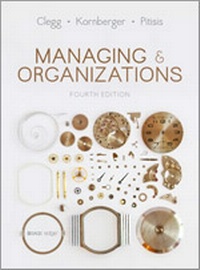
Managing and Organizations
An Introduction to Theory and Practice
4th Edition
Published on 3. December 2015
Book
Hardback
712 pages
978-1-4462-9836-7 (ISBN)
Description
Get 12 months FREE access to an interactive eBook* when you buy the paperback (Print paperback version only 9781446298374)
'Already a classic in its field, Managing and Organizations' success among teachers and students reflects its comprehensiveness and accuracy. A great handbook from which to teach management' - Dr Jose Bento da Silva, University of Warwick
A realist's guide to management, the authors capture the complex life of organizations, providing not only an account of theories, but also an introduction to their practice with examples from everyday life and culture discussing the key themes and debates along the way.
Intended as a 'travel guide' to the world of management, the content contains reliable maps of the terrain, critical viewpoints, with ways forward outlined, and an exploration of the nooks, crannies and byways whilst still observing the main thoroughfares. This is a resource that will help navigate this world, encouraging the reader to explore not only the new, exciting and brilliant aspects, but also some dark sides as well.
The new edition includes:
A new chapter on "Organizational Conflict"
Revised case studies examining key organizational issues and exploring diverse scenarios.
Even more examples and cases throughout covering the most current examples from the business world - e.g. Airbnb, Uber, Spotify.
A free interactive eBook* featuring author videos, web-links to news articles and Ted Talks, multiple choice questions, flashcards, SAGE journal articles and other relevant links, allowing access on the go and encouraging learning and retention whatever the reading or learning style.
Suitable for students studying Organisational Behaviour, Managing People in Organisations and Introductory Management courses taking an Organisational Behaviour slant.
(*interactivity only available through Vitalsource eBook)
'Already a classic in its field, Managing and Organizations' success among teachers and students reflects its comprehensiveness and accuracy. A great handbook from which to teach management' - Dr Jose Bento da Silva, University of Warwick
A realist's guide to management, the authors capture the complex life of organizations, providing not only an account of theories, but also an introduction to their practice with examples from everyday life and culture discussing the key themes and debates along the way.
Intended as a 'travel guide' to the world of management, the content contains reliable maps of the terrain, critical viewpoints, with ways forward outlined, and an exploration of the nooks, crannies and byways whilst still observing the main thoroughfares. This is a resource that will help navigate this world, encouraging the reader to explore not only the new, exciting and brilliant aspects, but also some dark sides as well.
The new edition includes:
A new chapter on "Organizational Conflict"
Revised case studies examining key organizational issues and exploring diverse scenarios.
Even more examples and cases throughout covering the most current examples from the business world - e.g. Airbnb, Uber, Spotify.
A free interactive eBook* featuring author videos, web-links to news articles and Ted Talks, multiple choice questions, flashcards, SAGE journal articles and other relevant links, allowing access on the go and encouraging learning and retention whatever the reading or learning style.
Suitable for students studying Organisational Behaviour, Managing People in Organisations and Introductory Management courses taking an Organisational Behaviour slant.
(*interactivity only available through Vitalsource eBook)
Reviews / Votes
Easily the best introductory text on management and organization available. The key issues are clearly articulates in ways that comprehensively introduce difficult concepts without using simplistic, jargonised language. -- Dr Christopher Sykes Already a classic in the field, Managing and Organizations' success among teachers and students reflects its comprehensiveness and accuracy. A great handbook from which to teach management. -- Dr Jose Bento da Silva A rare feat, this text manages to be accessible and mature at the same time. Excellent preparation for diving deeper into organizational science and practice. -- Professor Guido Moellering This book highlights a range of current issues and reviews contemporary events and issues. -- Lesley Mearns Great textbook. Takes critical approach to traditional topics and texts. Highly recommended -- Mr Christian LystbaekMore details
Edition
4th Revised edition
Language
English
Place of publication
London
United Kingdom
Target group
College/higher education
Edition type
Revised edition
Dimensions
Height: 265 mm
Width: 195 mm
Weight
1823 gr
ISBN-13
978-1-4462-9836-7 (9781446298367)
Copyright in bibliographic data and cover images is held by Nielsen Book Services Limited or by the publishers or by their respective licensors: all rights reserved.
Schweitzer Classification
Other editions
New editions
Stewart R. Clegg | Martin Kornberger | Tyrone S. Pitsis
Managing and Organizations
An Introduction to Theory and Practice
Book
03/2019
5th Edition
SAGE Publications Ltd
€200.56
Article exhausted; check for reprint
Previous edition
Stewart R. Clegg | Martin Kornberger | Tyrone S. Pitsis
Managing and Organizations
An Introduction to Theory and Practice
Book
01/2012
3rd Edition
SAGE Publications Ltd
€160.44
Article exhausted; check for reprint
Persons
Stewart Clegg is Professor at the University of Sydney in the School of Project Management and the John Grill Institute for Project Leadership and an Emeritus Professor of the University of Technology Sydney.
Martin Kornberger received his PhD form the University of Vienna in 2002. Currently he works as full time Visiting Professor at the Department of Organization, Copenhagen Business School. Trained as philosopher, he researches and teaches about practices of organizing, strategizing, accounting, and marketing, and explores how they shape, and are shaped by, the economy and society at large. Tyrone S. Pitsis is Professor of Strategy, Technology & Society at Durham University Business School. He is also Director of the Global Doctor of Business Administration programme between Durham and emlyon. His research is at the intersection between strategy design, innovation and complex projects, with a focus on transformative technologies. He is consistently rated as one of the top teachers and is a sought-after speaker. He has been the recipient of several awards for his research and was also awarded the Practice Theme Committee of the Academy of Management leadership award for his contribution to AOM's strategic aims of promoting and recognizing the impact members make through their scholarship. Having worked since he was 14, Tyrone originally began his working life as a chef, starting off as a kitchen hand and working his way up to executive chef in award-winning restaurants and hotels. He now cooks as little as possible but still loves to eat. Aside from his family, Tyrone could not imagine life without music.
Martin Kornberger received his PhD form the University of Vienna in 2002. Currently he works as full time Visiting Professor at the Department of Organization, Copenhagen Business School. Trained as philosopher, he researches and teaches about practices of organizing, strategizing, accounting, and marketing, and explores how they shape, and are shaped by, the economy and society at large. Tyrone S. Pitsis is Professor of Strategy, Technology & Society at Durham University Business School. He is also Director of the Global Doctor of Business Administration programme between Durham and emlyon. His research is at the intersection between strategy design, innovation and complex projects, with a focus on transformative technologies. He is consistently rated as one of the top teachers and is a sought-after speaker. He has been the recipient of several awards for his research and was also awarded the Practice Theme Committee of the Academy of Management leadership award for his contribution to AOM's strategic aims of promoting and recognizing the impact members make through their scholarship. Having worked since he was 14, Tyrone originally began his working life as a chef, starting off as a kitchen hand and working his way up to executive chef in award-winning restaurants and hotels. He now cooks as little as possible but still loves to eat. Aside from his family, Tyrone could not imagine life without music.
Content
Introduction
PART ONE: Managing People in Organizations
Chapter 1: Managing and Organizations in Changing Contexts
Chapter 2: Managing Sensemaking
Chapter 3: Managing Individuals
Chapter 4: Managing Teams and Groups
Chapter 5: Managing Leading, Coaching, and Motivating
Chapter 6: Managing Human Resources
PART TWO: Managing Organizational Practices
Chapter 7: Managing Cultures
Chapter 8: Managing Conflict
Chapter 9: Managing Power, Politics, and Decision-Making in Organizations
Chapter 10: Managing Communications
Chapter 11: Managing Knowledge and Learning
Chapter 12: Managing Innovation and Change
Chapter 13: Managing Social Responsibilty Ethically
PART THREE: Managing Organizational Structures and Processes
Chapter 14: Managing Bureaucracy
Chapter 15: Managing Beyond Bureaucracy
Chapter 16: Managing Organizational Design
Chapter 17: Managing Globalization
PART ONE: Managing People in Organizations
Chapter 1: Managing and Organizations in Changing Contexts
Chapter 2: Managing Sensemaking
Chapter 3: Managing Individuals
Chapter 4: Managing Teams and Groups
Chapter 5: Managing Leading, Coaching, and Motivating
Chapter 6: Managing Human Resources
PART TWO: Managing Organizational Practices
Chapter 7: Managing Cultures
Chapter 8: Managing Conflict
Chapter 9: Managing Power, Politics, and Decision-Making in Organizations
Chapter 10: Managing Communications
Chapter 11: Managing Knowledge and Learning
Chapter 12: Managing Innovation and Change
Chapter 13: Managing Social Responsibilty Ethically
PART THREE: Managing Organizational Structures and Processes
Chapter 14: Managing Bureaucracy
Chapter 15: Managing Beyond Bureaucracy
Chapter 16: Managing Organizational Design
Chapter 17: Managing Globalization