

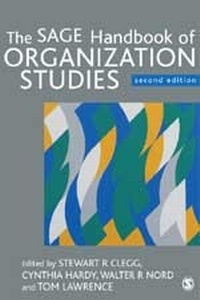
Handbook of Organization Studies
1st Edition
Published on 6. August 1996
Book
Hardback
760 pages
978-0-7619-5132-2 (ISBN)
Description
`A valuable guide to major issues in the field' - Gareth Morgan, University of York
`The Handbook of Organization Studies completes the trilogy begun by two previous pathbreaking handbooks - March's Handbook of Organizations (1965) and Nystrom and Starbuck's Handbook of Organizational Design (1981). Like the earlier two handbooks, the editors have recruited an international group of up-and-coming junior scholars, as well as seasoned veterans, and the result is stunning... a gold mine of ideas. I wholeheartedly recommend this book' - Howard E Aldrich, Kenan Professor of Sociology, University of Northern Carolina at Chapel Hill
`A marvellous collection of up-to-date scholarship on organization studies from a whole array of perspectives. A must for any organization researcher's bookshelf' - Koya Azumi, Professor of Sociology, International Christian University, Tokyo
`The Handbook of Organization Studies provides a much-needed synthesis of the literature and knowledge about organizations and organizing.... I recommend it as an essential reference book for business schools as well as social science departments' - Professor Jean-Claude Thoenig, INSEAD, Fontainebleau, France
`This book is the most significant contribution to the study of organizations to have appeared in one volume since the classic Handbook of Organizations which James March edited thirty years ago.... This Handbook of Organization Studies should remain relevant for at least as long as its predecessor' - John Child, Guinness Professor of Management Studies, The Judge Institute of Management Studies, University of Cambridge
`The Handbook of Organization Studies is a stunning accomplishment. The volume forces relics of an earlier era, like me, to rethink the fields of organizations and organization studies. It captures the exciting differences that are part of our literature in one place. The volume undoubtedly will stimulate new enquiries which will require another such handbook in another three decades' - Richard H Hall, Distinguished Service Professor, Department of Sociology and Management, State University of New York, Albany
`This book will stimulate many exciting conversations among readers that would not have occurred without it. It is creative in design and conception and the quality... is superb. Definintely, it will appeal to those who wish to celebrate the diversity of perspectives and issues in the field and outflank those who wish to imagine that there is nothing of value outside the mainstream' - Professor John M Jermier, University of South Florida, Tampa
This unique handbook presents a major retrospective and prospective overview of the field of organization studies. Drawing on the talents of an outstanding team of international contributors, the editors have assembled, assessed and synthesized the key strands in past and current theory.
The text moves from the general to the specific, from the past to the present and from the present to the future. Addressing the established traditions, as well as newer foci of inquiry, it examines the questions that the fin de si[gr]ecle poses for organizations, and for ourselves as organization members and researchers. Central to the enterprise has been a concern to reflect and honour the manifest diversity of the field - including recognition of the extent to which the very notion of a single field of organization studies is itself debated - while also directing attention to the points of intersection and potential dialogue across the numerous `conversations' that make up this area of study.
`The Handbook of Organization Studies completes the trilogy begun by two previous pathbreaking handbooks - March's Handbook of Organizations (1965) and Nystrom and Starbuck's Handbook of Organizational Design (1981). Like the earlier two handbooks, the editors have recruited an international group of up-and-coming junior scholars, as well as seasoned veterans, and the result is stunning... a gold mine of ideas. I wholeheartedly recommend this book' - Howard E Aldrich, Kenan Professor of Sociology, University of Northern Carolina at Chapel Hill
`A marvellous collection of up-to-date scholarship on organization studies from a whole array of perspectives. A must for any organization researcher's bookshelf' - Koya Azumi, Professor of Sociology, International Christian University, Tokyo
`The Handbook of Organization Studies provides a much-needed synthesis of the literature and knowledge about organizations and organizing.... I recommend it as an essential reference book for business schools as well as social science departments' - Professor Jean-Claude Thoenig, INSEAD, Fontainebleau, France
`This book is the most significant contribution to the study of organizations to have appeared in one volume since the classic Handbook of Organizations which James March edited thirty years ago.... This Handbook of Organization Studies should remain relevant for at least as long as its predecessor' - John Child, Guinness Professor of Management Studies, The Judge Institute of Management Studies, University of Cambridge
`The Handbook of Organization Studies is a stunning accomplishment. The volume forces relics of an earlier era, like me, to rethink the fields of organizations and organization studies. It captures the exciting differences that are part of our literature in one place. The volume undoubtedly will stimulate new enquiries which will require another such handbook in another three decades' - Richard H Hall, Distinguished Service Professor, Department of Sociology and Management, State University of New York, Albany
`This book will stimulate many exciting conversations among readers that would not have occurred without it. It is creative in design and conception and the quality... is superb. Definintely, it will appeal to those who wish to celebrate the diversity of perspectives and issues in the field and outflank those who wish to imagine that there is nothing of value outside the mainstream' - Professor John M Jermier, University of South Florida, Tampa
This unique handbook presents a major retrospective and prospective overview of the field of organization studies. Drawing on the talents of an outstanding team of international contributors, the editors have assembled, assessed and synthesized the key strands in past and current theory.
The text moves from the general to the specific, from the past to the present and from the present to the future. Addressing the established traditions, as well as newer foci of inquiry, it examines the questions that the fin de si[gr]ecle poses for organizations, and for ourselves as organization members and researchers. Central to the enterprise has been a concern to reflect and honour the manifest diversity of the field - including recognition of the extent to which the very notion of a single field of organization studies is itself debated - while also directing attention to the points of intersection and potential dialogue across the numerous `conversations' that make up this area of study.
Reviews / Votes
`The Handbook of Organization Studies is a timely and much needed addition to the field of study. The editors of this volume desired to map the terrain of organization studies, but to also generate conversations about it. Their goal was not to create a consensus but to create multiple dialogues about a field of study that continues to grow and develop. From the perspective of a practitioner of organization development, they most certainly have accomplished their goal' - Management Learning`This handbook is organized to help teachers and students to cover the mainstream work in the field of organization studies. The aim has been to incorporate the diverse changes in the practice and knowledge of organizations that have occurred in recent years. This it review the old as well as the new. The Handbook is developed in three sections: frameworks for analysis; current issues in organization studies; and reflections on research, theory and practice. Part 1 identifies some of the major contemporary forms of theoretical practices in organization studies. Part 2 offers specific insight into subjects and considers the following: strategy, leadership, decision-making, cognition, groups, communications, technology, innovation, organization learning, diversity, the
ecological environment and globalization. Some of the issues are well-established, and others have developed in response to changes and challenges found in the contemporary world of organizations. in Part 3, the connection between theory and practice is examined closely. In the conclusion attention is given to the status of representation, as processes of representation o both the individual and the organizational subject provides an opportunity to carry out research that meshes theory and practice. This is an excellent reference tool with which to study organizational theory and practice' - International Review of Administrative Sciences
`In many ways, the editors have put together an impressive reference work, serious in intent and rigorous in implementation. As a publishing achievement, and a scholarly `event' in the field, SAGE is to be congratulated. It is designed as a work of synthesis, to link past and present, general and specific.... The Handbook is clearly intellectually challenging' - Journal of General Management
`It [the book] is well crafted: the editors have done a thoroughtly excellent job, and they have managed their contributing authors so they in turn express their theses clearly. I recommend this handbook to all who have to grapple with the "study" of an organization' - Journal of the Operational Research Society
`A valuable guide to major issues in the field' - Gareth Morgan, University of York
`The Handbook of Organization Studies completes the trilogy begun by two previous pathbreaking handbooks - March's Handbook of Organizations (1965) and Nystrom and Starbuck's Handbook of Organizational Design (1981). Like the earlier two handbooks, the editors have recruited an international group of up-and-coming junior scholars, as well as seasoned veterans, and the result is stunning... a gold mine of ideas. I wholeheartedly recommend this book' - Howard E Aldrich, Kenan Professor of Sociology, University of Northern Carolina at Chapel Hill
`A marvellous collection of up-to-date scholarship on organization studies from a whole array of perspectives. A must for any organization researcher's bookshelf' - Koya Azumi, Professor of Sociology, International Christian University, Tokyo
`The Handbook of Organization Studies provides a much-needed synthesis of the literature and knowledge about organizations and organizing.... I recommend it as an essential reference book for business schools as well as social science departments' - Professor Jean-Claude Thoenig, INSEAD, Fontainebleau, France
`This book is the most significant contribution to the study of organizations to have appeared in one volume since the classic Handbook of Organizations which James March edited thirty years ago.... This Handbook of Organization Studies should remain relevant for at least as long as its predecessor' - John Child, Guinness Professor of Management Studies, The Judge Institute of Management Studies, University of Cambridge
`The Handbook of Organization Studies is a stunning accomplishment. The volume forces relics of an earlier era, like me, to rethink the fields of organizations and organization studies. It captures the exciting differences that are part of our literature in one place. The volume undoubtedly will stimulate new enquiries which will require another such handbook in another three decades' - Richard H Hall, Distinguished Service Professor, Department of Sociology and Management, State University of New York, Albany
`This book will stimulate many exciting conversations among readers that would not have occurred without it. It is creative in design and conception and the quality... is superb. Definintely, it will appeal to those who wish to celebrate the diversity of perspectives and issues in the field and outflank those who wish to imagine that there is nothing of value outside the mainstream' - Professor John M Jermier, University of South Florida, Tampa
More details
Language
English
Place of publication
Thousand Oaks
United States
Target group
Professional and scholarly
Dimensions
Height: 253 mm
Width: 175 mm
Weight
1659 gr
ISBN-13
978-0-7619-5132-2 (9780761951322)
Copyright in bibliographic data and cover images is held by Nielsen Book Services Limited or by the publishers or by their respective licensors: all rights reserved.
Schweitzer Classification
Other editions
New editions
Stewart R. Clegg | Cynthia Hardy | Thomas B. Lawrence
The SAGE Handbook of Organization Studies
Book
06/2006
2nd Edition
SAGE Publications Inc
€201.00
Shipment within 15-20 days
Persons
Stewart Clegg is Professor at the University of Sydney in the School of Project Management and the John Grill Institute for Project Leadership and an Emeritus Professor of the University of Technology Sydney.
Cynthia Hardy is a Professor in the Faculty of Management, McGill University. Her publications include Strategies for Retrenchment and Turnaround: The Politics of Survival (De Gruyter, 1990) and Managing Organizational Closure (Gower, 1985). Management professor Walt Nord studies organization theory and behavior and is currently researching the topic in a political/economic context. The author of numerous books, textbooks, and scholarly articles, his newest book will offer a new philosophical framework for organization studies, seeking to overcome current polarizing debates by developing an improved philosophical perspective for organization studies.
As an author, Nord received the George Terry Award in 1997 for co-editing the Handbook of Organization Studies, an annual award from the Academy of Management that is bestowed to a book judged to have made the most outstanding contribution to the field. The same academy named Nord a Distinguished University Professor in 2002 (USF named him Distinguished University Professor in 2003); these honors recognize significant contributions to the science and practice of management.
Nord earned a BA in economics from Williams College, an MS in organizational behavior from Cornell University, and a PhD in social psychology from Washington University. Before joining USF in 1989, he taught at Tulane University, Northwestern University, Vanderbilt University, the University of British Columbia, and Washington University. He is an editor or reviewer for numerous academic journals.
Cynthia Hardy is a Professor in the Faculty of Management, McGill University. Her publications include Strategies for Retrenchment and Turnaround: The Politics of Survival (De Gruyter, 1990) and Managing Organizational Closure (Gower, 1985). Management professor Walt Nord studies organization theory and behavior and is currently researching the topic in a political/economic context. The author of numerous books, textbooks, and scholarly articles, his newest book will offer a new philosophical framework for organization studies, seeking to overcome current polarizing debates by developing an improved philosophical perspective for organization studies.
As an author, Nord received the George Terry Award in 1997 for co-editing the Handbook of Organization Studies, an annual award from the Academy of Management that is bestowed to a book judged to have made the most outstanding contribution to the field. The same academy named Nord a Distinguished University Professor in 2002 (USF named him Distinguished University Professor in 2003); these honors recognize significant contributions to the science and practice of management.
Nord earned a BA in economics from Williams College, an MS in organizational behavior from Cornell University, and a PhD in social psychology from Washington University. Before joining USF in 1989, he taught at Tulane University, Northwestern University, Vanderbilt University, the University of British Columbia, and Washington University. He is an editor or reviewer for numerous academic journals.
Content
Introduction - Stewart R Clegg and Cynthia Hardy
Organizations, Organization and Organizing
PART ONE: FRAMEWORKS FOR ANALYSIS
Organizational Theorizing - Michael Reed
A Historically Contested Terrain
The Normal Science of Structural Contingency Theory - Lex Donaldson
Organizational Ecology - Joel A C Baum
Organizational Economics - Jay B Barney and William Hesterly
Understanding the Relationship between Organizations and Economic Analysis
The Individual in Organizational Studies - Walter R Nord and Suzy Fox
The Great Disappearing Act?
The Institutionalization of Institutional Theory - Pamela S Tolbert and Lynne G Zucker
Critical Theory and Postmodernism Approaches to Organizational Studies - Mats Alvesson and Stanley Deetz
From `The Woman's' Point of View - Marta B Cal[ac]as and Linda Smircich
Feminist Approaches to Organization Studies
PART TWO: CURRENT ISSUES IN ORGANIZATION STUDIES
Creative Deconstruction - Richard Whipp
Strategy and Organizations
Leadership in Organizations - Alan Bryman
Decision-Making in Organizations - Susan J Miller, David J Hickson and David C Wilson
Cognitions in Organizations - Ann E Tenbrunsel et al
Diverse Identities in Organizations - Stella M Nkomo and Taylor Cox Jr
Putting Group Information Technology in its Place - Arthur D Shulman
Communication and Good Work Group Performance
Metaphors of Communication and Organization - Linda L Putnam, Nelson Phillips and Pamela Chapman
Organizations, Technology and Structuring - Karlene H Roberts and Martha Grabowski
Organizing for Innovation - Deborah Dougherty
Organizational Learning - Karl E Weick and Frances Westley
Affirming an Oxymoron
Organizations and the Biosphere - Carolyn P Egri and Lawrence T Pinfield
Ecologies and Environments
Evolution and Revolution - Barbara Parker
From International Business to Globalization
PART THREE: REFLECTIONS ON RESEARCH, THEORY AND PRACTICE
Data in Organization Studies - Ralph Stablein
Action Research for the Study of Organizations - Colin Eden and Chris Huxham
Emotion and Organizing - Stephen Fineman
Exploring the Aesthetic Side of Organizational Life - Pasquale Gagliardi
Images of Time in Work and Organization - John Hassard
The Organizational Culture War Games - Joanne Martin and Peter Frost
A Struggle for Intellectual Dominance
Some Dare Call It Power - Cynthia Hardy and Stewart R Clegg
Normal Science, Paradigms, Metaphors, Discourses and Genealogies of Analysis - Gibson Burrell
The Owl of Minerva - Richard Marsden and Barbara Townley
Reflections on Theory in Practice
Conclusion - Stewart R Clegg and Cynthia Hardy
Representations
Organizations, Organization and Organizing
PART ONE: FRAMEWORKS FOR ANALYSIS
Organizational Theorizing - Michael Reed
A Historically Contested Terrain
The Normal Science of Structural Contingency Theory - Lex Donaldson
Organizational Ecology - Joel A C Baum
Organizational Economics - Jay B Barney and William Hesterly
Understanding the Relationship between Organizations and Economic Analysis
The Individual in Organizational Studies - Walter R Nord and Suzy Fox
The Great Disappearing Act?
The Institutionalization of Institutional Theory - Pamela S Tolbert and Lynne G Zucker
Critical Theory and Postmodernism Approaches to Organizational Studies - Mats Alvesson and Stanley Deetz
From `The Woman's' Point of View - Marta B Cal[ac]as and Linda Smircich
Feminist Approaches to Organization Studies
PART TWO: CURRENT ISSUES IN ORGANIZATION STUDIES
Creative Deconstruction - Richard Whipp
Strategy and Organizations
Leadership in Organizations - Alan Bryman
Decision-Making in Organizations - Susan J Miller, David J Hickson and David C Wilson
Cognitions in Organizations - Ann E Tenbrunsel et al
Diverse Identities in Organizations - Stella M Nkomo and Taylor Cox Jr
Putting Group Information Technology in its Place - Arthur D Shulman
Communication and Good Work Group Performance
Metaphors of Communication and Organization - Linda L Putnam, Nelson Phillips and Pamela Chapman
Organizations, Technology and Structuring - Karlene H Roberts and Martha Grabowski
Organizing for Innovation - Deborah Dougherty
Organizational Learning - Karl E Weick and Frances Westley
Affirming an Oxymoron
Organizations and the Biosphere - Carolyn P Egri and Lawrence T Pinfield
Ecologies and Environments
Evolution and Revolution - Barbara Parker
From International Business to Globalization
PART THREE: REFLECTIONS ON RESEARCH, THEORY AND PRACTICE
Data in Organization Studies - Ralph Stablein
Action Research for the Study of Organizations - Colin Eden and Chris Huxham
Emotion and Organizing - Stephen Fineman
Exploring the Aesthetic Side of Organizational Life - Pasquale Gagliardi
Images of Time in Work and Organization - John Hassard
The Organizational Culture War Games - Joanne Martin and Peter Frost
A Struggle for Intellectual Dominance
Some Dare Call It Power - Cynthia Hardy and Stewart R Clegg
Normal Science, Paradigms, Metaphors, Discourses and Genealogies of Analysis - Gibson Burrell
The Owl of Minerva - Richard Marsden and Barbara Townley
Reflections on Theory in Practice
Conclusion - Stewart R Clegg and Cynthia Hardy
Representations