

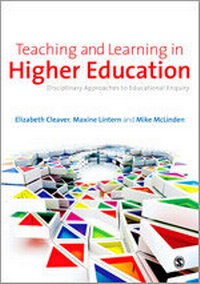
Teaching and Learning in Higher Education
Disciplinary Approaches to Educational Enquiry
1st Edition
Published on 14. March 2014
Book
Paperback/Softback
272 pages
978-1-4462-5463-9 (ISBN)
Description
In today's higher education climate academic staff are encouraged to focus not only on the up-to-date content of their teaching, but also to identify the most effective ways to engage students in learning, often alongside other key transferrable skills. This had led to a growing requirement for staff to adopt a scholarly approach to learning and teaching practice, and to undertake scholarship of learning and teaching as part of ongoing professional development.
This text explores broad best practice approaches to undertaking enquiry into learning and teaching in higher education. It provides an introduction for staff who have been educated within a range of academic disciplines, often with high-level but very focused knowledge about, and understandings of, research processes to the potentially new world of educational enquiry. This is complemented by chapters exploring what educational enquiry means in the context of different academic disciplines, including physical sciences, mathematics, engineering, the life sciences, the arts, the humanities, the health professions, and law.
It also includes:
An overview of research methodology including data collection, literature reviews, good ethical practice, and research dissemination
Case studies of actual research projects to support understanding of how to carry out educational enquiry in practice.
Lecturers, why waste time waiting for the post arrive? Request and receive your e-inspection copy today!
This text explores broad best practice approaches to undertaking enquiry into learning and teaching in higher education. It provides an introduction for staff who have been educated within a range of academic disciplines, often with high-level but very focused knowledge about, and understandings of, research processes to the potentially new world of educational enquiry. This is complemented by chapters exploring what educational enquiry means in the context of different academic disciplines, including physical sciences, mathematics, engineering, the life sciences, the arts, the humanities, the health professions, and law.
It also includes:
An overview of research methodology including data collection, literature reviews, good ethical practice, and research dissemination
Case studies of actual research projects to support understanding of how to carry out educational enquiry in practice.
Lecturers, why waste time waiting for the post arrive? Request and receive your e-inspection copy today!
Reviews / Votes
'This book argues for educational enquiry as a way to invigorate academic teaching and student learning. It takes the individual academic's point of view as it shows how educational enquiry starts in the discipline and evolves further into an invitation for students to participate. It is important, inspiring and useful.' -- Torgny Roxa 'This is a comprehensive and important volume. Disciplinary-focussed chapters can be read as stand alone pieces, but when combined with the introductory material in Part 1, the result is one of both breadth and depth of insight into the principles and practices of educational enquiry in a HE setting. It will be particularly useful for those starting out in discipline-based educational research, those moving into this area and those charged with supporting or leading this vital form of scholarship.' -- Simon Bates 'For all academics who care about their own teaching and who want to engage students fully, this book will be invaluable. The authors show how it's possible to draw on the special culture of one's own subject discipline to enhance education in ways which benefit staff as well as students. Make this the first book on your reading list.' -- Dr Dilly Fung 'Teaching and Learning in Higher Education explores an exciting new development in higher education: educational enquiry as an approach to improving teaching and informing pedagogical and curricular design. As this welcome guide attractively illustrates and clearly explains, educational enquiry is not just for education researchers and social scientists, but can be undertaken by academics in any discipline through methods that are a good (3)fit (2) for their own fields. For readers who want to know why and how to get started, this is your book!' -- Mary Taylor HuberMore details
Language
English
Place of publication
London
United Kingdom
Target group
College/higher education
Dimensions
Height: 242 mm
Width: 170 mm
Weight
453 gr
ISBN-13
978-1-4462-5463-9 (9781446254639)
Copyright in bibliographic data and cover images is held by Nielsen Book Services Limited or by the publishers or by their respective licensors: all rights reserved.
Schweitzer Classification
Other editions
New editions
Elizabeth Cleaver | Maxine Lintern | Mike Mclinden
Teaching and Learning in Higher Education
Disciplinary Approaches to Educational Enquiry
Book
08/2018
2nd Edition
SAGE Publications Ltd
€80.70
Shipment within 15-20 days
Persons
Prof. Elizabeth Cleaver is Professor of Learning and Teaching at the University of the West of England, UK (UWE) where she has built and leads the University's Academic Practice Directorate: the central hub for the support, development and enhancement of academic programmes and practice. Over a career spanning 23 years she has taught, written and researched in sociology and education. Her early academic career was in the discipline of sociology where she specialised in the area of youth transitions to adulthood (early works are published in name Kenyon). It was during this period that her interest in disciplinary teaching approaches, and the importance of not just thinking and researching sociologically, but teaching sociologically, began to grow. Following a six-year spell outside the HE sector, undertaking local and government-funded policy research and evaluations at NFER, she returned to higher education in 2008. This most recent stage of Elizabeth's career has focused on providing strategic leadership for curricular and pedagogic development and change in a range of contrasting higher education institutions. Elizabeth is a Principal Fellow of the Higher Education Academy.
Prof. Maxine Lintern is Associate Dean for Research and Enterprise for the Faculty of Business, Law and Social Science at Birmingham City University, UK. Her background is in biochemistry and neurophysiology and she has always been profoundly interested in the links and interfaces between research and teaching. The research strategy she has developed for the Faculty overtly links all research activity back into the development of innovative teaching environments and the curriculum. While based in the Faculty of Health she established a successful research centre and created innovative learning experiences such as the 'Major Incident Simulation'. Prior to her roles at BCU she was Director of Learning and Teaching at the University of Birmingham where she worked closely with staff from a wide range of subject areas as they undertook formal training in teaching as part of their PGCert. The challenge of helping them to see links back to their own research environment and how that could inspire educational development is one of drivers for producing this book. Maxine is a Principal Fellow of the Higher Education Academy.
Prof. Mike McLinden is based in the School of Education at the University of Birmingham as has over 25 years' experience of curriculum design, delivery and evaluation. He has a broad interest in professional learning and pedagogy and has been involved in a range of funded pedagogical projects in partnership with colleagues in the sector. This includes Strand Lead (Part Time Learners) for HEA-funded 'Flexible Pedagogies' project. Mike's research interests include developing 'research-informed' pedagogical practice with a particular focus on the development of student-centred approaches (including problem/enquiry-based learning). With colleagues at the University, he has led a number of funded projects that link to strategic developments within the institution. Mike's disciplinary professional role is concerned with the inclusion of children and young people with special educational needs and disabilities. He is co-Director of the Visual Impairment Centre for Teaching and Research (VICTAR) in the Department of Disability Inclusion and Special Needs (DISN), Programme Director for the professional development courses in vision impairment, and is a Principal Fellow of the Higher Education Academy.
Prof. Maxine Lintern is Associate Dean for Research and Enterprise for the Faculty of Business, Law and Social Science at Birmingham City University, UK. Her background is in biochemistry and neurophysiology and she has always been profoundly interested in the links and interfaces between research and teaching. The research strategy she has developed for the Faculty overtly links all research activity back into the development of innovative teaching environments and the curriculum. While based in the Faculty of Health she established a successful research centre and created innovative learning experiences such as the 'Major Incident Simulation'. Prior to her roles at BCU she was Director of Learning and Teaching at the University of Birmingham where she worked closely with staff from a wide range of subject areas as they undertook formal training in teaching as part of their PGCert. The challenge of helping them to see links back to their own research environment and how that could inspire educational development is one of drivers for producing this book. Maxine is a Principal Fellow of the Higher Education Academy.
Prof. Mike McLinden is based in the School of Education at the University of Birmingham as has over 25 years' experience of curriculum design, delivery and evaluation. He has a broad interest in professional learning and pedagogy and has been involved in a range of funded pedagogical projects in partnership with colleagues in the sector. This includes Strand Lead (Part Time Learners) for HEA-funded 'Flexible Pedagogies' project. Mike's research interests include developing 'research-informed' pedagogical practice with a particular focus on the development of student-centred approaches (including problem/enquiry-based learning). With colleagues at the University, he has led a number of funded projects that link to strategic developments within the institution. Mike's disciplinary professional role is concerned with the inclusion of children and young people with special educational needs and disabilities. He is co-Director of the Visual Impairment Centre for Teaching and Research (VICTAR) in the Department of Disability Inclusion and Special Needs (DISN), Programme Director for the professional development courses in vision impairment, and is a Principal Fellow of the Higher Education Academy.
Content
PART ONE: UNDERSTANDING EDUCATIONAL ENQUIRY
What is educational enquiry and why is it important? - Elizabeth Cleaver, Maxine Lintern and Mike McLinden
What do I need to know before I read educational literature? - Mike McLinden, Elizabeth Cleaver and Maxine Lintern
How is educational literature evidenced and reviewed? - Mike McLinden, Elizabeth Cleaver and Maxine Lintern
What about ethics and safety? - Elizabeth Cleaver, Maxine Lintern and Mike McLinden
What kind of data should I collect and use? - Maxine Lintern, Mike McLinden and Elizabeth Cleaver
What about dissemination? - Maxine Lintern, Mike McLinden and Elizabeth Cleaver
PART TWO: ENQUIRY IN THE DISCIPLINES
Enquiry into learning and teaching in the physical sciences - Helen King and Tina Overton
Enquiry into learning and teaching in mathematics and engineering - Michael Grove and Joe Kyle
Enquiry into learning and teaching in the life sciences - Helen Barefoot and Mark Russell
Enquiry into learning and teaching in arts and creative practice - Susan Orr and Julian McDougall
Enquiry into learning and teaching in the humanities - Rebecca O'Loughlin and Elaine Fulton
Enquiry into learning and teaching in the health professions - Sharon Buckley and Patricia Fell
Enquiry into learning and teaching in the professions: the case of law - Rob Clucas and Gerry Johnstone
What is educational enquiry and why is it important? - Elizabeth Cleaver, Maxine Lintern and Mike McLinden
What do I need to know before I read educational literature? - Mike McLinden, Elizabeth Cleaver and Maxine Lintern
How is educational literature evidenced and reviewed? - Mike McLinden, Elizabeth Cleaver and Maxine Lintern
What about ethics and safety? - Elizabeth Cleaver, Maxine Lintern and Mike McLinden
What kind of data should I collect and use? - Maxine Lintern, Mike McLinden and Elizabeth Cleaver
What about dissemination? - Maxine Lintern, Mike McLinden and Elizabeth Cleaver
PART TWO: ENQUIRY IN THE DISCIPLINES
Enquiry into learning and teaching in the physical sciences - Helen King and Tina Overton
Enquiry into learning and teaching in mathematics and engineering - Michael Grove and Joe Kyle
Enquiry into learning and teaching in the life sciences - Helen Barefoot and Mark Russell
Enquiry into learning and teaching in arts and creative practice - Susan Orr and Julian McDougall
Enquiry into learning and teaching in the humanities - Rebecca O'Loughlin and Elaine Fulton
Enquiry into learning and teaching in the health professions - Sharon Buckley and Patricia Fell
Enquiry into learning and teaching in the professions: the case of law - Rob Clucas and Gerry Johnstone