

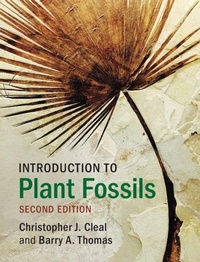
Introduction to Plant Fossils
2nd Edition
Will be published approx. on 27. June 2019
Book
Hardback
262 pages
978-1-108-48344-5 (ISBN)
Description
Plant remains can preserve a critical part of history of life on Earth. While telling the fascinating evolutionary story of plants and vegetation across the last 500 million years, this book also crucially offers non-specialists a practical guide to studying, dealing with and interpreting plant fossils. It shows how various techniques can be used to reveal the secrets of plant fossils and how to identify common types, such as compressions and impressions. Incorporating the concepts of evolutionary floras, this second edition includes revised data on all main plant groups, the latest approaches to naming plant fossils using fossil-taxa and techniques such as tomography. With extensive illustrations of plant fossils and living plants, the book encourages readers to think of fossils as once-living organisms. It is written for students on introductory or intermediate courses in palaeobotany, palaeontology, plant evolutionary biology and plant science, and for amateurs interested in studying plant fossils.
Reviews / Votes
'... affording quick access to the world of fossil plants to any interested reader. Their direct approach is refreshing, making the book eminently useful for the basic identification of fossil plants, in some cases down to species-level determinations ... Undergraduate students willing to read this book will quickly gain a core understanding of an important subject that is rarely included in today's college curriculum.' P. K. Strother, Choice 'This edition is great for everyone interested in fossils, plants, and (specially) fossil plants, being especially useful for those starting to study plant evolution and paleobotany. It may also be of interest for everyone who ever found a piece of petrified wood and wanted to learn more about it, and about all of the wonderful and strange plants that inhabited the earth a long time ago.' Andres Elgorriaga, Plant Science BulletinMore details
Edition
2nd Revised edition
Language
English
Place of publication
Cambridge
United Kingdom
Target group
Professional and scholarly
College/higher education
Edition type
Revised edition
Illustrations
Worked examples or Exercises; 17 Plates, color; 144 Halftones, black and white; 58 Line drawings, black and white
Dimensions
Height: 260 mm
Width: 208 mm
Thickness: 19 mm
Weight
800 gr
ISBN-13
978-1-108-48344-5 (9781108483445)
Copyright in bibliographic data and cover images is held by Nielsen Book Services Limited or by the publishers or by their respective licensors: all rights reserved.
Schweitzer Classification
Other editions
Additional editions
Christopher J. Cleal
Introduction to Plant Fossils
E-Book
06/2019
Cambridge University Press
€37.99
Available for download
Christopher J. Cleal | Barry A. Thomas
Introduction to Plant Fossils
E-Book
06/2019
2nd Edition
Cambridge University Press
€41.99
Available for download
Persons
Christopher J. Cleal is Head of Botany at National Museum Wales. He is a Fellow of the Geological Society, London, and the Linnean Society, London, and is a member of the Fossil Plant Committee of the International Association of Plant Taxonomy (IAPT). He has published nine books and over 200 papers in academic journals, dealing with palaeobotany, stratigraphy and geoconservation. Barry A. Thomas is an Honorary Professor and a Lifelong Learning Lecturer at Aberystwyth University and is a Research Fellow at the National Museum of Wales. He is a Trustee of the British Institute for Geological Conservation, a member of the Advisory Group to the National Library and is Past President of the British Pteridological Society. Previously, he was Head of Life Sciences and Dean of the Faculty of Science and Mathematics, at Goldsmiths College, University London, and Keeper of Botany at the National Museum of Wales, Cardiff.
Content
1. Introduction; 2. Highlights of palaeobotanical study; 3. Studying plant fossils; 4. Early land plants; 5. Lycophytes; 6. Sphenophytes; 7. Ferns; 8. Early gymnosperms; 9. Modern gymnosperms; 10. Angiosperms; 11. The history of land vegetation.