

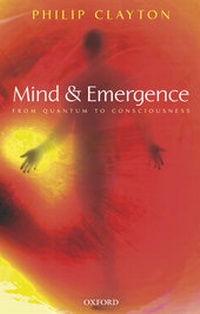
Mind and Emergence
From Quantum to Consciousness
Published on 1. November 2004
Book
Hardback
248 pages
978-0-19-927252-5 (ISBN)
Description
Strong claims have been made for emergence as a new paradigm for understanding science, consciousness, and religion. Tracing the past history and current definitions of the concept, Clayton assesses the case for emergent phenomena in the natural world and their significance for philosophy and theology. Complex emergent phenomena require irreducible levels of explanation in physics, chemistry and biology. This pattern of emergence suggests a new approach to the problem of consciousness, which is neither reducible to brain states nor proof of a mental substance or soul. Although emergence does not entail classical theism, it is compatible with a variety of religious positions. Clayton concludes with a defence of emergentist panentheism and a Christian constructive theology consistent with the new sciences of emergence.
Reviews / Votes
a useful survey of the field and many of the main issues...contain[ing] a wide range of references. Scientific and Medical Network ReviewMore details
Language
English
Place of publication
Oxford
United Kingdom
Target group
Professional and scholarly
Scholars and readers interested in the field of `religion and science', theologians, metaphysicians, philosophers of science, scientists.
Illustrations
num. line drawings
numerous line drawings
Dimensions
Height: 216 mm
Width: 138 mm
Weight
414 gr
ISBN-13
978-0-19-927252-5 (9780199272525)
Copyright in bibliographic data and cover images is held by Nielsen Book Services Limited or by the publishers or by their respective licensors: all rights reserved.
Schweitzer Classification
Other editions
Additional editions
E-Book
10/2004
1st Edition
OUP
€74.58
Available for download
Person
Philip Clayton, Ingraham Professor, Claremont School of Theology; Professor of Philosophy and of Religion, Claremont Graduate University
Content
1. From Reduction to Emergence; 2. Defining Emergence; 3. Emergence in the Natural Sciences; 4. Emergence and Mind; 5. Emergence and Transcendence