

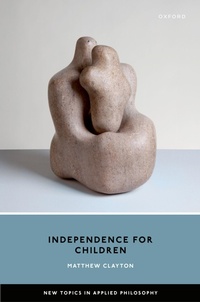
Independence for Children
Published on 19. March 2025
Book
Hardback
240 pages
978-0-19-886054-9 (ISBN)
Description
Independence for Children presents an alternative conception of parenting to those that have dominated our thinking about children and the family to date. It offers an elaboration and defence of anti-perfectionist parenting. The central argument of this book is that, as they develop, children become entitled to adopt and pursue their own conceptions of religion and human well-being. As young children, they are entitled to an upbringing that is informed by ideals and reasons they can later accept in the light of the religious or ethical values they go on to hold as adults. In short, parents and others owe children an upbringing from which they are not alienated later in life.
Parental anti-perfectionism suggests that parents should introduce their children to the various and sometimes competing views concerning our place in the universe and human flourishing and raise them to be respectful of the diversity of lifestyles within society. But Matthew Clayton argues that parents have no right to steer their children towards particular religious doctrines or conceptions of human flourishing, and that religious schools ought to be phased out.
This book addresses several questions in the philosophy of upbringing, such as how we ought to understand the interests of children, the moral claims of parents, and what constitutes a valuable family life. Clayton finishes by briefly exploring the implications of anti-perfectionist morality for how parents ought to approach issues concerning work, consumption, gender, and food.
Parental anti-perfectionism suggests that parents should introduce their children to the various and sometimes competing views concerning our place in the universe and human flourishing and raise them to be respectful of the diversity of lifestyles within society. But Matthew Clayton argues that parents have no right to steer their children towards particular religious doctrines or conceptions of human flourishing, and that religious schools ought to be phased out.
This book addresses several questions in the philosophy of upbringing, such as how we ought to understand the interests of children, the moral claims of parents, and what constitutes a valuable family life. Clayton finishes by briefly exploring the implications of anti-perfectionist morality for how parents ought to approach issues concerning work, consumption, gender, and food.
More details
Series
Language
English
Place of publication
Oxford
United Kingdom
Target group
College/higher education
Product notice
sewn/stitched
Cloth over boards
Dimensions
Height: 226 mm
Width: 152 mm
Thickness: 25 mm
Weight
522 gr
ISBN-13
978-0-19-886054-9 (9780198860549)
Copyright in bibliographic data and cover images is held by Nielsen Book Services Limited or by the publishers or by their respective licensors: all rights reserved.
Schweitzer Classification
Other editions
Additional editions
Person
Matthew Clayton is Professor of Political Theory in the Department of Politics and International Studies at the University of Warwick. He has also held posts at the University of Essex and Brunel University. He is the author of Justice and Legitimacy in Upbringing (2006), co-author of How to Think About Religious Schools: Principles and Policies (2024), and co-editor of Social Justice (2004) and The Ideal of Equality (2002).