

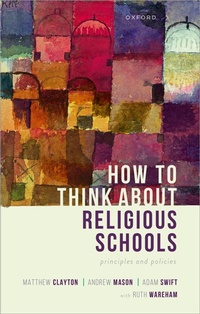
How to Think about Religious Schools
Principles and Policies
Published on 15. August 2024
Book
Hardback
224 pages
978-0-19-892400-5 (ISBN)
Description
Should religious schools be an option? Should they receive public funding? Are they bad for community cohesion? What should we make of the charge that they indoctrinate? How should they be regulated? People disagree on the answers to these questions. Some maintain that religious schools should not be permitted. If parents want to raise their children in a particular faith at home, then that is up to them, but schools should not be involved. Others think it obvious that parents should be free to send their children to religious schools. Any government that ruled that out would be violating parents' right to religious freedom, or their right to raise their children according to their own beliefs. In order to make progress on these issues, we need a way of thinking about them that enables us to understand more clearly what is at stake.
This book provides a framework that identifies the different kinds of normative considerations that are in play and provides the basis for understanding why people disagree about religious schools. It uses a method that involves moving from the relevant normative considerations--especially the child's potential to acquire personal autonomy and to develop a capacity and disposition to treat others as equals--to specific policy proposals for governing religious schools in England today, taking into account the legal and political constraints on policy options and the likely unintended consequences of reforms.
A unique feature of the book is that its three authors have somewhat different perspectives on the implications of the normative framework they each endorse, which they draw out in separate chapters. Despite reaching different conclusions on some philosophical issues concerning religious schools, the framework and method they share enables them to converge on a regulatory framework that forbids directive teaching aimed at imparting religious beliefs in publicy-funded religious schools, and that makes the charitable status of private religious schools conditional on avoiding this kind of teaching.
This book provides a framework that identifies the different kinds of normative considerations that are in play and provides the basis for understanding why people disagree about religious schools. It uses a method that involves moving from the relevant normative considerations--especially the child's potential to acquire personal autonomy and to develop a capacity and disposition to treat others as equals--to specific policy proposals for governing religious schools in England today, taking into account the legal and political constraints on policy options and the likely unintended consequences of reforms.
A unique feature of the book is that its three authors have somewhat different perspectives on the implications of the normative framework they each endorse, which they draw out in separate chapters. Despite reaching different conclusions on some philosophical issues concerning religious schools, the framework and method they share enables them to converge on a regulatory framework that forbids directive teaching aimed at imparting religious beliefs in publicy-funded religious schools, and that makes the charitable status of private religious schools conditional on avoiding this kind of teaching.
Reviews / Votes
I. THE TERMS OF THE DEBATE II. THREE VIEWS III. FROM PRINCIPLES TO POLICIESMore details
Language
English
Place of publication
Oxford
United Kingdom
Target group
College/higher education
Product notice
sewn/stitched
Cloth over boards
Dimensions
Height: 222 mm
Width: 147 mm
Thickness: 19 mm
Weight
426 gr
ISBN-13
978-0-19-892400-5 (9780198924005)
Copyright in bibliographic data and cover images is held by Nielsen Book Services Limited or by the publishers or by their respective licensors: all rights reserved.
Schweitzer Classification
Other editions
Additional editions
Matthew Clayton | Andrew Mason | Adam Swift
How to Think about Religious Schools
Principles and Policies
E-Book
07/2024
OUP eBook
€21.99
Available for download
Matthew Clayton | Andrew Mason | Adam Swift
How to Think about Religious Schools
Principles and Policies
E-Book
07/2024
OUP eBook
€21.99
Available for download
Persons
Matthew Clayton is Professor of Political Theory in the Department of Politics and International Studies at the University of Warwick. He has also held posts at the University of Essex and Brunel University. He is author of Justice and Legitimacy in Upbringing (OUP, 2006) and co-editor of Social Justice (Blackwell, 2004) and The Ideal of Equality (Palgrave, 2002).
Andrew Mason is Professor of Political Theory in the Department of Politics and International Studies at the University of Warwick. He has also held posts at the Universities of St Andrews, Oxford, Hull, Reading, and Southampton, and visiting fellowships at the European University Institute, KU Leuven, Goethe University Frankfurt, and Aarhus University. He is author of several books, including What's Wrong with Lookism? (OUP, 2023), Living Together as Equals (OUP, 2012), Levelling the Playing Field (OUP, 2006), and Community, Solidarity and Belonging (CUP, 2000).
Adam Swift is Professor of Political Theory in the Department of Political Science at University College London. Before moving to UCL he was Fellow in Politics and Sociology at Balliol College, University of Oxford, where he founded the Centre for the Study of Social Justice, and Professor of Political Theory at the University of Warwick. He is co-author of Educational Goods: Values, Evidence and Decision-Making (Chicago UP, 2018) and Family Values: The Ethics of Parent-Child Relationships (Princeton UP, 2014), and author of Political Philosophy: A Beginners' Guide for Students and Politicians (Polity 4th edition, 2019) and How Not To Be A Hypocrite: School Choice for the Morally Perplexed Parent (Routledge, 2003).
Andrew Mason is Professor of Political Theory in the Department of Politics and International Studies at the University of Warwick. He has also held posts at the Universities of St Andrews, Oxford, Hull, Reading, and Southampton, and visiting fellowships at the European University Institute, KU Leuven, Goethe University Frankfurt, and Aarhus University. He is author of several books, including What's Wrong with Lookism? (OUP, 2023), Living Together as Equals (OUP, 2012), Levelling the Playing Field (OUP, 2006), and Community, Solidarity and Belonging (CUP, 2000).
Adam Swift is Professor of Political Theory in the Department of Political Science at University College London. Before moving to UCL he was Fellow in Politics and Sociology at Balliol College, University of Oxford, where he founded the Centre for the Study of Social Justice, and Professor of Political Theory at the University of Warwick. He is co-author of Educational Goods: Values, Evidence and Decision-Making (Chicago UP, 2018) and Family Values: The Ethics of Parent-Child Relationships (Princeton UP, 2014), and author of Political Philosophy: A Beginners' Guide for Students and Politicians (Polity 4th edition, 2019) and How Not To Be A Hypocrite: School Choice for the Morally Perplexed Parent (Routledge, 2003).
Content
I. THE TERMS OF THE DEBATE
1: Mapping the Terrain
2: A Normative Framework
II. THREE VIEWS
3: Religious Schools: A Qualified Defence (Andrew Mason)
4: Against Religious Schools (Matthew Clayton)
5: Parents' Rights, Children's Schools (Adam Swift)
III. FROM PRINCIPLES TO POLICIES
6: Being Realistic
7: A Regulatory Framework for England
1: Mapping the Terrain
2: A Normative Framework
II. THREE VIEWS
3: Religious Schools: A Qualified Defence (Andrew Mason)
4: Against Religious Schools (Matthew Clayton)
5: Parents' Rights, Children's Schools (Adam Swift)
III. FROM PRINCIPLES TO POLICIES
6: Being Realistic
7: A Regulatory Framework for England